Elements, Compounds and Mixtures
Grades 6–8 · MS-PS1-1 · MS-PS1-2 · MS-PS1-5 (PS1.A, PS1.B)
Mix, heat, split and zoom in to see how elements, compounds and mixtures differ.

Lab controls
Views
More activities
Share & teachers
scisim.org/sims/chemistry/elements_compounds_mixtures
Students scan it with a phone or tablet camera.
Elements, Compounds and Mixtures lesson plan
Students will
- Tell elements, compounds and mixtures apart with a particle model (atoms, molecules, extended structures).
- Explain why a compound has a fixed ratio and new properties, using the iron and sulfur magnet test as evidence.
- Use formulas to count atoms and decide whether a sample is a pure substance or a mixture.
Lesson
5 min · Hook: why does the magnet stop working?
Ask: Watch the intro. Same iron, same sulfur: why does the magnet pull iron out the first time but not after heating?
Expected answer
Heating made a new substance, iron sulfide, with new properties: it is not attracted to a magnet. The unheated powder was only a mixture.
12 min · Zoom in and classify (pairs): activity 1
Ask: Zoom in on gold, oxygen, water, air and brass. What do you see at each zoom level, and what kind of matter is each?
Expected answer
Gold and oxygen: elements (O₂ is an element made of molecules). Water: compound. Air and brass: mixtures; brass looks like one metal even under a microscope.
13 min · Magnet test (pairs): activity 2
Ask: Mix, then heat, iron and sulfur. When does the magnet work? What happens with 10 g of iron and 4 g of sulfur?
Expected answer
Mixture: the magnet pulls out all the iron. Compound: almost no iron. With extra iron only the leftover (about 3 g) is pulled out: compounds form in a fixed ratio (about 7 : 4).
10 min · Build it: activity 3
Ask: Build one H₂O, one O₂, one CO₂ and one CH₄. Then build a mixture. How do you know which is which?
Expected answer
One kind of particle with one element = element; one kind with 2+ elements = compound; 2+ kinds of particles = mixture.
5 min · Exit ticket (CER)
Ask: Is water an element, a compound or a mixture? Claim, evidence, reasoning.
Expected answer
A compound: one kind of particle, 2 H bonded to 1 O; electricity splits it into hydrogen and oxygen in a fixed 2 : 1 ratio.
What each part does
- Mix or heat / Zoom in / Build
- Three labs in one card: reactions that make or split compounds, real samples from the eye down to the atoms, and building molecules from atoms.
- Chips
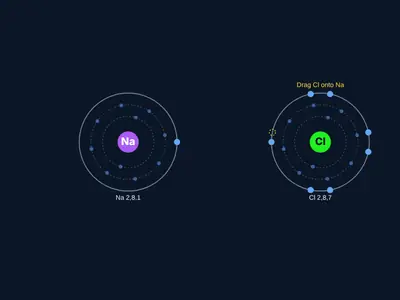
- Iron + sulfur, Split water, Sodium + chlorine; 11 samples to zoom in on; 5 pairs of elements to build with.
- 3D | 2D
- The lab bench on the left and the particle view on the right (zoomed in about 100 million times). 2D shows the same without 3D graphics; tap a particle to name it.
- Predict and Run
- Students commit to a prediction first; the Result box shows the verdict, the evidence and why.
- Graph
- Total mass (it stays the same), the magnet test, gas collected (2 : 1), the fixed-ratio graph (product vs iron added), and a before / after table.
Activity answers
Is it an element, a compound or a mixture?
Can a magnet tell a mixture from a compound?
Can you build these molecules?
How many atoms are in each formula?
Which mystery sample is which?
What is water made of?
Which kitchen things are pure substances?
Day 2 extension: activities 4 (Count the atoms), 5 (Mystery samples), 6 (Split water) and 7 (Kitchen hunt), then the Medium quiz. Real demo: the product is not always free of iron (leftover iron or iron-poor iron sulfide), so test it with a weak magnet. Safety: eye protection; sulfur that boils or burns releases toxic, corrosive sulfur dioxide (it can trigger asthma), so heat only a small amount in a test tube plugged with mineral wool, in a fume hood or a well-ventilated room (RSC); sodium and chlorine are shown as a simulation only. NGSS: MS-PS1-2 lists density, melting and boiling point, solubility, flammability and odor; color and magnetism here are extra evidence for discussion. The mass graphs and Build (atoms are never lost) also fit MS-PS1-5. Build joins atoms by a simple model rule; masses and gas volumes are calculated from standard atomic weights and Faraday’s law; lab times are model times.
What is the difference between elements, compounds and mixtures?
Elements, compounds and mixtures differ in their particles: an element has 1 kind of atom, and a compound has 2 or more elements bonded in a fixed ratio. A mixture has substances that are only mixed, not bonded. Water (2 hydrogen atoms to 1 oxygen) is a compound; air (78 % nitrogen, 21 % oxygen) is a mixture.
In this lab you can
- Test iron and sulfur with a magnet, first mixed and then heated, and watch a compound with new properties form.
- Split water with electricity and measure hydrogen and oxygen gas in a 2 : 1 ratio.
- Zoom in on gold, water, air, brass, soil and more, from what your eye sees down to the atoms.
- Build molecules such as H₂O, CO₂ and CH₄ from atoms and decide if you made an element, a compound or a mixture.
On this page: What is an element?What is a compound?What is a mixture?What is the difference between elements, compounds and mixtures?What is the difference between atoms and molecules?What is the difference between a pure substance and a mixture?How can you tell if something is an element, a compound or a mixture?What are examples of elements, compounds and mixtures?Go deeper: fixed ratios, mass percent and electrolysisMyths and factsFAQSources
What is an element?
An element is a pure substance made of only one kind of atom, so no chemical change can break it down into anything simpler. Scientists know 118 elements; the newest four, numbers 113, 115, 117 and 118, were named in 2016 (IUPAC periodic table). An element can be single atoms (argon, helium), a lattice of one kind of atom (gold, copper) or molecules of one kind of atom: oxygen gas is O₂, and the stable form of sulfur at room temperature is made of eight-atom rings, S₈ (OpenStax Chemistry 2e, 18.10). Find every element on the periodic table and see what is inside an atom in atomic structure.
“Pure substances that cannot be broken down into simpler substances by chemical changes are called elements.”
What is a compound?
A compound is a pure substance made of atoms of two or more elements chemically bonded in a fixed ratio. Water always has 2 hydrogen atoms for every oxygen atom, and any sample of table sugar is 42.1 % carbon, 6.5 % hydrogen and 51.4 % oxygen by mass (OpenStax Chemistry 2e, 1.2). A compound has new properties: sodium, a soft shiny metal, and chlorine, a yellow-green gas, combine into table salt, a white crystalline solid (OpenStax Chemistry 2e, 1.2). Some compounds are made of molecules (H₂O, CO₂); others, like sodium chloride, are extended structures: a repeating pattern of ions with no separate molecules (see chemical bonding).
What is a mixture?
A mixture is two or more substances mixed together but not chemically bonded, so each keeps its own properties and the amounts can change. Air is a mixture of about 78 % nitrogen, 21 % oxygen and 0.9 % argon by volume (NASA Earth Fact Sheet). Cartridge brass is 70 % copper and 30 % zinc (SAAMI glossary): an alloy that looks like one metal but is a mixture. Mixtures can be separated by physical means, like the magnet in this lab; homogeneous and heterogeneous mixtures shows the kinds of mixtures and how to separate them.
What is the difference between elements, compounds and mixtures?
Elements, compounds and mixtures differ in their particles: an element has one kind of atom, a compound has one kind of particle built from two or more elements bonded together, and a mixture has two or more substances that are not bonded. Iron and sulfur show all three: 7 g of gray iron and 4 g of yellow sulfur stirred together make a mixture a magnet can pull apart, but heated they react to give black iron sulfide, about 11 g if it all reacts (RSC Education / Nuffield practical (teacher notes)), a compound that is no longer magnetic (PrepRoom).
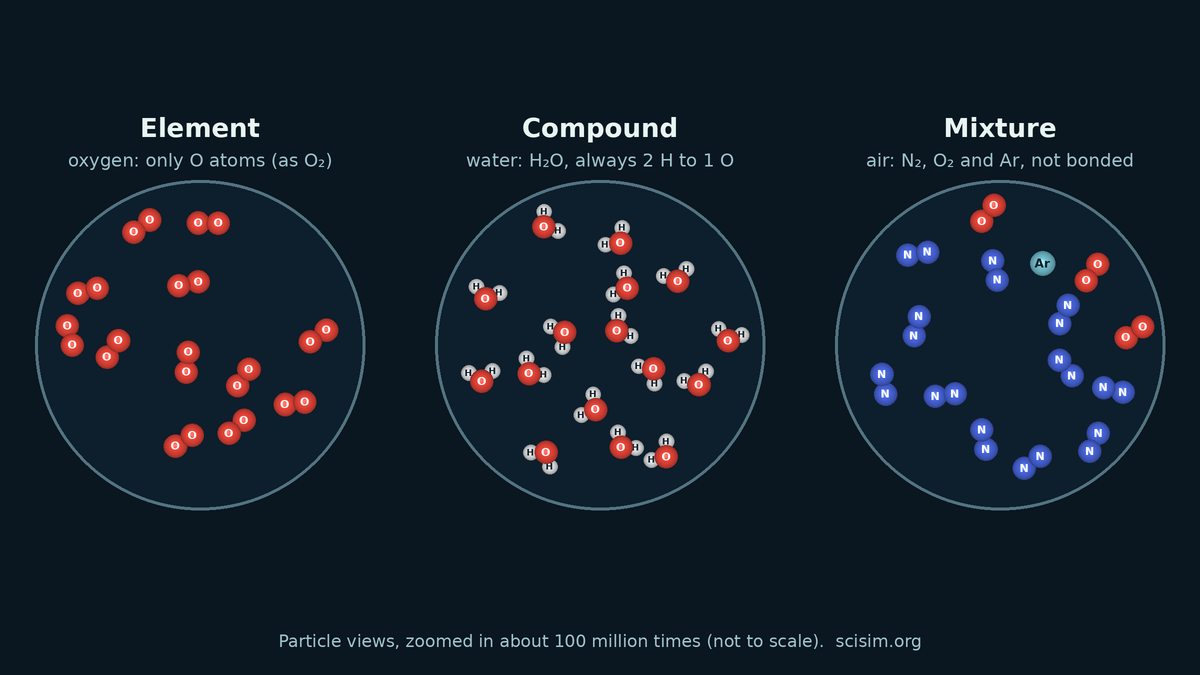
| Element | Compound | Mixture | |
|---|---|---|---|
| Particles | One kind of atom | One kind of particle, 2+ elements bonded | 2+ substances, not bonded |
| Pure substance? | Yes | Yes | No |
| Make-up | Fixed | Fixed ratio (water: always 2 H to 1 O) | Can vary |
| Properties | Its own | New, unlike its elements | Each part keeps its own |
| Separated by | Cannot be broken down chemically | Only a chemical change (heat, electricity) | Physical means (magnet, filter, boiling) |
| Examples | Gold, copper, oxygen (O₂), sulfur (S₈) | Water, table salt, sugar, carbon dioxide | Air, salt water, brass, soil |
What is the difference between atoms and molecules?
An atom is the smallest particle of an element that still has that element’s properties, and a molecule is two or more atoms joined by chemical bonds. Atoms are tiny: about 10−10 m (0.1 nanometer) across (OpenStax Chemistry 2e, 2.3), so this lab’s particle view is zoomed in about 100 million times. A molecule can hold one element (O₂, N₂, S₈) or several (H₂O, CO₂): the word “molecule” tells you the atoms are bonded, not whether the substance is an element or a compound.
What is the difference between a pure substance and a mixture?
A pure substance has a fixed make-up that is the same in every sample, while the make-up of a mixture can change. Elements and compounds are pure substances. This is the law of definite proportions: all samples of a pure compound contain the same elements in the same proportion by mass (OpenStax Chemistry 2e, 2.1). Water, for example, is always about 11.2 % hydrogen by mass (2 × 1.008 ÷ 18.015, from the standard atomic weights (IUPAC CIAAW)), whether it comes from a glacier or a lab. Salt water can be a little salty or very salty: it is a mixture.
How can you tell if something is an element, a compound or a mixture?
Testing a sample means asking two questions: can a physical method separate it, and if not, can a chemical change break it down?
- A magnet, a filter or boiling separates it into different substances: it is a mixture.
- Only a chemical change, such as strong heating or electricity, breaks it into simpler substances: it is a compound.
- Nothing breaks it into anything simpler: it is an element.
Electricity splits water into hydrogen and oxygen gas, and the hydrogen fills twice the volume of the oxygen (Temple University chemistry demos) (OpenStax Chemistry 2e, 1.2): water is a compound. Some mixtures, such as salt water or brass, look like one substance even under a microscope, so tests or a particle model tell them apart; compare physical and chemical changes.
What are examples of elements, compounds and mixtures?
Examples of elements, compounds and mixtures are all around you: a formula shows how many atoms of each element a compound has, so sugar, C₁₂H₂₂O₁₁, has 45 atoms in every molecule (PubChem: sucrose).
| Elements | Compounds | Mixtures |
|---|---|---|
| Gold (Au) | Water (H₂O) | Air |
| Copper (Cu) | Table salt (NaCl) | Salt water |
| Oxygen (O₂) | Sugar (C₁₂H₂₂O₁₁) | Brass (copper + zinc) |
| Helium (He) | Carbon dioxide (CO₂) | Steel (iron + carbon) |
| Sulfur (S₈) | Baking soda (NaHCO₃) | Soil, milk |
Go deeper: fixed ratios, mass percent and electrolysis
High school: definite and multiple proportions, mass percent and Faraday’s law
Dalton’s atomic theory says a compound contains atoms of two or more elements in a small, whole-number ratio (OpenStax Chemistry 2e, 2.1). Iron sulfide, FeS, is 55.845 ÷ (55.845 + 32.06) × 100 % ≈ 63.5 % iron by mass, so 7 g of iron needs 7 × 32.06 ÷ 55.845 ≈ 4.0 g of sulfur. Carbon forms both CO and CO₂: for the same mass of carbon the oxygen masses are in a 1 : 2 ratio, the law of multiple proportions. In electrolysis 2 mol of electrons make 1 mol of H₂; with Faraday’s constant, 96,485 C per mole of electrons (OpenStax Chemistry 2e, 17.7), 0.5 A for 10 min (300 C) gives 0.00155 mol of H₂, about 37.4 mL at 20 °C and 1 atm, and half that volume of O₂. Real iron sulfide made in a test tube is often slightly short of iron (Fe1−xS), which is one reason a strong magnet can still pull it a little.
Key terms
- Element
- A pure substance made of only one kind of atom.
- Compound
- A pure substance of two or more elements bonded in a fixed ratio.
- Mixture
- Two or more substances mixed but not bonded.
- Pure substance
- Matter with a fixed make-up: an element or a compound.
- Atom
- The smallest particle of an element that has its properties.
- Molecule
- Two or more atoms joined by chemical bonds.
- Extended structure
- A repeating pattern of atoms or ions with no separate molecules, like table salt.
- Alloy
- A mixture of a metal with other elements, like brass or steel.
- Chemical formula
- Symbols and numbers that show which atoms, and how many, are in a substance.
- Law of definite proportions
- A pure compound always has the same elements in the same ratio by mass.
Myths and facts
Myth: Elements are always single atoms.
Fact: Many elements are molecules: oxygen is O₂, nitrogen is N₂, and solid sulfur is S₈ rings. They are still elements because every atom is the same kind.
Myth: All compounds are made of molecules.
Fact: Table salt (NaCl) and iron sulfide (FeS) are extended structures: repeating patterns with no separate molecules. They are still compounds, with a fixed make-up.
Myth: A mixture always looks uneven.
Fact: Air, salt water and brass look the same everywhere, even under a microscope, but they are mixtures: their parts are not combined in a fixed ratio, and their amounts can change.
Myth: A compound is just its elements stirred together.
Fact: Stirring iron and sulfur only makes a mixture. A chemical reaction is needed to make iron sulfide, which is black and no longer attracted to a magnet.
Myth: Gold jewelry is always pure gold.
Fact: 24-karat gold is pure gold. 14-karat gold is only 14/24, about 58 % gold, mixed with other metals: an alloy, which is a mixture.
Frequently asked questions
What is the difference between elements, compounds and mixtures?
An element has only one kind of atom (gold, oxygen). A compound has two or more elements chemically bonded in a fixed ratio (water, table salt). A mixture has two or more substances that are only mixed, not bonded (air, salt water).
Is air an element, a compound or a mixture?
Air is a mixture: about 78 % nitrogen, 21 % oxygen and 0.9 % argon by volume, plus small amounts of other gases, all mixed but not bonded.
Is water an element, a compound or a mixture?
Pure water is a compound, H₂O: 2 hydrogen atoms bonded to 1 oxygen atom. Tap water is a mixture because it also holds dissolved minerals.
Is salt water an element, a compound or a mixture?
Salt water is a mixture (a homogeneous one): the salt is spread through the water but not bonded to it, and evaporating the water gives the salt back.
Is gold an element, a compound or a mixture?
Pure gold is an element (Au). Most gold jewelry is a mixture: an alloy of gold with other metals.
Is sugar an element, a compound or a mixture?
Sugar (sucrose, C₁₂H₂₂O₁₁) is a compound of carbon, hydrogen and oxygen. Sugar dissolved in tea is part of a mixture.
Is carbon dioxide a compound or a mixture?
Carbon dioxide is a compound: every CO₂ molecule has 1 carbon atom bonded to 2 oxygen atoms.
What is the difference between a pure substance and a mixture?
A pure substance (an element or a compound) has a fixed make-up. A mixture’s make-up can change, and its parts can be separated by physical means.
Are elements and compounds pure substances?
Yes. Both have a fixed make-up; only mixtures are not pure substances.
What is the difference between an atom and a molecule?
An atom is the smallest particle of an element. A molecule is two or more atoms bonded together, like O₂ or H₂O.
Can a compound be separated by physical means?
No. A compound can only be broken down by a chemical change, such as electricity splitting water into hydrogen and oxygen.
Is sodium an element, a compound or a mixture?
Sodium is an element (Na), a soft reactive metal. Bonded to chlorine it becomes the compound sodium chloride, table salt.
Related simulations
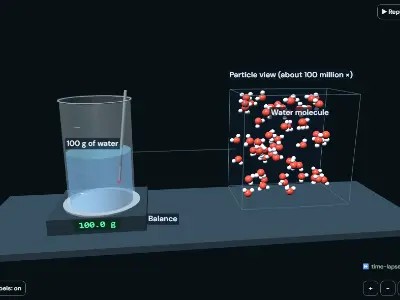 Homogeneous and Heterogeneous Mixtures & Solutions
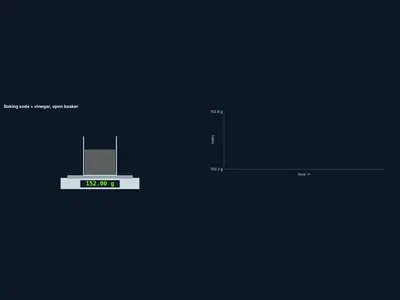 Physical and Chemical Changes
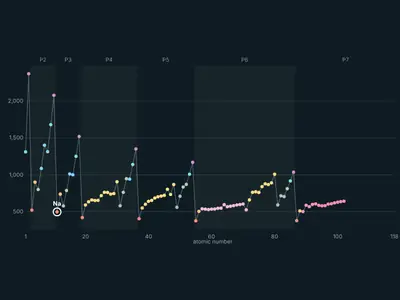 Interactive Periodic Table
 Chemical Bonding
Get new simulations by email
Teachers and other adults: sign up for new simulations and free lesson packs. Contact us
Sources
- OpenStax Chemistry 2e, 1.2 Phases and Classification of Matter
- OpenStax Chemistry 2e, 2.1 Early Ideas in Atomic Theory
- OpenStax Chemistry 2e, 2.3 Atomic Structure and Symbolism
- OpenStax Chemistry 2e, 17.7 Electrolysis (Faraday’s constant)
- OpenStax Chemistry 2e, 18.10 Occurrence, Preparation, and Properties of Sulfur (S₈)
- IUPAC: Periodic Table of Elements
- IUPAC CIAAW: abridged standard atomic weights
- NASA Earth Fact Sheet (composition of air)
- SAAMI glossary: cartridge brass (70 % copper, 30 % zinc)
- RSC Education / Nuffield Practical Collection: Iron and sulfur reaction (7 g iron + 4 g sulfur)
- PrepRoom: iron and sulfur practical (the compound is no longer magnetic)
- Temple University Chemistry Demos: electrolysis of water (hydrogen twice the volume of oxygen)
- PubChem: Sucrose (C₁₂H₂₂O₁₁)
- NGSS MS-PS1-1
- NGSS MS-PS1-2
- NGSS MS-PS1-5
How we checked this page
Checked against:
- OpenStax Chemistry 2e (1.2, 2.1, 2.3, 17.7, 18.10)
- IUPAC CIAAW abridged standard atomic weights
- NASA Earth Fact Sheet (air)
- SAAMI glossary (cartridge brass)
- RSC Education / Nuffield and PrepRoom (iron and sulfur practical)
- Temple University chemistry demos (electrolysis of water)
Key numbers: Iron and sulfur react in a fixed mass ratio of about 7 : 4: 7 g of iron + 4 g of sulfur give about 11 g of iron sulfide if it all reacts (RSC practical). Splitting water gives hydrogen and oxygen in a 2 : 1 volume ratio (Faraday’s law, Temple demo). Water is always about 11.2 % hydrogen by mass (IUPAC CIAAW atomic weights). Air is about 78 % nitrogen, 21 % oxygen and 0.9 % argon by volume (NASA). The full list is in the references above.
What the model simplifies: It is a simplified teaching model: in Build, atoms join by a simple model rule (simplest stable molecules first), lab times on the stopwatch are model values, iron sulfide is shown as an ideal 1 : 1 compound that a magnet does not pull (real samples can be slightly short of iron and weakly magnetic), and atoms are drawn far larger and fewer than real ones (not to scale). A separate science check compared every number with its source on 1 November 2026.
Standards: NGSS MS-PS1-1, MS-PS1-2, MS-PS1-5
Last reviewed · How we check our science · Report a mistake
Published · Last updated
Cite this page
SciSim. (2026, November 1). Elements, compounds and mixtures. https://scisim.org/sims/chemistry/elements_compounds_mixtures