Homogeneous and Heterogeneous Mixtures and Solutions
Grades 6–8 · MS-PS1-1 · MS-PS1-2 (PS1.A)
Mix things into water, zoom in, then separate them again.

Lab controls
Views
More activities
Share & teachers
scisim.org/sims/chemistry/mixtures_and_solutions
Students scan it with a phone or tablet camera.
Homogeneous and Heterogeneous Mixtures and Solutions lesson plan
Students will
- Tell pure substances, homogeneous mixtures (solutions) and heterogeneous mixtures apart, using a particle model.
- Explain what changes how fast a solid dissolves and what changes how much can dissolve (solubility).
- Choose a separation method from the physical property it uses (size, boiling point, magnetism, density).
Lesson
5 min · Hook: where did the salt go?
Ask: Watch the intro. The salt disappeared. Is it gone? What will the balance read?
Expected answer
It is still there, spread out as Na⁺ and Cl⁻ ions; the balance reads 110 g (100 g water + 10 g salt).
12 min · Mix and classify (pairs): activity 1
Ask: Run all six substances. Which make homogeneous mixtures, which heterogeneous? What does the particle view show?
Expected answer
Salt and sugar: solutions (homogeneous). Sand, chalk, oil: heterogeneous. Milk: a colloid (looks even, scatters a laser).
13 min · Unmix it (pairs): activity 2
Ask: Get sand, salt and iron back from one jar of water. Which order works and why?
Expected answer
Magnet (magnetism), filter (particle size), evaporate (boiling point). Evaporating first leaves salt stuck in the sand.
10 min · Dissolving race: activity 3
Ask: Stirring, hot water or crushing: which speeds dissolving most? Which one lets MORE dissolve?
Expected answer
All three speed it up (fast stirring most in the model); only temperature changes how much can dissolve.
5 min · Exit ticket (CER)
Ask: Is salt water a mixture or a pure substance? Claim, evidence, reasoning.
Expected answer
A homogeneous mixture: two kinds of particles not bonded, mass 110 g = 100 + 10, evaporating gives the salt back.
What each part does
- Mix it / Separate it
- Two labs in one card: making mixtures, and pulling them apart again.
- Substance chips
- Salt and sugar dissolve; sand and chalk sink; oil floats; milk is a colloid. In Separate it: six methods.
- 3D | 2D
- The lab bench on the left and the particle view on the right (zoomed in about 100 million times). 2D shows the same without 3D graphics.
- Predict and Run
- Students commit to a prediction first. During the run a lab stopwatch shows the time in a real lab (real time for quick steps, time-lapse for slow ones), with Pause and Skip; the Result box then shows the verdict, the evidence (including the balance) and why.
- Graph
- Dissolving over time, total mass (it stays flat), the real solubility curves of salt and sugar, separating, temperature, before / after.
Activity answers
Pure substance or mixture?
Can you unmix sand, salt and iron?
What makes salt dissolve faster?
How much salt can water hold?
Can a laser spot a colloid?
What colors hide in black ink?
Which white powder is which?
Day 2 extension: activities 4 (How much fits?), 5 (Laser test), 6 (Hidden colors) and 7 (Mystery powder), then the Medium quiz. Dissolving times are a model (relative); solubility values are real table values. Without 3D graphics the 2D view shows the same ideas.
What is the difference between homogeneous and heterogeneous mixtures?
Homogeneous and heterogeneous mixtures differ in how evenly they are mixed: a homogeneous mixture such as salt water is the same all the way through, with up to 35.9 g of salt spread evenly in 100 g of water at 20 °C. A heterogeneous mixture has parts you can see, like sand that sinks in water or oil that floats.
In this lab you can
- Mix salt, sugar, sand, chalk, oil or milk into water and zoom in to see the particles: ions, whole molecules or big grains.
- Watch the balance prove that dissolving keeps the total mass the same, while a lab stopwatch shows about how long each step would take in a real lab.
- Find out what makes salt dissolve faster and how much salt or sugar water can hold at each temperature.
- Separate mixtures by filtering, evaporating, distilling, using a magnet, chromatography and pouring off oil.
On this page: What is a mixture?What is the difference between homogeneous and heterogeneous mixtures?Is a solution a mixture?What makes something dissolve faster?What are colloids and suspensions?How can mixtures be separated?Go deeper: concentration and boiling pointMyths and factsFAQSources
What is a mixture?
A mixture is two or more substances that are mixed together but not chemically joined, so each keeps its own properties and they can be separated again. A pure substance, like distilled water or copper, has only one kind of particle and a fixed make-up (OpenStax Chemistry 2e). Air is a mixture of gases: about 78 % nitrogen and 21 % oxygen by volume (NASA Earth Fact Sheet). Mixing is a physical change, not a chemical change: no new substance forms.
What is the difference between homogeneous and heterogeneous mixtures?
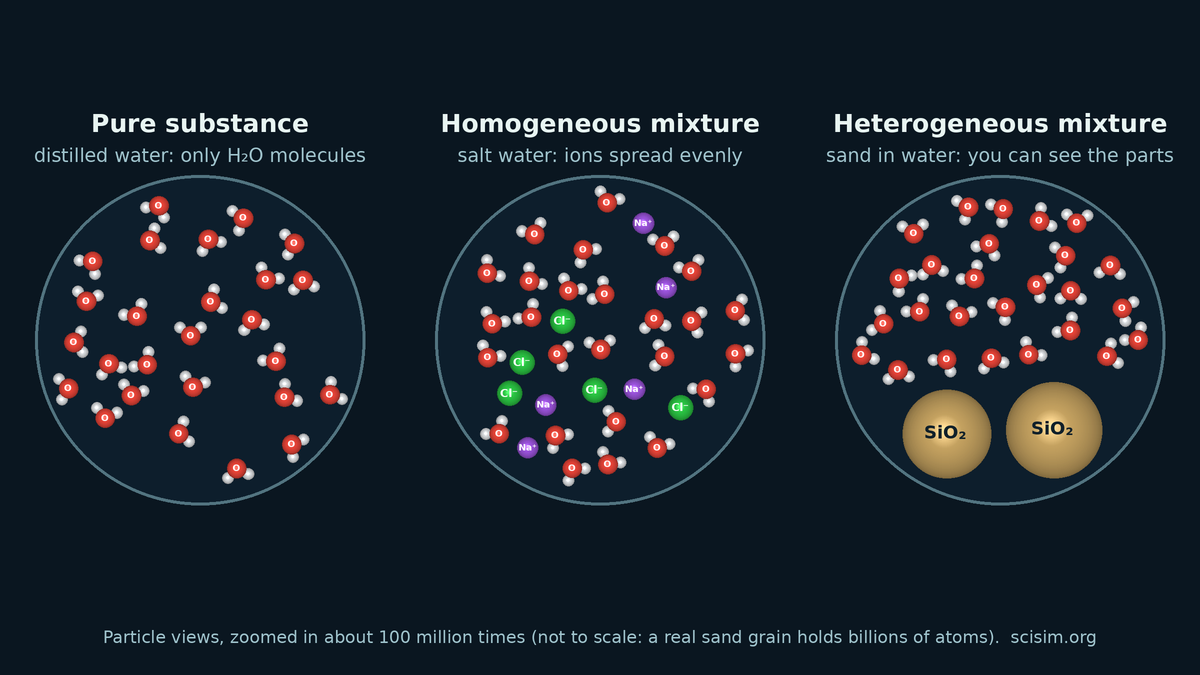
A homogeneous mixture has the same make-up everywhere; a heterogeneous mixture has parts that differ from place to place. Sea water is homogeneous: it holds about 3.5 % dissolved salts by weight, spread evenly (NOAA Ocean Service). Sand in water, oil on water and a salad are heterogeneous.
“A homogeneous mixture, also called a solution, exhibits a uniform composition and appears visually the same throughout.”
| Homogeneous mixture | Heterogeneous mixture | |
|---|---|---|
| Looks | The same everywhere | You can see different parts or layers |
| Particles | Single ions or molecules, evenly spread | Bigger grains, droplets or layers |
| Settles? | Never | Often (sand, chalk) or forms a layer (oil) |
| Examples | Salt water, sugar water, air, brass | Sand in water, oil and water, granite, salad |
Is a solution a mixture?
Yes: a solution is a homogeneous mixture in which one substance (the solute) is dissolved in another (the solvent). In salt water, salt is the solute and water is the solvent. Water pulls the salt crystal apart into Na⁺ and Cl⁻ ions, while sugar dissolves as whole molecules (OpenStax Chemistry 2e, 11.1). There is a limit, the solubility: at 20 °C about 35.9 g of salt but about 204 g of sugar dissolve in 100 g of water (Solubility table (CRC data)) (Lowe, Experimental Cookery). A solution holding that much is saturated (OpenStax Chemistry 2e, 11.3). Because nothing is destroyed, 10 g of salt in 100 g of water weighs 110 g.
What makes something dissolve faster?
Dissolving rate is how fast a solute goes into solution; stirring, warmer water and smaller grains all make it faster because fresh water reaches more of the solid surface. They do not change how much can dissolve. For a solid in water, mainly temperature changes that, and by very different amounts: from 20 °C to 80 °C the solubility of sugar rises from about 204 g to 362 g per 100 g of water, but salt only from 35.9 g to 37.9 g (Lowe, Experimental Cookery (sugar)) (Solubility table (CRC data, salt)). The dissolving times in the lab are a model; the solubility values are real.
What are colloids and suspensions?
A colloid is a mixture whose particles are bigger than molecules but too small to settle, roughly 1 nanometer to 1 micrometer across (IUPAC Gold Book). Milk is a colloid: its fat droplets stay spread out and scatter a beam of light, which is called the Tyndall effect (OpenStax Chemistry 2e, 11.5). A suspension, like chalk dust or muddy water, has even bigger particles that make it cloudy and then settle out: it is a heterogeneous mixture.
How can mixtures be separated?
Mixtures are separated by physical methods, each using a property that differs between the parts. Water boils at 100 °C at sea level but salt not until 1,465 °C, so evaporation or distillation leaves the salt behind (PubChem: sodium chloride). Oil (about 0.92 g/mL) floats on water (1.00 g/mL), so water can be drained off first (Engineering ToolBox: liquid densities) (USGS Water Science School). See also density and buoyancy and states of matter.
| Method | Separates | Property used |
|---|---|---|
| Filtration | Sand from water | Particle size |
| Evaporation | Salt from salt water | Boiling point |
| Magnet | Iron filings from sand | Magnetism |
| Distillation | Pure water from salt water | Boiling point |
| Chromatography | Dyes in ink | How far each dye travels on paper |
| Pouring off (separating funnel) | Oil from water | Density |
Go deeper: concentration and boiling point
High school: mass percent, saturated solutions and boiling-point elevation
Mass percent = mass of solute ÷ mass of solution × 100 %. 25 g of salt in 100 g of water gives 25 ÷ 125 × 100 % = 20 %. A saturated sugar solution at 80 °C (362.1 g per 100 g water) cooled to 20 °C can drop about 158 g of crystals, which is how rock candy grows. Dissolved particles raise the boiling point, a colligative property: ΔT = i·Kb·m with Kb = 0.512 °C·kg/mol for water (OpenStax Chemistry 2e, 11.4), so 10 g of NaCl in 100 g of water boils about 1.8 °C higher (ideal estimate). More: colligative properties and solubility equilibria (Ksp).
Key terms
- Mixture
- Two or more substances mixed but not chemically joined.
- Pure substance
- Matter with only one kind of particle and a fixed make-up (an element or a compound).
- Homogeneous mixture
- A mixture that is the same all the way through; a solution.
- Heterogeneous mixture
- A mixture whose parts differ from place to place.
- Solute
- The substance that dissolves.
- Solvent
- The substance that does the dissolving, often water.
- Solubility
- The most solute that can dissolve in a given amount of solvent at one temperature.
- Saturated
- Holding as much solute as can dissolve at that temperature.
- Colloid
- A mixture with particles too small to settle but big enough to scatter light.
- Suspension
- A cloudy mixture whose particles settle out over time.
Myths and facts
Myth: When salt dissolves, it disappears.
Fact: It is still there as Na⁺ and Cl⁻ ions: the mass stays the same (10 g salt + 100 g water = 110 g) and evaporating the water gives the salt back.
Myth: Dissolving is the same as melting.
Fact: Melting needs heat alone; salt melts at 801 °C (PubChem). Dissolving happens at room temperature because water pulls the particles apart.
Myth: A clear liquid must be pure.
Fact: Salt water and sugar water are clear but are mixtures (solutions). Clear means the particles are too small to see, not that there is only one substance.
Myth: Stirring lets more salt dissolve.
Fact: Stirring only makes it dissolve faster. How much can dissolve (35.9 g per 100 g water at 20 °C) depends on temperature.
Myth: Milk is a solution because it looks the same everywhere.
Fact: Milk is a colloid: its fat droplets scatter a beam of light (the Tyndall effect), which a true solution does not.
Frequently asked questions
What is the difference between homogeneous and heterogeneous mixtures?
A homogeneous mixture is the same everywhere, like salt water or air. A heterogeneous mixture has parts you can see or that separate, like sand in water or oil on water.
Is a solution a mixture?
Yes. A solution is a homogeneous mixture: a solute (like salt) is spread evenly through a solvent (like water) as single ions or molecules.
Is a solution a pure substance?
No. A solution holds at least two substances that are not chemically joined, and their amounts can vary, so it is a mixture.
What are examples of homogeneous mixtures?
Salt water, sugar water, vinegar, air, sea water and metal alloys such as brass and steel.
What are examples of heterogeneous mixtures?
Sand in water, oil and water, granite, a salad, cereal in milk and muddy water.
How do you separate a mixture of sand and salt?
Add water so the salt dissolves, filter out the sand, then evaporate the water to get the salt back as crystals.
How do you separate salt and water?
Evaporate the water to keep the salt, or distill it: the steam is cooled in a condenser and collected as pure water while the salt stays behind.
How do you separate oil and water?
Let them form two layers and drain the denser water from the bottom of a separating funnel, or carefully pour the oil off the top.
What is the difference between a mixture and a compound?
In a compound, elements are chemically bonded in a fixed ratio (like NaCl). In a mixture, substances are only mixed and can be separated by physical means.
Is milk homogeneous or heterogeneous?
Milk looks homogeneous but is a colloid: it holds tiny fat droplets that scatter light. Many chemistry courses treat colloids as heterogeneous mixtures.
Related simulations
 Physical and Chemical Changes
 States of Matter
 Density and Buoyancy
 Colligative Properties
Get new simulations by email
Teachers and other adults: sign up for new simulations and free lesson packs. Contact us
Sources
- OpenStax Chemistry 2e, 1.2 Phases and Classification of Matter
- OpenStax Chemistry 2e, 11.1 The Dissolution Process
- OpenStax Chemistry 2e, 11.3 Solubility
- OpenStax Chemistry 2e, 11.4 Colligative Properties
- OpenStax Chemistry 2e, 11.5 Colloids
- Solubility table: sodium chloride in water vs temperature (CRC Handbook data)
- Lowe, Experimental Cookery: the solubility of the sugars (sucrose vs temperature, from Browne, Handbook of Sugar Analysis)
- Engineering ToolBox: Liquids – densities (vegetable oils)
- PubChem: Sodium chloride (melting and boiling point)
- PubChem: Sucrose
- IUPAC Gold Book: colloidal
- NASA Earth Fact Sheet (composition of air)
- NOAA Ocean Service: Why is the ocean salty?
- USGS Water Science School: Water density (water)
- NGSS MS-PS1-1
- NGSS MS-PS1-2
How we checked this page
Checked against:
- OpenStax Chemistry 2e (1.2, 11.1, 11.3, 11.5)
- Solubility table for sodium chloride (CRC Handbook data)
- Browne, Handbook of Sugar Analysis (sucrose solubility, in Lowe, Experimental Cookery)
- Engineering ToolBox (oil density)
Key numbers: Solubility in 100 g of water from 20 °C to 80 °C: salt about 35.9 g to 37.9 g, sugar about 204 g to 362 g (real table values). Dissolving salt does not change the total mass: 100 g water + 10 g salt = 110 g. The full list is in the references above.
What the model simplifies: It is a simplified teaching model: lab times on the stopwatch are model values (not measured) and long steps play as a time-lapse, particles are drawn far fewer and larger than real ones, and a sugar molecule is drawn with a few atoms instead of 45. A separate science check compared every number with its source on 1 November 2026.
Standards: NGSS MS-PS1-1, MS-PS1-2
Last reviewed · How we check our science · Report a mistake
Published · Last updated
Cite this page
SciSim. (2026, November 1). Homogeneous and heterogeneous mixtures and solutions. https://scisim.org/sims/chemistry/mixtures_and_solutions