Plant Cell Model: 3D Organelles, Microscope & Osmosis Labs
🌿 Interactive 3D Plant Cell
Interactive 3D model of a plant leaf cell drawn to true proportions, about 50 micrometres long. A cellulose cell wall with plasmodesmata surrounds the cell membrane. A large central vacuole fills most of the cell, pushing a thin layer of cytoplasm, the nucleus and about thirty lens-shaped chloroplasts with grana stacks against the wall. Mitochondria, small Golgi stacks, endoplasmic reticulum and many ribosomes sit in the cytoplasm. Drag or use the arrow keys to turn it, plus and minus to zoom, and tap a part to read about it.
Or press “Take the tour”. Try “Cut open” to see inside.
Find the parts 0 / 10
Drawn to true proportions for a leaf cell (about 50 × 30 × 30 µm). Membranes, ER, ribosomes and grana are drawn several times thicker than true so you can see them; a real cell has far more ribosomes.
🎓 For teachers: a 40-minute lesson with this page
- Hook (5 min): project the page in full screen (⛶) and press Take the tour.
- Explore (10 min): students find all 10 parts, then switch on Bacterium for scale. Ask: which parts does an animal cell not have?
- Microscope lab (10 min): onion skin, then Elodea. Students estimate cell length from the field of view.
- Osmosis (10 min): make a cell turgid and plasmolysed, then run the potato experiment and find the isotonic point.
- Exit ticket (5 min): the final quiz. Missions are saved in each student’s browser; finishing all 7 unlocks a printable certificate.
Works in Google Classroom and Teams: just share the link. No sign-up, no ads, works on Chromebooks and phones.
🔬 Mission 2 · Microscope Lab: Onion & Elodea Cells
Prepare a slide, choose the right stain, add the coverslip without air bubbles and focus up to high power — then measure a cell using the field of view. This is the practical every biology student does.
Objective lens
Coarse focus (big knob)
Fine focus (small knob)
The objective is the lens near the slide. The eyepiece is 10×, so a 4× objective gives 10 × 4 = 40× in total (10× gives 100×, 40× gives 400×). Field-of-view sizes are typical for a school microscope; check your own with a clear ruler at low power.
💧 Mission 3 · Water In, Water Out (Osmosis)
Water moves by osmosis from a dilute solution to a more concentrated one, through the partly permeable cell membrane. Change the solution outside the cell. Make the onion cell turgid (pushing hard on its wall) and plasmolysed (membrane pulled away from the wall), then run the potato experiment.
The potato experiment
Cylinders of potato were weighed, left overnight in sucrose solutions, then weighed again. Run the experiment (3 repeats per concentration), then find the concentration with no change in mass: that solution has the same water potential as the potato cells.
Teaching model. 0.9% salt (about 300 mOsm per litre) is isotonic with blood; red blood cells begin to burst below about 0.45%. The onion cell sap is taken as about 0.3 M sucrose; real values vary between plants.
⚖️ Mission 4 · Compare Animal, Plant & Bacterial Cells
Tick every cell type that has each feature, then press Check. Some features are in all three.
See the 3D bacterial cell and the 3D animal cell to compare in more detail.
📏 Mission 5 · How Small Is a Cell?
Everything is drawn to the same scale. Tap an object to zoom to it — try the plant cell, then zoom down to a ribosome.
🏷️ Mission 6 · Labeled Plant Cell Diagram, Label Quiz & Functions
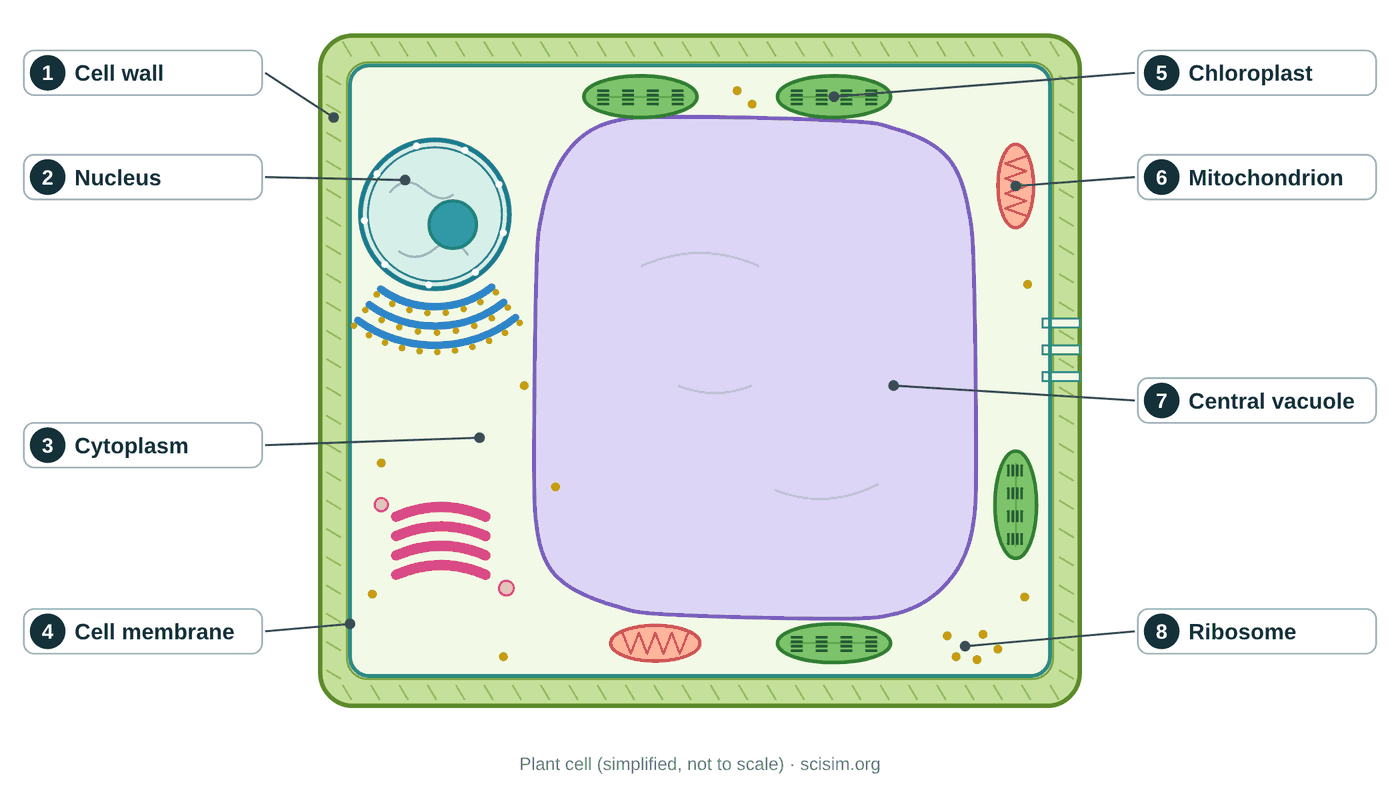
The 3D model above shows the cell in depth; this flat diagram is the version you draw in an exam. Pick Basic (the 8 parts most courses ask for) or Advanced (12 parts). Then switch between the labeled diagram, a blank one to test your memory, a label quiz where you place each label yourself, and match the jobs, where you pair each part with what it does. You can also download the diagrams or print a worksheet with an answer key. On a phone, swipe the diagram sideways.
Tap a word, then tap the numbered box it belongs to (on the diagram or in the list below). Tap a filled box to take the word back.
Each line describes the job of one part. Tap a part name, then tap the box next to the job it does. Tap a filled box to take the word back.
✅ Mission 7 · Final Quiz
10 questions from a bank of 20. Get 6 or more to complete the mission.
💡 The Idea, Step by Step
Picture a plant cell as a tiny green factory packed inside a stiff cardboard box. The box is the cell wall, a rigid layer of cellulose that gives the cell its neat brick-like shape and holds the plant up. Just inside the wall is the plasma membrane — the real gatekeeper that decides what gets into the cell. A typical plant cell is roughly $10$–$100\,\mu\mathrm{m}$ across, a bit bigger than a comparable animal cell, mostly because so much of it is taken up by one giant water balloon.
That water balloon is the central vacuole, and it can fill most of the cell, shoving every other organelle into a thin layer of cytoplasm around the edge. Pressed up against that edge you find the cell's superstar: the green chloroplasts, where sunlight is turned into sugar by photosynthesis. The plant cell still keeps all the familiar parts an animal cell has too — nucleus (the manager), mitochondria (the power plants), endoplasmic reticulum and Golgi apparatus (the build-and-ship line). Click each one in the sim to meet it.
The vacuole does more than store water: by swelling it presses outward and the cell wall pushes back, creating turgor pressure that keeps soft leaves and stems firm (a wilted plant is one whose vacuoles have lost water). Energy flows in two directions here. Chloroplasts store light energy in sugar: roughly $6\,\mathrm{CO_2}+6\,\mathrm{H_2O}\rightarrow \mathrm{C_6H_{12}O_6}+6\,\mathrm{O_2}$. Mitochondria then release that energy as ATP by running respiration almost in reverse. And because the rigid walls box each cell in, neighbours stay connected through tiny channels called plasmodesmata that thread right through the wall.
Press Cut open: most of the cell is the vacuole, and the chloroplasts sit in a thin layer of cytoplasm against the wall. Switch on Bacterium for scale — a whole bacterium is smaller than one chloroplast. In the microscope lab, compare onion skin (no chloroplasts) with an Elodea leaf (full of them), and in the osmosis lab plasmolyse the cell and watch the membrane pull away from the wall.
📐 The Parts of a Plant Cell and Their Jobs
| Part | Main job | Plant-only? |
|---|---|---|
| Cell wall | Rigid cellulose layer outside the membrane; gives shape, support, protection; freely permeable | Yes |
| Plasma membrane | Selectively controls what enters and leaves the cytoplasm (the real barrier) | No |
| Central vacuole | Stores water, ions and pigments; turgor pressure for support; bounded by the tonoplast | Yes (large one) |
| Chloroplast | Photosynthesis — captures light to build sugar; has its own DNA | Yes |
| Nucleus | Stores DNA and directs protein synthesis (the control center) | No |
| Nucleolus | Makes ribosomal RNA and assembles ribosome subunits | No |
| Mitochondrion | Aerobic respiration → ATP energy; releases what the chloroplast stored | No |
| Rough ER | Synthesizes and folds proteins (ribosome-studded) | No |
| Smooth ER | Makes lipids, stores ions, detoxifies | No |
| Golgi apparatus | Modifies, sorts and ships proteins; also makes cell-wall polysaccharides | No |
| Peroxisome | Breaks down fatty acids; in leaves aids photorespiration | No |
| Ribosome | Reads mRNA and builds proteins | No |
| Plasmodesmata | Channels through the wall linking neighbouring cells' cytoplasm | Yes |
Why the vacuole is so big
In most mature plant cells one vacuole swells until it occupies the bulk of the interior — commonly $30$–$90\%$ of the cell volume. This is an efficient design: water is cheap, so a plant can grow a large cell mostly by inflating a vacuole rather than by building expensive cytoplasm. The swollen vacuole presses the thin cytoplasm and its organelles against the wall, which also keeps the light-catching chloroplasts near the surface where sunlight reaches them. The pressure it generates — turgor — is what holds up plants that have no wood.
Chloroplasts and the endosymbiotic story
Photosynthesis happens in the chloroplast's stacked thylakoid membranes (piled into grana), where chlorophyll absorbs light, while the sugar-building Calvin cycle runs in the surrounding fluid stroma. Chloroplasts, like mitochondria, carry their own circular DNA and replicate by dividing — strong evidence for the endosymbiotic theory that both organelles descend from ancient free-living bacteria engulfed by an early cell.
🎓 Going Further (AP / A-level / Intro College)
Water potential
Water moves from higher to lower water potential ($\Psi$). For a plant cell $\Psi = \Psi_s + \Psi_p$, where $\Psi_s$ is the solute potential (always zero or negative) and $\Psi_p$ the pressure potential (positive in a turgid cell). For a solution, $\Psi_s = -iCRT$. Example: 0.40 M sucrose ($i = 1$) at 22 °C (295 K) has $\Psi_s = -(1)(0.40)(0.0831)(295) \approx -9.8$ bar $\approx -0.98$ MPa. A potato cylinder neither gains nor loses mass in a solution whose water potential equals that of its cells — that is what the potato experiment above measures.
Why the wall matters
As water enters, the protoplast presses on the wall and $\Psi_p$ rises until $\Psi_{cell} = \Psi_{outside}$. The wall stops the cell bursting, so a plant cell in pure water becomes turgid instead of lysing. In a hypertonic solution the protoplast shrinks: first incipient plasmolysis (the membrane just starts to leave the wall), then full plasmolysis.
Endosymbiosis
Chloroplasts and mitochondria are thought to come from free-living bacteria taken in by an ancestral cell (Margulis, 1967). Evidence: both have two membranes, their own circular DNA, 70S ribosomes like bacteria, and they divide by a process like binary fission.
Cells connected
Plasmodesmata join the cytoplasm of neighboring cells into one continuous network, the symplast; water can also travel through the walls and spaces between cells (the apoplast). This matters for how water and sugars move through roots and leaves.
🔎 How we checked this page
Checked against:
- Campbell & Reece — Biology (Ch. 6 and Ch. 10)
- Alberts et al. — Molecular Biology of the Cell (Ch. 12–14)
- Taiz & Zeiger — Plant Physiology and Development
Key numbers: The model leaf cell is about 50 × 30 × 30 µm, with its parts in true proportion. The full list is in the references above.
What the model simplifies: Membranes, the ER, ribosomes and grana are drawn several times thicker than they really are so you can see them, and a real cell has far more ribosomes.
Standards: NGSS MS-LS1-1, MS-LS1-2
Last reviewed · How we check our science · Report a mistake
❓ FAQ
A plant cell has a rigid cell wall outside its plasma membrane, chloroplasts that carry out photosynthesis, and one large central vacuole. Animal cells lack all three. Animal cells instead rely on centrioles and many small lysosomes, which are uncommon or absent in mature plant cells.
Key takeaway: cell wall, chloroplasts, and a large central vacuole are the hallmark plant-only structures.The plant cell wall is a rigid layer outside the plasma membrane built mainly from cellulose fibres, along with hemicellulose and pectin. It gives the cell a fixed box-like shape, supports the plant against gravity, and protects the cell, while still being freely permeable so water and small molecules pass through easily. The plasma membrane underneath is the layer that actually controls what enters the cytoplasm.
Key takeaway: the cellulose cell wall provides shape and support but is not the selective barrier — the membrane inside it is.The large central vacuole can fill 30 to 90 percent of a mature plant cell's volume. It is a sac bounded by a membrane called the tonoplast and filled with cell sap — water, ions, sugars, pigments, and waste. By taking up water it presses outward on the cell wall, creating turgor pressure that keeps leaves and stems firm. When a plant wilts, its vacuoles have lost water and turgor.
Key takeaway: the central vacuole stores water and maintains the turgor pressure that holds a non-woody plant upright.A chloroplast is wrapped in a double membrane and filled with a fluid called stroma. Inside, flattened discs called thylakoids are stacked into piles named grana, and the thylakoid membranes hold the green pigment chlorophyll. The light reactions of photosynthesis happen on these thylakoid membranes, while the Calvin cycle that builds sugar takes place in the stroma. Like mitochondria, chloroplasts have their own small DNA.
Key takeaway: stacked thylakoids hold chlorophyll for the light reactions, and the surrounding stroma runs the sugar-building Calvin cycle.Yes. Plant cells contain both. Chloroplasts capture light energy and store it in sugar during photosynthesis, but the cell still has to release that stored energy as ATP, and that job belongs to the mitochondria through cellular respiration. Photosynthesis and respiration are different, complementary processes, so plants run both — including at night and in non-green tissues like roots, where there is no photosynthesis at all.
Key takeaway: chloroplasts make food, mitochondria release its energy, so plant cells need both organelles.Plasmodesmata are tiny channels that pass through the cell walls connecting one plant cell's cytoplasm to its neighbour's. Because plant cells are boxed in by rigid walls, these channels let water, nutrients, and signalling molecules move directly from cell to cell without crossing the wall. This connected network of cytoplasm across many cells is called the symplast.
Key takeaway: plasmodesmata are cytoplasmic bridges through the cell wall that link neighbouring plant cells into a communicating network.The rigid cellulose cell wall holds a plant cell in a fixed, often brick-like shape, and turgor pressure from the water-filled vacuole pushes the membrane firmly against that wall. Animal cells have no wall, so their flexible membrane lets them take on rounded or irregular shapes and even change shape to move. The wall is also why neighbouring plant cells fit together like bricks in tissue.
Key takeaway: the cell wall plus turgor pressure lock plant cells into a regular shape, whereas wall-less animal cells stay flexible.For onion, peel the thin see-through skin from the inside of a layer, lay it flat in a drop of water or iodine solution on a slide and lower a coverslip slowly at an angle so no air bubbles are trapped. Start with the 4× objective and the coarse focus, then move up to 10× and 40× and use only the fine focus. Iodine makes the walls and nuclei show up. An Elodea leaf needs no stain: its chloroplasts are already green, and in warm light you can see them stream around the cell.
Key takeaway: Thin sample, the right stain, a careful coverslip, and start at low power.A turgid cell has taken in water by osmosis until its contents press firmly on the cell wall; turgid cells keep leaves and stems firm. A flaccid cell is in a solution of the same concentration, so it is not pushing on the wall. A plasmolysed cell has lost so much water to a strong solution that the membrane and cytoplasm pull away from the wall. When many cells lose turgor, the plant wilts.
Key takeaway: Turgid = pushing on the wall, flaccid = not pushing, plasmolysed = shrunk away from it.Equal cylinders of potato are weighed and left in sugar (or salt) solutions of different concentrations, then weighed again. In dilute solutions they gain mass because water moves in by osmosis; in strong solutions they lose mass. Plotting the percentage change against concentration and finding where the line crosses zero gives the concentration with the same water potential as the potato cells (often around 0.2–0.4 M sucrose).
Key takeaway: Where the graph crosses 0% change, the solution matches the cells.When a plant loses more water through its leaves than its roots can take up, the vacuoles in its cells lose water and the cells stop pushing on their walls (they become flaccid). Without turgor pressure the soft parts of the plant cannot hold themselves up, so the leaves and stems droop. Watering the plant lets the cells take in water again and become turgid.
Key takeaway: Wilting is what happens when cells lose turgor pressure.⚠️ Misconceptions & Common Errors