Dichotomous Key Simulator: Use a Key and Make Your Own
Grades 6–8 · MS-LS1-1 · science practice: analyzing and interpreting data · Go deeper: high school
Identify mystery organisms with yes/no couplets, build your own key, test it, and sort life into kingdoms.

Quiz questions with explanations
Easy
What is a dichotomous key?
- A branching chart that shows which organisms share a common ancestor
- A guide that sorts organisms by the year they were first discovered
- A complete list of every species that lives in one kingdom
- A tool that names an organism through a series of two-choice steps
Why: "Dichotomous" means divided into two parts: every step gives two choices.
What is one step of a dichotomous key, with its two choices, called?
- A node
- A kingdom
- A couplet
- A clade
Why: A couplet is a pair of opposite statements, such as 1a and 1b.
Which is the best first couplet for a key to a spider, an ant and a bee?
- 8 legs / 6 legs
- Scary / not scary
- Can sting / cannot sting
- Big / small
Why: Leg number can be seen and counted the same way by everyone.
How do you start using a dichotomous key?
- Read both statements of couplet 1 and choose the one that fits
- Jump to the couplet that has the name you already guess it is
- Start at the last couplet and work your way back to the first one
- Read only the first statement of each couplet and say yes or no
Why: Always start at couplet 1 and compare BOTH statements with the specimen.
Why is "Is it big?" a bad question for a key?
- Keys may only ask about the color
- It always has more than two answers
- Big organisms cannot be named with keys
- Two people can answer it differently
Why: Big compared to what? A key needs traits that everyone sees the same way.
A spider has 8 legs and no antennae. Is it an insect?
- No, it is a crustacean
- Yes, because it has a hard outer skeleton
- Yes, all bugs are insects
- No, it is an arachnid
Why: Insects have 6 legs and antennae; spiders are arachnids.
What are the three domains of life?
- Bacteria, viruses and protists
- Plants, animals and fungi
- Vertebrates, invertebrates and plants
- Bacteria, Archaea and Eukarya
Why: Woese, Kandler and Wheelis proposed the three domains in 1990.
Which kingdom does a mushroom belong to?
- Plants
- Animals
- Fungi
- Protists
Why: Mushrooms have chitin in their cell walls and absorb their food.
Which organisms have cells with NO nucleus?
- Bacteria and archaea
- All living organisms
- Animals and protists
- Plants and fungi only
Why: Prokaryotes (bacteria and archaea) have no nucleus.
A leaf is made of 5 leaflets that spread from one point like fingers. It is…
- A bundle of needles
- Palmately compound
- Pinnately compound
- Simple and deeply lobed
Why: Leaflets from one point = palmate; leaflets in pairs along a stalk = pinnate.
Where does a dichotomous key end?
- At couplet 1
- At a question mark
- At the kingdom Animalia every time
- At the name of an organism
Why: Each path ends in a name (or a group, in a short key).
Medium
In the best-balanced yes / no key for 8 organisms, what is the most questions any one organism needs?
- 4
- 8
- 7
- 3
Why: 2 × 2 × 2 = 8: three questions that each split a group in half are enough.
A complete dichotomous key names 8 organisms. How many couplets does it have in all?
- 16
- 3
- 8
- 7
Why: Every couplet turns one group into two, so 8 names need 8 − 1 = 7 couplets.
In the lab’s insect key, why does the honey bee need 7 questions but the spider only 1?
- Bees are much harder to see clearly than spiders are in a picture
- The key removes one organism at a time and the bee comes last
- Spiders have fewer legs to count, so they need fewer questions
- The insect key was written wrongly for the honey bee and the fly
Why: A chain-like key is easy to read but makes the last organism wait for every couplet.
Two students use your key on the same alien and reach different names. What is the most likely problem?
- The alien changed while they looked
- A couplet is a matter of opinion
- The key has only two choices per step
- The key has too few organisms
Why: Vague couplets ("big", "friendly") send the same organism two ways.
Your key test says "Wex and Nubb end in the same box." What should you do?
- Take Wex out of the key so that only Nubb is left there
- Add a couplet with a trait that splits Wex and Nubb
- Change every yes into a no and every no into a yes
- Delete couplet 1 so that the key becomes much shorter
Why: Every box at the end of a key must hold exactly one organism.
"Can it fly?" is a poor couplet for a key to preserved insects. Why?
- Every insect in the world can fly
- You cannot see it on the specimen
- Flying is a trait used only for kingdoms
- The question has three or more answers
Why: A key should use traits you can observe on the specimen in front of you.
Euglena has a nucleus, chloroplasts and no cell wall, and in the dark it takes in food from the water. The kingdom key puts it with…
- Protists
- Plants
- Bacteria
- Animals
Why: It is not a fungus (no chitin), not a plant (one cell, no cellulose walls) and not an animal (one cell).
Cyanobacteria make their own food with sunlight. Why are they not plants?
- They have no nucleus, so they are bacteria
- They have the wrong green color for plants
- They live in water instead of in the soil
- They are far too small to count as plants
Why: Making food is not enough: plants are eukaryotes with a nucleus and many cells.
Which trait separates the domain Archaea from the domain Bacteria in the lab’s key?
- Cell walls that contain chitin
- No peptidoglycan in the cell wall
- Many cells instead of just one
- A nucleus inside every cell
Why: Bacterial cell walls contain peptidoglycan; archaea cell walls do not.
Yeast is one cell. Why is it still in the kingdom Fungi?
- It makes its own food with sunlight, like a plant
- All one-celled organisms with a cell wall are fungi
- Its cell has no nucleus, like all one-celled fungi
- Its cell wall contains chitin and it absorbs its food
Why: Fungi can be one cell (yeasts) or many (mushrooms); the cell wall and the way they feed are what count.
What is the difference between a dichotomous key and a cladogram?
- A key shows shared ancestry; a cladogram names organisms by traits
- They are two different names for one and the same kind of diagram
- A key is used only for plants; a cladogram is used only for animals
- A key names by visible traits; a cladogram shows shared ancestry
Why: Keys are for naming; cladograms are hypotheses about evolutionary relationships.
Hard
In the best-balanced yes / no key for 20 organisms, what is the most questions any one organism needs?
- 19
- 5
- 4
- 10
Why: 2⁴ = 16 is too few and 2⁵ = 32 is enough, so ⌈log₂ 20⌉ = 5.
A key is a chain: each couplet removes one organism. With 20 organisms, how many questions does the last one need?
- 19
- 5
- 10
- 20
Why: A chain of n organisms needs n − 1 questions for the last two.
A balanced key and a chain key both name 16 organisms. Which statement is true?
- The balanced key has fewer couplets in total than the chain key
- Both have 15 couplets, but the balanced key’s longest path is 4
- The chain key has a shorter longest path than the balanced key
- Both keys have a longest path of 15 questions for the last one
Why: Any complete key with 16 names has 15 couplets; balance only changes path length.
Put these taxonomic levels in order from the most general to the most specific.
- Species, genus, family, order, class, phylum, kingdom, domain
- Domain, kingdom, phylum, class, order, family, genus, species
- Domain, phylum, kingdom, order, class, genus, family, species
- Kingdom, domain, class, phylum, family, order, species, genus
Why: OpenStax lists the eight levels from domain down to species.
In the scientific name Canis lupus, what is "lupus"?
- The kingdom, written in Latin form
- The family name, shortened for use
- The specific epithet (the species part)
- The genus name, written in capitals
Why: Binomial nomenclature writes the genus first and the species second.
What kind of evidence did Carl Woese use to propose the domain Archaea?
- The shape of the cells under a light microscope
- Ribosomal RNA sequences
- Where the organisms live
- The color of their colonies
Why: Comparing rRNA showed archaea are as different from bacteria as both are from eukaryotes.
Why do many biologists no longer treat "Protista" as a natural group?
- Protists have no nucleus, so they were moved to the prokaryotes
- Protists were moved into the domain Archaea in the year 1990
- Protists do not share one ancestor that excludes plants, animals and fungi
- All protists turned out to be plants once their DNA was studied
Why: Protists are defined by what they are not, so they are paraphyletic (not one clade).
Molecular evidence shows fungi are more closely related to…
- Bacteria than to plants
- Archaea than to animals
- Plants than to animals
- Animals than to plants
Why: OpenStax: analysis of fungal genomes shows fungi are closer to animals than plants.
A microbiology lab identifies an unknown bacterium with a key: Gram stain, then shape, then sugar tests. Each test is a…
- Domain
- Clade
- Couplet
- Binomial name
Why: Lab keys work like field keys: each test result sends you to the next couplet.
A key couplet reads "1a Leaves needle-like … Pinus; 1b Leaves broad … 2". What style of key is this?
- A cladogram with leaves
- A polytomous (many-way) key
- A bracketed (linked) key
- An indented (nested) key
Why: In a bracketed key both leads of a couplet are printed together, with a number to go to.
Mora and colleagues (2011) estimated about 8.7 million species of eukaryotes. About what share has been described?
- About 14 %
- Nearly 100 %
- About 86 %
- About 50 %
Why: They estimated that some 86 % of species on Earth still await description.
Lab controls
Views
More activities
Share & teachers
scisim.org/sims/biology/dichotomous_key
Students scan it with a phone or tablet camera.
Dichotomous Key Simulator: Use a Key and Make Your Own lesson plan
Students will
- Use a dichotomous key to identify an organism by comparing both statements of each couplet with the specimen.
- Build and test a dichotomous key, and explain why couplets must use visible traits that everyone sees the same way.
- Classify organisms into 3 domains and 6 kingdoms using cell evidence (nucleus, cell wall, food, number of cells).
Lesson
5 min · Hook: 8 aliens, 3 questions
Ask: Watch the intro. Can you give every alien its own name with only 3 yes / no questions?
Expected answer
Yes: each good question halves the group, 8 → 4 → 2 → 1, because 2 × 2 × 2 = 8.
10 min · Use a key (pairs): activity 1
Ask: Identify specimens 3, 5 and 8 with the insect key. Which needs the most questions, and why?
Expected answer
The honey bee needs 7: the key is a chain that removes one bug at a time.
15 min · Make and test a key (pairs): activity 2
Ask: Build a key for the 8 aliens, predict, and test it. How many questions does your longest path need?
Expected answer
A balanced key names every alien in 3 questions (2 × 2 × 2 = 8); any complete key for 8 has 7 couplets.
10 min · Is a mushroom a plant? Activity 4
Ask: Use the kingdom key on the mushroom and the moss. Which couplet tells them apart?
Expected answer
Couplet 3: the mushroom has chitin in its cell walls and absorbs food (Fungi); moss has cellulose walls and makes food (Plants).
5 min · Exit ticket (CER)
Ask: Is a mushroom a plant? Claim, evidence, reasoning.
Expected answer
No: a fungus. Evidence: chitin cell walls, no chloroplasts, absorbs food. Reasoning: plants have cellulose walls and make their own food.
What each part does
- Use a key / Build a key / Kingdoms & domains
- Three labs in one card: identify a hidden specimen with a ready-made key, build and test your own key, and classify cells into domains and kingdoms.
- Samples
- Insects, leaves and aliens (8 each), a ready-made broken key to fix, and 9 organisms for the kingdom key.
- Stage
- Use: tap 1a or 1b on the couplet card. Build: tap a group to split it, tap a couplet to remove it. Kingdoms: the microscope shows the cell after Run.
- Predict and Run
- Use: checks the student’s path. Build: tests the key with two testers. Kingdoms: zooms into the cell and walks the kingdom key.
Activity answers
What is the mystery bug?
Can you make a key that names all 8 aliens?
Where does this key break?
Is a mushroom a plant?
Which kingdom is it?
Day 2 (45 min): activities 3 (Where does this key break?) and 5 (Which kingdom is it?), then the Medium quiz. Extension: let students write a key for objects in the room (shoes, pens, leaves from the schoolyard), then swap keys and test each other’s. The kingdom key follows the 6-kingdom system used in many US middle-school courses; Go deeper explains why many biologists now treat "protists" as an informal group. NGSS: MS-LS1-1 (all living things are made of cells: one or many); the keys practice analyzing and interpreting data.
What is a dichotomous key?
A dichotomous key is a tool that identifies an organism through a series of steps, each with 2 opposite choices called a couplet, such as 6 legs or 8 legs. You start at couplet 1, choose the statement that fits, and follow it to the next couplet until you reach a name. Balanced couplets split groups about in half.
In this lab you can
- Identify a hidden bug, leaf or alien by answering the couplets of a ready-made key, then check your path.
- Build your own dichotomous key: tap a group of organisms and watch it split into a Yes group and a No group.
- Test your key with two testers and see exactly where it breaks: vague questions, traits you cannot see, or two organisms left in one box.
- Look at the cells of 9 organisms and use a kingdom key to sort them into 3 domains and 6 kingdoms.
Activities in this lab: What is the mystery bug? · Can you make a key that names all 8 aliens? · Where does this key break? · Is a mushroom a plant? · Which kingdom is it?
Modes in this lab: Use a key · Build a key · Kingdoms & domains
On this page: What is a dichotomous key?How do you use a dichotomous key?How do you make a dichotomous key?Why do some dichotomous keys fail?What are the 3 domains and 6 kingdoms of life?Is a mushroom a plant?What is the difference between a dichotomous key and a cladogram?Go deeper: how are living things classified?How do you use a dichotomous key? Worked example: the ladybugMyths and factsFAQSources
What is a dichotomous key?
A dichotomous key is an identification tool made of couplets: pairs of opposite statements about a trait, where each statement leads either to the next couplet or to a name. “Dichotomous” means “cut in two”, so every step has exactly two choices. Botanists credit Jean-Baptiste Lamarck’s Flore françoise, published in 1778, as an early book designed for identifying plants with dichotomous keys (Britannica). Field guides, lab manuals and apps still use keys, because a few couplets take you from “a bug” or “a leaf” to one name.
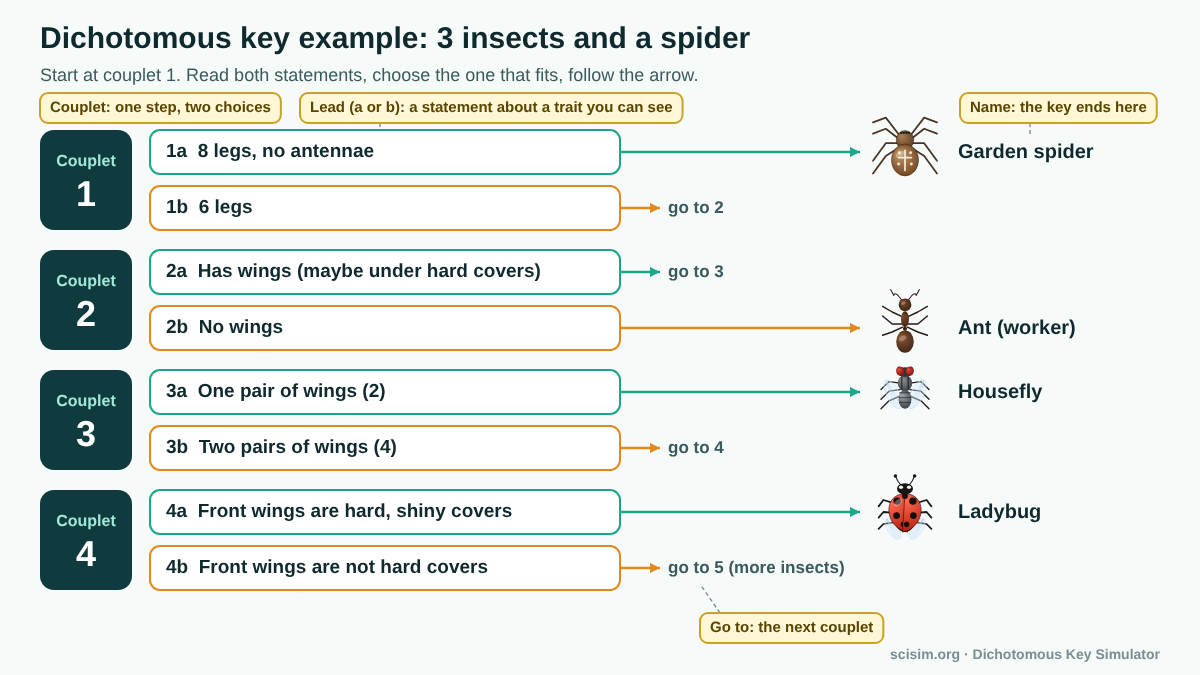
A key is different from a cladogram: a key only helps you name things, while a cladogram shows how they are related.
How do you use a dichotomous key?
Using a dichotomous key means starting at couplet 1, reading both statements, choosing the one that is true for your specimen, and following its number until you reach a name. Read both statements every time, because the second one is often the clue: a tree key may start with “leaves are thin needles” versus “leaves are broad and flat”, and the next couplet for pines can count needles: eastern white pine has soft needles in groups of five (US Forest Service). Write down your path (1b → 2a → 3b …) so someone else can check it. In the lab, the Use a key mode hides the name of each of 8 insects, 8 leaves and 8 aliens until you have answered the couplets.
Try it in the lab: Use a key ↑ Try it in the lab: What is the mystery bug? ↑
How do you make a dichotomous key?
Making a dichotomous key means splitting a group of organisms in two again and again with yes / no questions about visible traits, until every organism has its own box. Steps: (1) list the organisms; (2) find one trait that splits them into two groups, ideally about half and half; (3) write it as two opposite statements, 1a and 1b; (4) repeat for each group that still has 2 or more; (5) test the key on every organism, and ask a friend to test it too. A complete key always has one couplet fewer than the number of organisms it names, and each yes / no couplet can at most halve a group, so 3 couplets in a row can separate up to 2 × 2 × 2 = 8 organisms. Wings are useful couplets for insects: many insect order names describe the wings (Coleoptera, Diptera, Lepidoptera), and about 900,000 kinds of insects are known (Smithsonian Institution). In the lab’s Build a key mode, tap a group to pick a question and watch it split.
Try it in the lab: Build a key ↑ Try it in the lab: Can you make a key that names all 8 aliens? ↑
Why do some dichotomous keys fail?
A dichotomous key fails when two people using it on the same organism can reach different names, or when it cannot tell two organisms apart. The three usual causes are a couplet that is a matter of opinion (“Is it big?” compared to what?), a trait that cannot be seen on the specimen (“Can it fly?”, “Does it sting?”), and a box at the end that still holds 2 organisms. The lab tests your key with 2 testers who answer opinion questions differently, so a vague couplet sends the same alien two ways. Keys have always been built from opposite pairs of features: Lamarck’s 1778 plant keys asked the user to choose between opposing pairs of plant characters (Britannica).
What are the 3 domains and 6 kingdoms of life?
The 3 domains of life are Bacteria, Archaea and Eukarya, the broadest groups of living things; in 1990 Carl Woese, Otto Kandler and Mark Wheelis proposed that each domain contains two or more kingdoms (Woese, Kandler & Wheelis 1990, PNAS). Many US middle-school courses use 6 kingdoms: Eubacteria and Archaebacteria (one-celled prokaryotes with no nucleus) and the four kingdoms of Eukarya: protists, fungi, plants and animals. The first couplet of a kingdom key is the cell itself: no nucleus means a prokaryote. Most species are still unknown: Mora and colleagues estimated about 8.7 million species of eukaryotes, with some 86 % not yet described (Mora et al. 2011, PLoS Biology). See a cell with no nucleus up close in the bacterial cell lab.
| Kingdom | Domain | Nucleus? | Cell wall | Cells | Food | Examples in the lab |
|---|---|---|---|---|---|---|
| Bacteria (Eubacteria) | Bacteria | No | Peptidoglycan | One | Some make food, most absorb it | E. coli, cyanobacteria |
| Archaea (Archaebacteria) | Archaea | No | No peptidoglycan | One | Varies; many live in extreme places | Halobacterium |
| Protists | Eukarya | Yes | Some, none or varied | Mostly one | Make food, eat, or both | Amoeba, Euglena |
| Fungi | Eukarya | Yes | Chitin | One or many | Absorb food | Yeast, mushroom |
| Plants | Eukarya | Yes | Cellulose | Many | Make food (photosynthesis) | Moss, oak tree |
| Animals | Eukarya | Yes | None | Many | Eat other living things | Frog, human |
Try it in the lab: Kingdoms & domains ↑ Try it in the lab: Which kingdom is it? ↑
Is a mushroom a plant?
A mushroom is not a plant: it belongs to the kingdom Fungi, whose cell walls contain chitin and which absorb their food instead of making it by photosynthesis (OpenStax Biology 2e, 24.1). Molecular evidence shows fungi are more closely related to animals than to plants (OpenStax Biology 2e, 24.1). Fungi are a huge kingdom: Mora and colleagues estimated about 611,000 species of fungi, of which about 43,000 had been catalogued (Mora et al. 2011, PLoS Biology).
“In fact, up until the mid-20th century, many scientists classified fungi as plants!”
What is the difference between a dichotomous key and a cladogram?
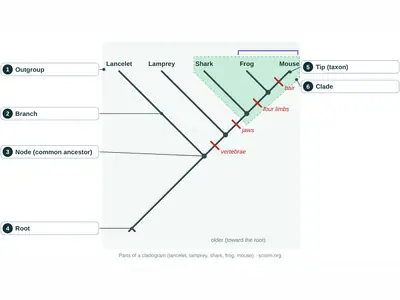
A dichotomous key is a tool for naming an organism from traits you can see, while a cladogram is a branching diagram that shows a hypothesis about how groups share common ancestors. A key may put a bat next to a bird because both have wings, even though bats are mammals; a cladogram would not. OpenStax shows all life on one phylogenetic tree with 3 domains, and notes that such trees are hypotheses that change as new evidence comes in (OpenStax Biology 2e, 20.1). Build one yourself in the cladogram lab.
| Dichotomous key | Cladogram | |
|---|---|---|
| What it is for | Naming (identifying) an organism | Showing how groups are related by common ancestry |
| What it uses | Traits you can see on the specimen, in any order that works | Shared derived traits (or DNA) that appeared in a common ancestor |
| Branches | Always 2 per couplet | Usually 2 per branch point |
| Ends in | One organism’s name | Groups (taxa) at the tips |
| Different correct versions? | Yes: many keys can name the same organisms | It is a hypothesis; new evidence can change it |
| Used by | Field guides, lab identification | Evolution and classification research |
Key terms
- Dichotomous key
- A tool that identifies organisms through steps that each offer two opposite choices.
- Couplet
- One step of a key: a pair of opposite statements (a and b) about one trait.
- Lead
- One statement of a couplet; it leads to the next couplet or to a name.
- Trait
- A feature you can observe, such as number of legs or leaf shape.
- Taxonomy
- The science of naming and classifying living things.
- Domain
- The broadest group of living things: Bacteria, Archaea or Eukarya.
- Kingdom
- A large group inside a domain, such as fungi, plants or animals.
- Prokaryote
- An organism whose cells have no nucleus (bacteria and archaea).
- Eukaryote
- An organism whose cells have a nucleus (protists, fungi, plants and animals).
- Binomial nomenclature
- The two-word scientific name of a species: genus plus species.
Go deeper: how are living things classified?
High school: taxonomic levels, scientific names, kinds of keys
Taxonomy is the science of naming and classifying organisms. Scientists use 8 main levels, from the most general to the most specific: domain, kingdom, phylum, class, order, family, genus and species (OpenStax Biology for AP Courses, 20.1). The dog, for example, is in domain Eukarya, kingdom Animalia, phylum Chordata, class Mammalia, order Carnivora, family Canidae, genus Canis, species Canis lupus (OpenStax Biology 2e, 20.1). The two-word scientific name (binomial nomenclature) is the genus plus the species: Canis lupus, Apis mellifera (honey bee), Pinus strobus (eastern white pine).
Kinds of keys. In a bracketed (linked) key both statements of a couplet are printed together with the number to go to (like the lab’s result box). In an indented key the second statement comes after everything that follows the first, so the layout itself shows the branches. Microbiology labs identify unknown bacteria with keys whose couplets are test results: Gram-positive or Gram-negative, rod or sphere, ferments lactose or not.
Why 3 domains? Comparisons of molecules, starting with ribosomal RNA, showed three very different groups of living things, more different from each other than animals are from plants (Woese, Kandler & Wheelis 1990, PNAS). “Protists” are defined by what they are not (not fungi, plants or animals), so many biologists treat them as an informal group rather than a natural kingdom.
The maths of keys. A complete key for n organisms always has n − 1 couplets. A balanced key needs only ⌈log2 n⌉ questions on its longest path (3 for 8, 5 for 20); a chain that removes one organism at a time needs n − 1.
How do you use a dichotomous key? Worked example: the ladybug
A key is read one couplet at a time, always starting at couplet 1. Dichotomous keys go back at least to Lamarck’s Flore françoise of 1778 (Britannica). Here is the lab’s insect key used on specimen 1:
- Couplet 1: 1a 8 legs, no antennae → Garden spider; 1b 6 legs → go to 2. The specimen has 6 legs: 1b.
- Couplet 2: 2a has wings → go to 3; 2b no wings → Ant. It has wings (some under its covers): 2a.
- Couplet 3: 3a one pair of wings (2 wings) → Housefly; 3b two pairs of wings (4), or no wings → go to 4. A ladybug has 2 hard front wings plus 2 thin flying wings: 3b.
- Couplet 4: 4a front wings are hard, shiny covers → Ladybug; 4b not hard covers → go to 5. Its red front wings are hard covers: 4a.
- Answer: Ladybug (Coccinella septempunctata), in 4 questions. Its path is written 1b → 2a → 3b → 4a.
Myths and facts
Myth: There is only one correct dichotomous key for a group of organisms.
Fact: Many different keys can name the same organisms correctly; a key works if every organism reaches its own name and everyone who uses it gets the same answer.
Myth: A good key asks about anything that is true of the organism.
Fact: A key should use traits you can see on the specimen and that everyone judges the same way. "Can it sting?" and "Is it big?" make keys break.
Myth: Things that look alike in a key are closely related.
Fact: A key groups by visible traits, not ancestry: bats and birds both have wings, but bats are mammals. A cladogram shows relationships.
Myth: Anything green that makes food is a plant.
Fact: Cyanobacteria make food with sunlight but have no nucleus, so they are bacteria; Euglena makes food but is a one-celled protist.
Myth: Mushrooms are plants.
Fact: Mushrooms are fungi: their cell walls contain chitin, they absorb food instead of making it, and fungi are more closely related to animals than to plants (OpenStax Biology 2e, 24.1).
Frequently asked questions
What is a dichotomous key?
A dichotomous key is a tool that identifies an organism through a series of couplets, each with two opposite statements. You choose the statement that fits and follow it until you reach a name.
How do you use a dichotomous key?
Start at couplet 1, read both statements, choose the one that is true for your specimen, and go to the number it gives. Repeat until a statement ends in a name, and write down your path so it can be checked.
How do you make a dichotomous key?
List the organisms, find a visible trait that splits them into two groups, write it as two opposite statements, and repeat for every group that still has two or more. Then test the key on every organism.
What is the purpose of a dichotomous key?
Its purpose is to identify an unknown organism or object step by step, without having to know all the names first. Field guides and labs use keys for plants, insects, fish, bacteria and rocks.
What is a couplet in a dichotomous key?
A couplet is one step of the key: a pair of opposite statements, such as "1a 6 legs" and "1b 8 legs". Each statement leads to another couplet or to a name.
Why is it called a dichotomous key?
"Dichotomous" means divided into two parts. Every step of the key gives exactly two choices.
What makes a good dichotomous key?
Each couplet compares two opposite forms of one visible trait that everyone judges the same way, every path ends in one name, and a balanced key splits groups about in half so paths stay short.
What is the difference between a dichotomous key and a cladogram?
A dichotomous key is used to name organisms from visible traits. A cladogram shows how groups are related by common ancestry.
What are the 6 kingdoms of life?
The 6 kingdoms used in many US middle schools are Eubacteria, Archaebacteria, protists, fungi, plants and animals.
What are the 3 domains of life?
Bacteria, Archaea and Eukarya. Bacteria and archaea are prokaryotes with no nucleus; Eukarya are organisms whose cells have a nucleus.
Can a dichotomous key be used for non-living things?
Yes. Keys are also used for rocks and minerals, shells and even everyday objects like shoes, as long as each couplet uses a visible trait.
Lesson pack
Printable activities for this lab, with answer keys and a Google Slides version, in 2 levels (grades 6–8 and 9–10): 24 original animal cards with two different keys, create-a-key pages, a hands-on “key the junk drawer” lab, 3 virtual-lab sheets for this simulator, 8 lab stations, task cards, an escape room and self-checking pixel art.
Related simulations
Get new simulations by email
Teachers and other adults: sign up for new simulations and free lesson packs. Contact us
Sources
- Encyclopaedia Britannica: Flore française (Lamarck, 1778)
- Smithsonian Institution: Numbers of Insects
- US Forest Service: Eastern white pine (needles in groups of five)
- OpenStax Biology 2e, 20.1 Organizing Life on Earth
- OpenStax Biology for AP Courses, 20.1 Organizing Life on Earth
- OpenStax Biology 2e, 24.1 Characteristics of Fungi
- Woese, Kandler & Wheelis (1990). Towards a natural system of organisms: proposal for the domains Archaea, Bacteria, and Eucarya. PNAS 87:4576–4579
- Mora et al. (2011). How Many Species Are There on Earth and in the Ocean? PLoS Biology 9(8): e1001127
- NGSS MS-LS1-1
Published · Last updated
Cite this page
SciSim. (2026, November 13). Dichotomous key simulator: use a key and make your own. https://scisim.org/sims/biology/dichotomous_key