Vectors: Types and Vector Addition
What is a vector?
A vector is a quantity with both a size (magnitude) and a direction, drawn as an arrow; displacement, velocity and force are vectors, while mass and time are scalars. School physics names 16 types of vectors, such as zero, unit, equal, parallel, perpendicular, position and displacement vectors, each set by one condition on size, direction or starting point.
In this lab you can
- See all 16 types of vectors drawn on a grid (15 views), and turn the same picture into 3D.
- Drag a vector’s tip and watch its components, length and angle change inside the equation.
- Watch the tags light up when two vectors become equal, parallel, perpendicular or collinear.
- Add two vectors and solve river-crossing and rain-umbrella problems with your own numbers.
- Download any diagram as a picture or copy a link to the exact view for your class.
Views in this lab: Zero vector · Unit vector · Rectangular unit vectors · Equal vectors · Negative vector · Parallel vectors · Antiparallel vectors · Perpendicular vectors · Collinear vectors · Coplanar vectors · Co-initial vectors · Position vector · Displacement vector · Free and localized vectors · Polar and axial vectors · Resultant vector · River crossing · Rain and umbrella
What is a vector?
A vector is a quantity that has both a magnitude (size) and a direction; a scalar has only a magnitude (source: OpenStax University Physics Vol. 1, 2.1).
Vectors are drawn as arrows: the length shows the size and the arrowhead shows the direction. Displacement, velocity, acceleration and force are vectors; distance, speed, mass, time and energy are scalars. So speed (20 m/s) is a scalar, but velocity (20 m/s north) is a vector.
| Scalar | Vector | |
|---|---|---|
| Has | size only | size and direction |
| Examples | distance, speed, mass, time, energy, temperature | displacement, velocity, acceleration, force, momentum |
| Adding | ordinary addition: 3 kg + 4 kg = 7 kg | depends on direction: 3 N + 4 N can be anything from 1 N to 7 N |
| Written | m = 5 kg | v = 3î + 4ĵ m/s, |v| = 5 m/s |
Types of vectors compared
Every type below is decided by one condition on the vectors’ size, direction or starting point. OpenStax puts it this way: “Two vectors are equal if and only if they have the same magnitudes and directions.” (source: OpenStax University Physics Vol. 1, chapter 2 summary)
| Type | Picture | Condition | Everyday example |
|---|---|---|---|
| Zero vector | |0| = 0, and A + (−A) = 0 | Walking 5 m east and then 5 m west gives a displacement of zero. | |
| Unit vector | Â = A / |A| | A compass needle shows north without any size. | |
| Rectangular unit vectors | A = Axî + Ayĵ + Azk̂ | 3 steps east and 2 steps north is 3î + 2ĵ. | |
| Equal vectors | A = B when Ax = Bx, Ay = By, Az = Bz | Two cars driving north at 20 m/s on different streets. | |
| Negative vector | −A = (−1)A, |−A| = |A| | Driving 10 km east, then 10 km west. | |
| Parallel vectors | B = kA with k > 0 (angle 0°) | Two trains heading north on parallel tracks. | |
| Antiparallel vectors | B = kA with k < 0 (angle 180°) | A ball thrown upward and the pull of gravity on it. | |
| Perpendicular vectors | A · B = AxBx + AyBy + AzBz = 0 | Gravity pulls a sliding book down while it moves sideways. | |
| Collinear vectors | parallel or antiparallel, and on the same line | Two cars on one straight road. | |
| Coplanar vectors | Go deeper: three vectors are coplanar when A · (B × C) = 0 | Forces on a box pushed across a floor. | |
| Co-initial vectors | the same tail (initial point) for every vector | Ropes pulling a tree stump from one knot. | |
| Position vector | r = xî + yĵ + zk̂, |r| = √(x² + y² + z²) | 3 blocks east and 2 blocks north of the school. | |
| Displacement vector | Δr = r2 − r1 | Walking around the block and stopping next door. | |
| Free and localized vectors | turning effect of a force on a door: τ = rF sin θ (= rF for a push at right angles) | Velocity is a free vector; a push on a door is localized. | |
| Polar and axial vectors | axial: direction by the right-hand rule (angular velocity ω, torque) | A spinning top: ω points along its axis. |
What is a zero vector?
A zero (null) vector has magnitude 0 and no fixed direction. (source: OpenStax University Physics Vol. 1, 2.1)
Also called: null vector
Condition / equation: |0| = 0, and A + (−A) = 0
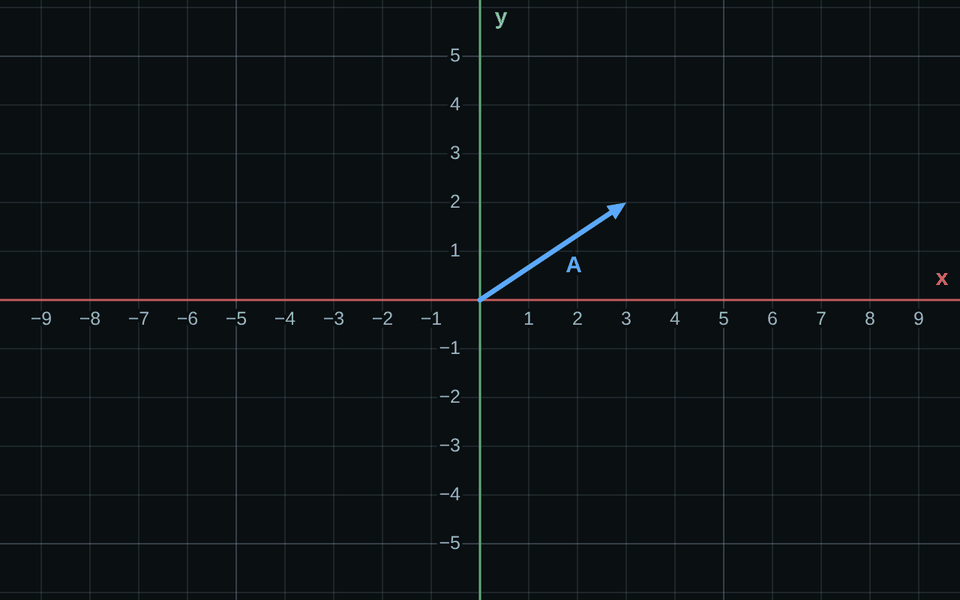
It is drawn as a dot. Adding any vector to its negative gives the zero vector. Everyday example: Walking 5 m east and then 5 m west gives a displacement of zero.
What is a unit vector, and how do you find it?
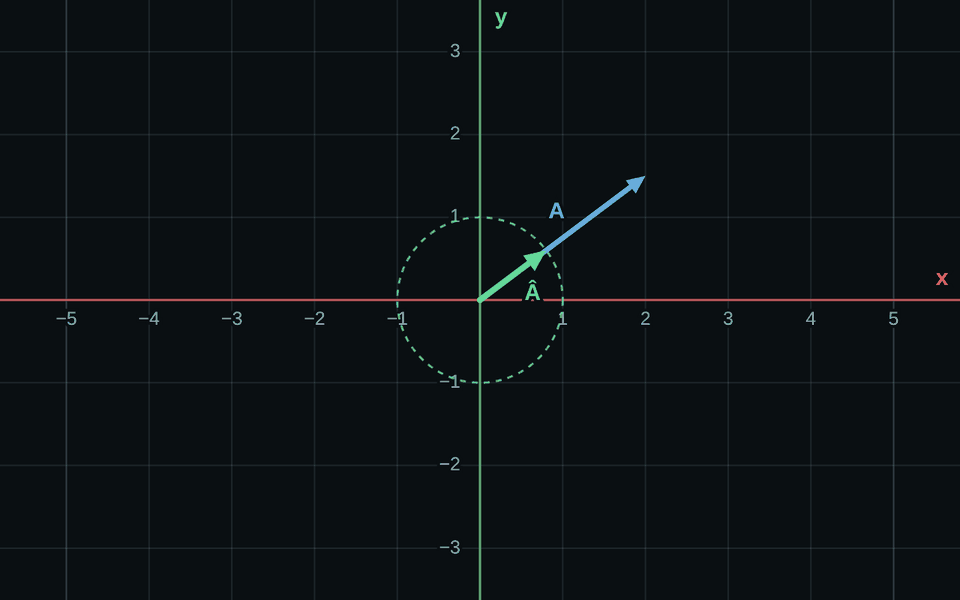
A unit vector has magnitude exactly 1 and only shows a direction. (source: OpenStax University Physics Vol. 1, 2.2)
Also called: “A hat”
Condition / equation: Â = A / |A|
Divide a vector by its own length to get its unit vector. For A = 3î + 4ĵ, |A| = 5, so  = 0.6î + 0.8ĵ. Everyday example: A compass needle shows north without any size.
What are i, j and k unit vectors?
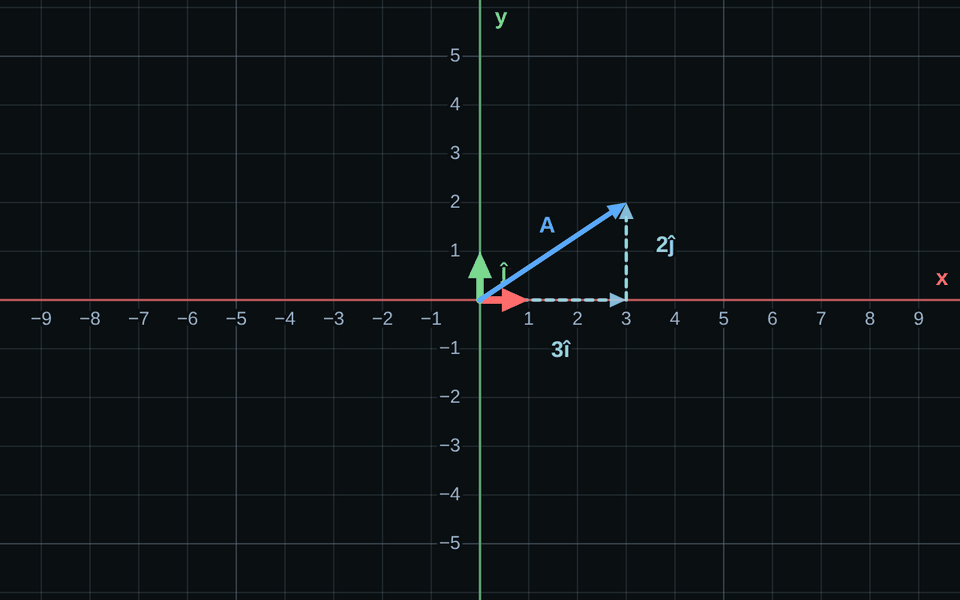
î, ĵ and k̂ are unit vectors that point along the x, y and z axes. (source: OpenStax University Physics Vol. 1, 2.2)
Also called: i-hat, j-hat, k-hat; basis vectors
Condition / equation: A = Axî + Ayĵ + Azk̂
Every vector can be written as a sum of these three, and each pair of them is perpendicular. Everyday example: 3 steps east and 2 steps north is 3î + 2ĵ.
What are equal vectors?
Equal vectors have the same magnitude and the same direction, wherever they start. (source: OpenStax University Physics Vol. 1, 2.1)
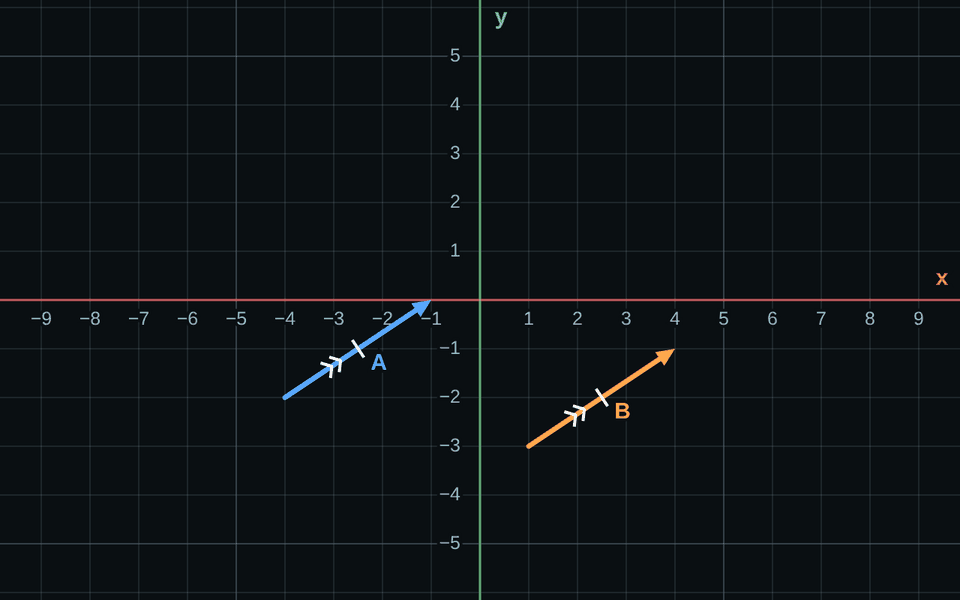
Condition / equation: A = B when Ax = Bx, Ay = By, Az = Bz
Moving a vector without turning or stretching it does not change it. Everyday example: Two cars driving north at 20 m/s on different streets.
What is the negative of a vector?
The negative −A has the same magnitude as A but points the opposite way. (source: OpenStax University Physics Vol. 1, 2.1)
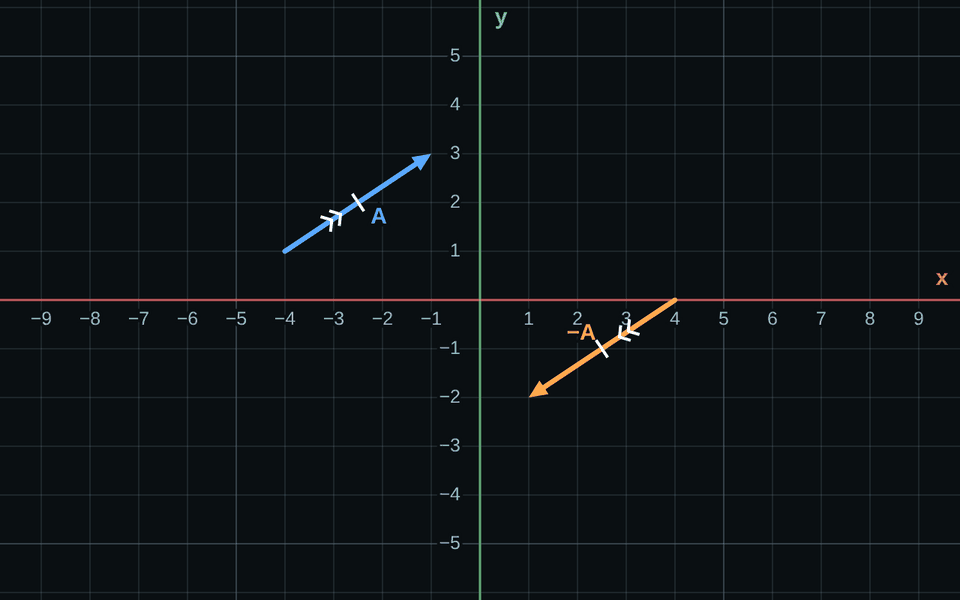
Also called: opposite vector
Condition / equation: −A = (−1)A, |−A| = |A|
Each component changes sign: −(3î + 2ĵ) = −3î − 2ĵ. Everyday example: Driving 10 km east, then 10 km west.
What are parallel vectors?
Parallel vectors point in the same direction; their lengths may differ. (source: OpenStax University Physics Vol. 1, 2.1)
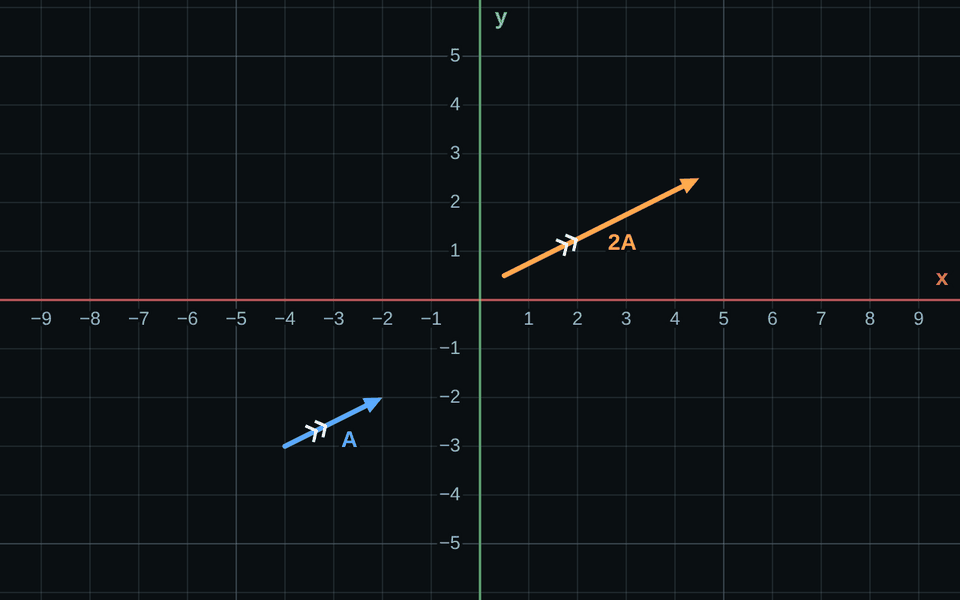
Also called: like vectors
Condition / equation: B = kA with k > 0 (angle 0°)
Multiplying a vector by a positive number stretches or shrinks it but keeps its direction. Everyday example: Two trains heading north on parallel tracks.
What are antiparallel vectors?
Antiparallel vectors point in exactly opposite directions; their lengths may differ. (source: OpenStax University Physics Vol. 1, 2.1)
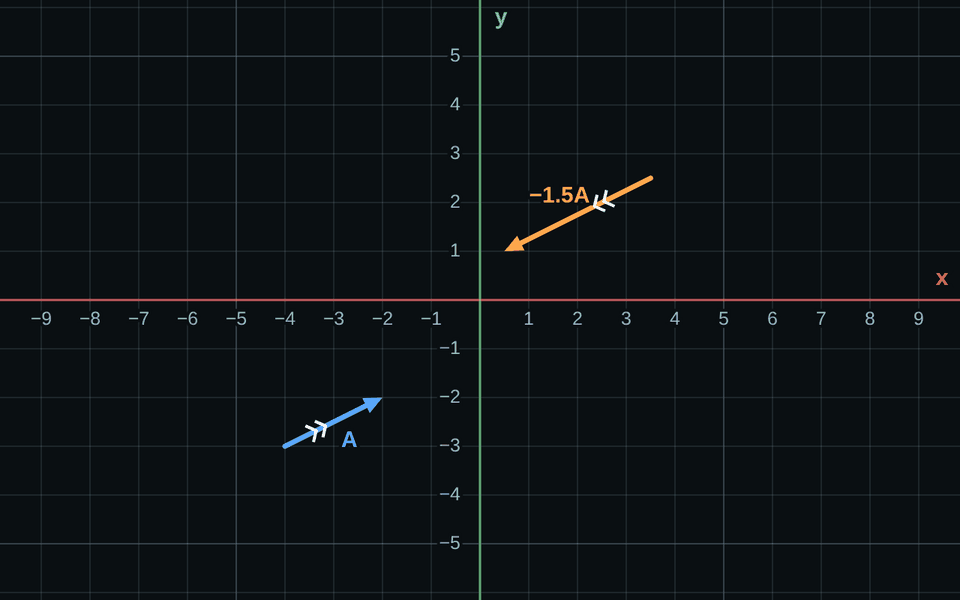
Also called: unlike vectors
Condition / equation: B = kA with k < 0 (angle 180°)
A negative vector is a special antiparallel vector with the same length. Everyday example: A ball thrown upward and the pull of gravity on it.
What are perpendicular (orthogonal) vectors?
Perpendicular vectors meet at 90°. (source: OpenStax University Physics Vol. 1, key terms)
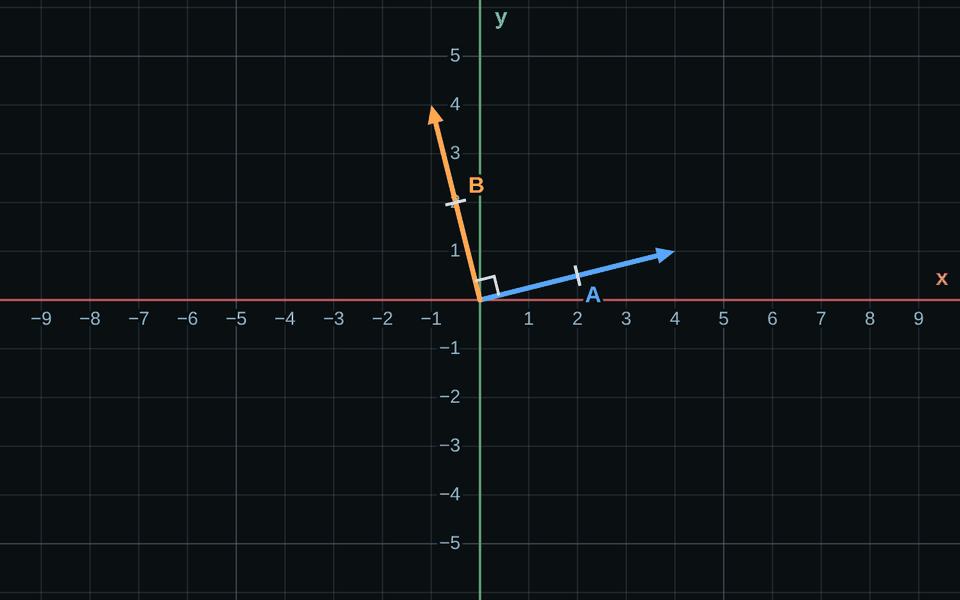
Also called: orthogonal vectors
Condition / equation: A · B = AxBx + AyBy + AzBz = 0
For A = 4î + ĵ and B = −î + 4ĵ: 4×(−1) + 1×4 = 0, so they are perpendicular. Everyday example: Gravity pulls a sliding book down while it moves sideways.
What are collinear vectors?
Collinear vectors lie along one straight line, pointing the same way or opposite ways.
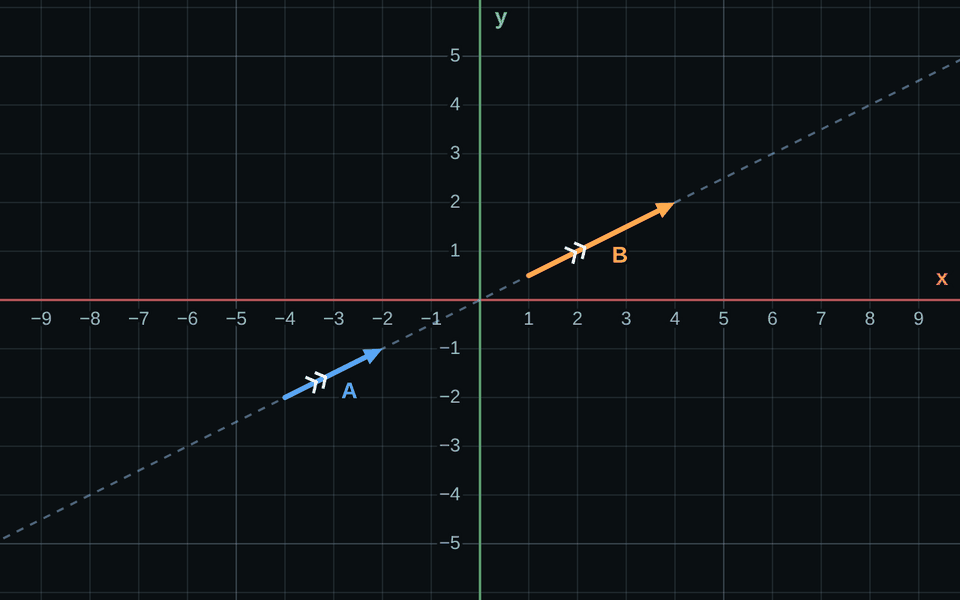
Condition / equation: parallel or antiparallel, and on the same line
Parallel vectors on two different lines are not collinear. Everyday example: Two cars on one straight road.
What are coplanar vectors?
Coplanar vectors all lie in one plane.
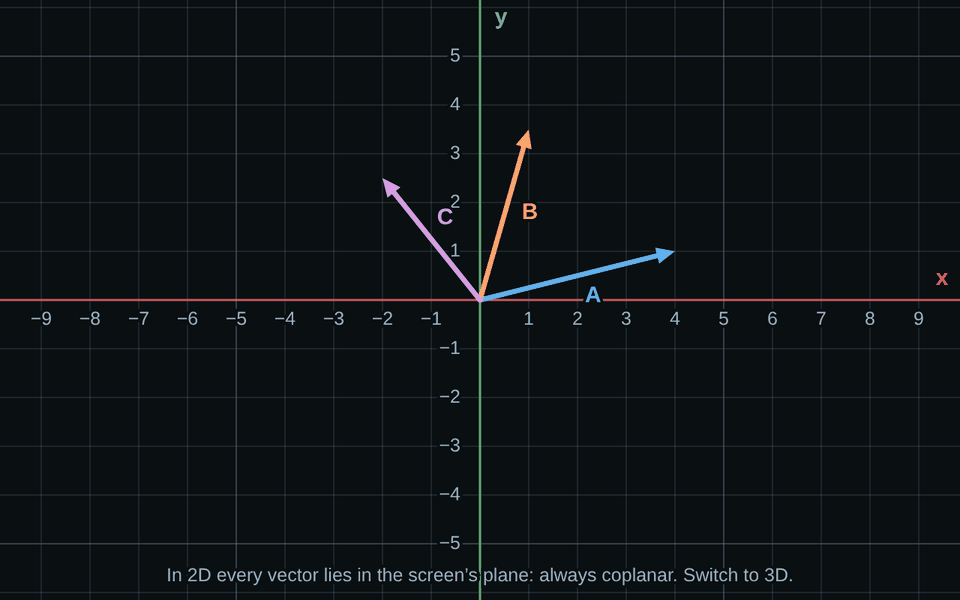
Condition / equation: Go deeper: three vectors are coplanar when A · (B × C) = 0
Any vectors drawn on a flat page are coplanar; in 3D one can tilt out of the plane. Everyday example: Forces on a box pushed across a floor.
What are co-initial vectors?
Co-initial vectors start from the same point.
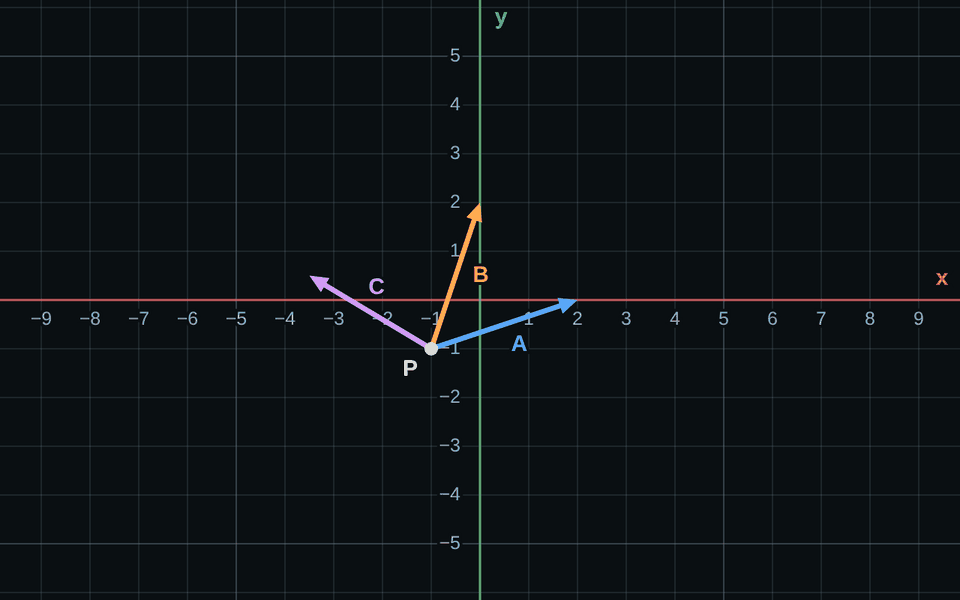
Condition / equation: the same tail (initial point) for every vector
Their directions and lengths can be anything. Everyday example: Ropes pulling a tree stump from one knot.
What is a position vector?
A position vector points from the origin O to a point P, so it says where P is. (source: OpenStax University Physics Vol. 1, 2.2)
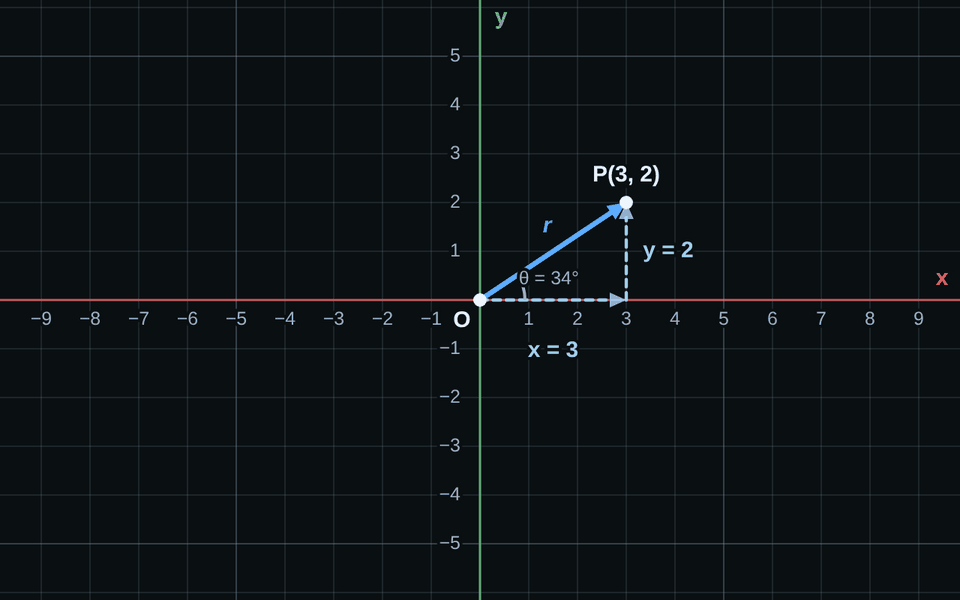
Also called: radius vector
Condition / equation: r = xî + yĵ + zk̂, |r| = √(x² + y² + z²)
For P(3, 2, 4): |r| = √(9 + 4 + 16) = √29 ≈ 5.39. Everyday example: 3 blocks east and 2 blocks north of the school.
What is a displacement vector?
A displacement vector goes straight from a start point to an end point, whatever path was taken. (source: OpenStax University Physics Vol. 1, 2.1)
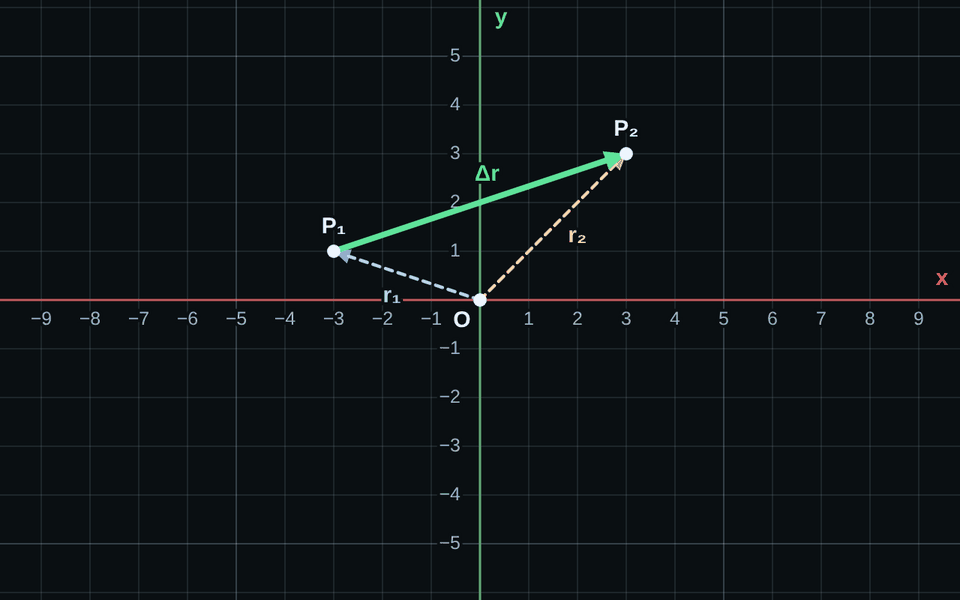
Also called: Δr
Condition / equation: Δr = r2 − r1
From P1(−3, 1) to P2(3, 3): Δr = 6î + 2ĵ, |Δr| ≈ 6.32. Everyday example: Walking around the block and stopping next door.
What is the difference between a free vector and a localized vector?
A free vector can be moved parallel to itself and stays the same; a localized (fixed) vector acts at one point.
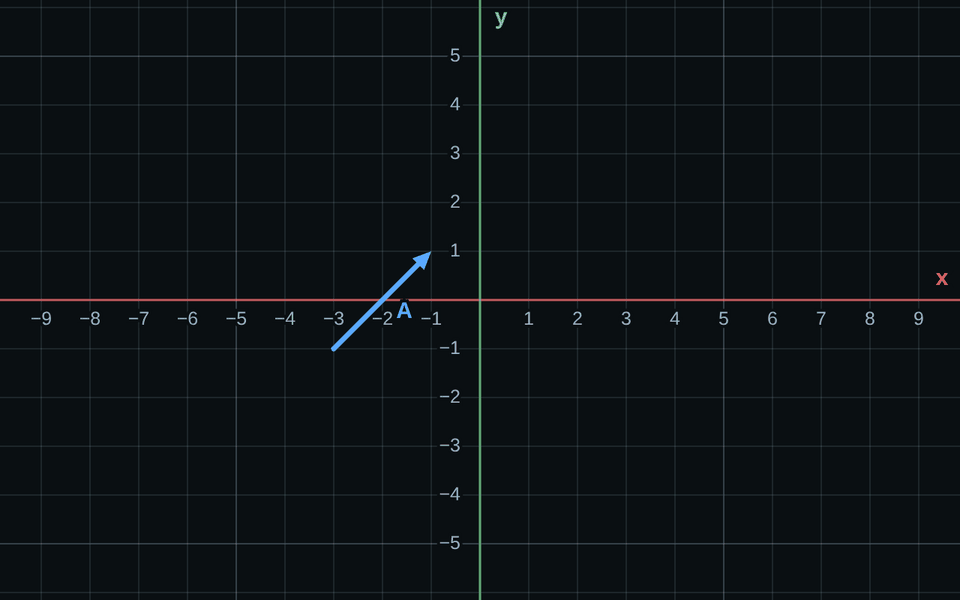
Also called: localized = fixed or bound vector
Condition / equation: turning effect of a force on a door: τ = rF sin θ (= rF for a push at right angles)
A 2 N push at right angles, 0.8 m from the hinge, gives τ = 1.6 N·m; the same push at the hinge gives 0 (illustrative numbers). Everyday example: Velocity is a free vector; a push on a door is localized.
What are polar and axial vectors?
A polar vector points the way something moves or pushes; an axial vector lies along an axis of rotation.
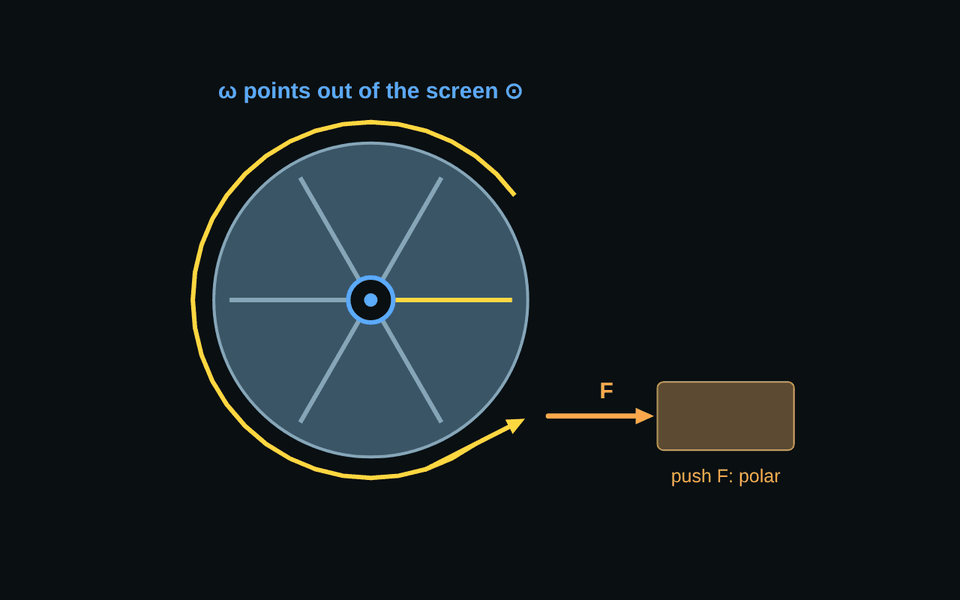
Also called: axial vector = pseudovector
Condition / equation: axial: direction by the right-hand rule (angular velocity ω, torque)
Curl the fingers of your right hand the way it turns; your thumb points along ω. Everyday example: A spinning top: ω points along its axis.
How do you find the magnitude of a vector?
The magnitude of a vector is its length: square each component, add them, and take the square root (source: OpenStax University Physics Vol. 1, 2.2).
2D: |A| = √(Ax² + Ay²) · 3D: |A| = √(Ax² + Ay² + Az²) · direction (2D): tan θ = Ay / Ax (check the quadrant: a calculator’s tan−1 only gives −90° to 90°)
For A = 3î + 4ĵ: |A| = √(9 + 16) = 5, and θ = tan−1(4/3) ≈ 53.1° from the +x axis. For r = 3î + 2ĵ + 4k̂: |r| = √29 ≈ 5.39.
How do you find the angle between two vectors?
The angle between two vectors comes from their dot product: cos θ = (A · B) / (|A| |B|) (source: OpenStax University Physics Vol. 1, 2.4).
Worked example: A = 4î + ĵ, B = 2î + 3ĵ.
- A · B = 4×2 + 1×3 = 11
- |A| = √17 ≈ 4.12, |B| = √13 ≈ 3.61
- cos θ = 11 / (4.12 × 3.61) ≈ 0.740, so θ ≈ 42.3°
If the dot product is 0, the angle is 90° and the vectors are perpendicular.
How do you find the resultant vector?
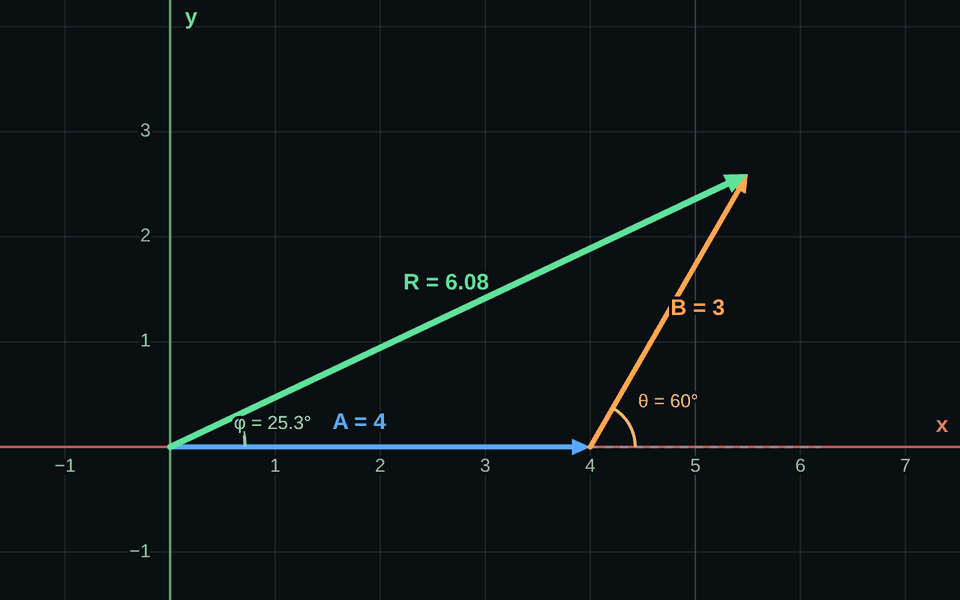
The resultant R = A + B is the single vector with the same effect as both together; place B at the tip of A and draw from the start of A to the tip of B (source: OpenStax University Physics Vol. 1, 2.3).
Magnitude (parallelogram law): R = √(A² + B² + 2AB cos θ)
Direction from A: tan φ = B sin θ / (A + B cos θ)
Special angles: θ = 0°: R = A + B (largest) · θ = 90°: R = √(A² + B²) · θ = 180°: R = |A − B| (smallest)
Difference: |A − B| = √(A² + B² − 2AB cos θ) · By components: Rx = Ax + Bx, Ry = Ay + By, Rz = Az + Bz
Angle between two vectors: cos θ = (AxBx + AyBy + AzBz) / (AB)
Worked example (the lab’s default numbers): A = 4, B = 3, θ = 60°.
- R = √(16 + 9 + 2×4×3×0.5) = √37 ≈ 6.08
- tan φ = 3×0.866 / (4 + 3×0.5) = 2.598 / 5.5 = 0.472, so φ ≈ 25.3° from A
- Check by components: Rx = 4 + 1.5 = 5.5, Ry = 2.598, √(5.5² + 2.598²) ≈ 6.08 ✓
How do you solve a river-crossing problem?
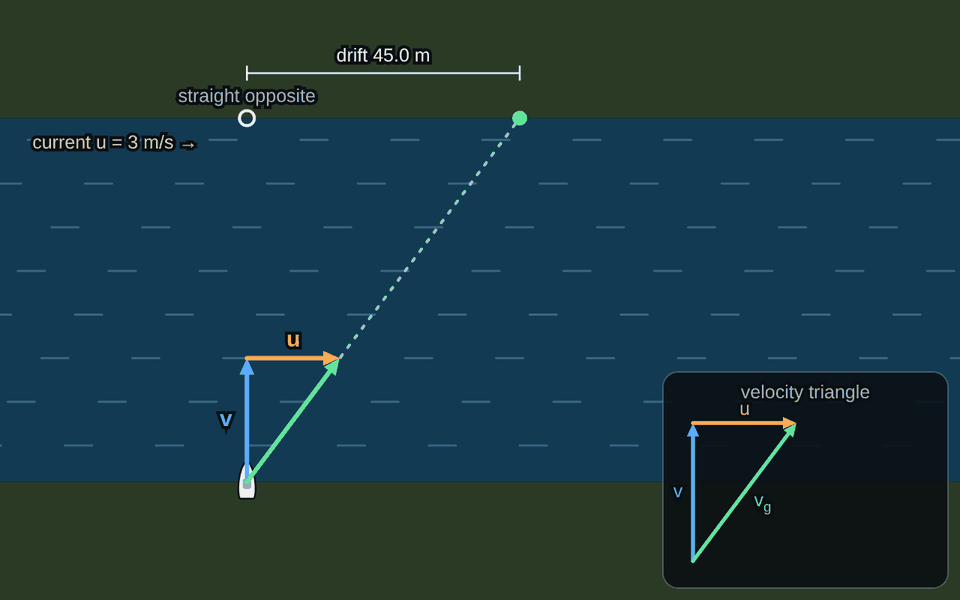
In a river-crossing problem the boat’s velocity over the ground is its velocity in still water plus the velocity of the current: vg = v + u (source: OpenStax University Physics Vol. 1, 4.5).
Worked example (the lab’s default numbers): river width d = 60 m, boat speed v = 4 m/s, current u = 3 m/s.
- Shortest time: head straight across. t = d/v = 60/4 = 15 s; drift = ut = 3 × 15 = 45 m downstream; speed over ground = √(4² + 3²) = 5 m/s.
- Land straight opposite: aim upstream at sin α = u/v = 0.75, so α ≈ 48.6°; t = d/√(v² − u²) = 60/√7 ≈ 22.7 s.
- Reach a chosen point 20 m downstream: the heading must make the path point at it; the lab solves u − v sin α = (20/60) v cos α for you.
- Current faster than the boat (v < u): the boat cannot land opposite; the least drift is at sin α = v/u, drift = d√(u² − v²)/v.
At what angle should you hold an umbrella in the rain?
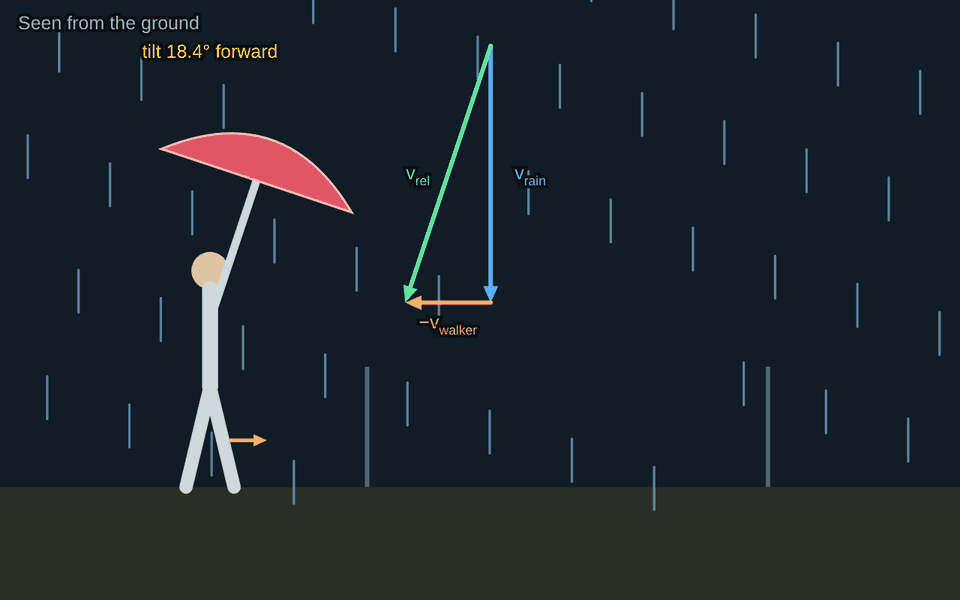
Tilt the umbrella toward the rain as the walker sees it: the rain’s velocity relative to you is vrain − vwalker, so for vertical rain tan θ = vwalker / vrain from the vertical (source: OpenStax University Physics Vol. 1, 4.5).
Worked examples (the lab’s default numbers):
- Rain straight down at 6 m/s, walking at 2 m/s: tan θ = 2/6, θ ≈ 18.4° forward; the rain hits you at √(2² + 6²) ≈ 6.32 m/s.
- Rain with wind: if the wind blows the rain forward at 2 m/s and you walk at 2 m/s, the rain looks vertical: hold the umbrella straight up.
- Rain looks vertical at 3 m/s, and at 6 m/s it looks 45° from vertical: the rain moves sideways at 3 m/s and falls at |6 − 3|/tan 45° = 3 m/s, so its real speed is 3√2 ≈ 4.24 m/s, 45° from vertical.
- Car back window sloping 30°, rain falling at 6 m/s: the window stays dry once the car is faster than 6/tan 30° ≈ 10.4 m/s.
Which vector types are easily confused?
Equal vs parallel: Equal vectors must match in length too; parallel vectors only need the same direction.
Parallel vs collinear: Collinear vectors are parallel (or antiparallel) and also lie on one line.
Negative vs antiparallel: A negative vector is antiparallel with exactly the same length.
Position vs displacement: A position vector starts at the origin; a displacement goes from one point to another.
Free vs fixed: A free vector may slide; a fixed (localized) one acts at one point, like a push on a door.
Polar vs axial: Polar vectors point along a motion or push; axial vectors point along a rotation axis.
❓ FAQ
School physics usually lists 16: zero, unit, equal, negative, parallel, antiparallel, perpendicular, collinear, coplanar, co-initial, position, displacement, free, localized, polar and axial vectors.
Key takeaway: One condition defines each type.A position vector starts at the origin and ends at a point. A displacement vector goes from one point to another: Δr = r2 − r1.
Key takeaway: Position: from the origin. Displacement: point to point.A vector quantity has both a size and a direction, such as displacement, velocity, acceleration or force. A scalar quantity, such as mass or time, has only a size.
Key takeaway: Vector = size + direction.Speed is a scalar: it has only a size (20 m/s). Velocity is the vector version: it also has a direction (20 m/s north).
Key takeaway: Speed: scalar. Velocity: vector.Yes. A position is given by the position vector r = xî + yĵ + zk̂, the arrow from the origin to the point.
Key takeaway: Position vector: from the origin to the point.Yes. It has magnitude 0 and no fixed direction. Adding a vector and its negative gives the zero vector: A + (−A) = 0.
Key takeaway: Zero vector: length 0, any direction.Yes. Equal vectors point the same way and have the same length, so they are parallel. Parallel vectors are equal only when their lengths also match.
Key takeaway: Equal ⇒ parallel, not the other way.R = √(A² + B² + 2AB cos θ), where θ is the angle between them. It is largest at 0° (A + B) and smallest at 180° (|A − B|).
Key takeaway: Parallelogram law.Point the boat straight across. The time is the river width divided by the boat’s speed in still water; the current only pushes you downstream.
Key takeaway: t = d / v when you head straight across.Because you move into the rain: seen by you, the rain also moves backward toward you, so it seems to come from in front. For rain falling straight down, tilt it by tan θ = vwalker / vrain.
Key takeaway: Relative velocity of rain.Sources
- OpenStax University Physics Volume 1, 2.1 Scalars and Vectors
- OpenStax University Physics Volume 1, 2.2 Coordinate Systems and Components of a Vector
- OpenStax University Physics Volume 1, 2.3 Algebra of Vectors
- OpenStax University Physics Volume 1, 2.4 Products of Vectors
- OpenStax University Physics Volume 1, chapter 2 key terms
- OpenStax University Physics Volume 1, 4.5 Relative Motion in One and Two Dimensions
- OpenStax University Physics Volume 1, chapter 2 summary
Related labs: projectile motion (velocity split into components), Newton’s laws (adding forces) and vector spaces and basis (the math behind î, ĵ, k̂).