Tide Predictor
Can you call the tide from the Moon?
See where the Moon, the Sun and your beach are. Say high or low tide, spring or neap tide.
Four activities. Each one checks an idea from the Tide lab.
Can you call the tide from the Moon?
See where the Moon, the Sun and your beach are. Say high or low tide, spring or neap tide.
When can the ship come in?
A ship needs deep water at the pier. Read the tide curve and pick the safe time, then the best day of the month.
Can you make a spring tide and a neap tide?
Drag the Moon and turn Earth to build five tide diagrams.
Can you find spring tides in real tide data?
One month of real water levels from NOAA. Find the biggest and smallest tides and name each coast’s tide pattern.
10 questions each time, picked at random. You see right away if you are right, and why.
What is a tide?
A tide is the regular rise and fall of the sea level, about twice a day on most coasts.
What is the main cause of tides on Earth?
The Moon’s gravity pulls the ocean into bulges. The Sun helps, but its tide is about half as large (NOAA).
How many high tides do most coasts get in about one day?
Most coasts get two high tides and two low tides every lunar day, 24 hours 50 minutes (NOAA).
What do we call the time when the sea is at its highest level on the shore?
High tide is the highest water level; low tide is the lowest.
Where are the two bulges of ocean water?
There is one bulge facing the Moon and one on the far side (NOAA, NASA). That gives two high tides a day.
About how long is it from one high tide to the next?
High tides come 12 hours 25 minutes apart, half of a lunar day (NOAA).
Which Moon phases give spring tides?
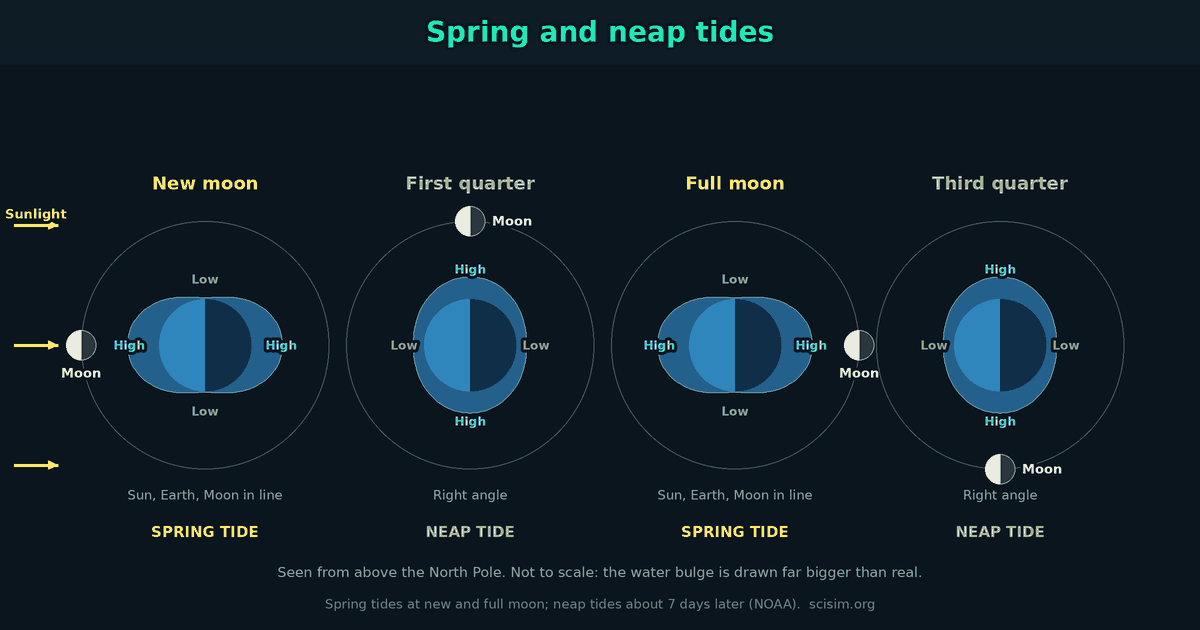
At new and full moon the Sun, Earth and Moon are in one line, so the two tides add up (NOAA).
Which tides have the smallest difference between high tide and low tide?
Neap tides come at first and third quarter moon, when the Sun and Moon are at right angles.
In the lab the Sun’s pull is off and your beach is a quarter turn away from the Moon. What is the tide?
A quarter turn from the Moon puts your beach between the two bulges: low tide.
What is the tidal range?
Tidal range is how far the water level goes up or down between low tide and high tide.
Besides the Moon, which object pulls on the oceans to make tides?
The Sun’s tide-generating force is about half the Moon’s (NOAA).
Your beach has just turned into the bulge of water under the Moon. What happens to the sea there?
Turning into a bulge brings deeper water to your beach: high tide.
Why is there a high tide on the side of Earth away from the Moon?
NOAA: on the far side the Moon’s attraction is less because it is farther away; inertia exceeds it and a second bulge forms.
Why does high tide come about 50 minutes later each day?
The Moon orbits in the same direction that Earth spins, so a lunar day is 24 hours 50 minutes (NOAA).
How long is a lunar day (also called a tidal day)?
A lunar day is the time for one place on Earth to turn from under the Moon back to under the Moon (NOAA).
The Sun, Earth and Moon are in one line. What tides follow?
In line, the Sun’s tide adds to the Moon’s: extra-high highs and very low lows (NOAA).
At first quarter moon, how are the Sun and the Moon placed as seen from Earth?
At the quarter moons the Sun’s tide partly cancels the Moon’s: neap tides.
About how many days pass from a spring tide to the next neap tide?
NOAA: a neap tide comes seven days after a spring tide.
Compared with the Moon, how strong is the Sun’s tide-generating force?
The Sun is far more massive but 390 times farther away, so its tide is about half the Moon’s (NOAA).
How long does the water take to go from high tide to low tide?
NOAA: six hours and 12.5 minutes from high to low, and the same back.
How many times in one lunar month do spring tides come?
NOAA: each lunar month has two sets of spring tides and two sets of neap tides.
High tide is at 3:00 PM today. About when is the matching high tide tomorrow?
A lunar day is 24 h 50 min, so the same tide comes about 50 minutes later.
In the lab you switch off the Sun’s pull. What changes in the Month view?
Spring and neap tides come from the Sun’s tide adding to or cancelling the Moon’s.
What is true about the bulge of water drawn in the lab?
The picture is labeled as not to scale. In the open ocean tides are usually 1 metre or less (NOAA).
How does the tide-generating force change with distance?
NOAA: tide-generating forces vary inversely as the cube of the distance; gravity itself varies with the square.
The Sun has 27 million times the Moon’s mass and is 390 times farther away (390³ ≈ 59 million). How big is the Sun’s tide compared with the Moon’s?
Mass raises the tide, distance cubed lowers it: 27 million ÷ 59 million ≈ 0.46 (NOAA: about half).
In the lab’s simple model the Moon’s tide is 1.00 and the Sun’s is 0.46. How does the spring range compare with the neap range?
Spring: 1 + 0.46 = 1.46. Neap: 1 − 0.46 = 0.54. 1.46 ÷ 0.54 ≈ 2.7. Real coasts differ.
NOAA calls a tide pattern with one high and one low tide each lunar day:
Diurnal = one high and one low a day, as in many areas of the Gulf of Mexico (NOAA).
Which U.S. coast tends to have mixed semidiurnal tides (two high tides a day of different height)?
NOAA: the West Coast tends to have mixed semidiurnal tides; a semidiurnal pattern is more typical of the East Coast.
In September 2026 NOAA’s Pensacola station recorded 32 high tides in 30 days and Boston recorded 58. What does this show?
Pensacola, on the Gulf of Mexico, is diurnal; Boston, on the Atlantic, is semidiurnal.
Why is the tidal range in the Bay of Fundy so large?
NOAA: funnel-shaped bays can dramatically change tidal magnitude; the Bay of Fundy is the classic example, over 15 metres.
A new moon happens while the Moon is at perigee, its closest point to Earth. What tide follows?
Closer Moon, stronger tide; in line with the Sun, the tides add. NOAA calls it a perigean spring tide.
At perigee the Moon is about 363,300 km away instead of its average 384,400 km (NASA). How does the Moon’s tide-generating force change?
Cube law: (384,400 ÷ 363,300)³ ≈ 1.18.
Why do real coasts not match the ocean-covered model exactly?
NOAA: continents block the westward passage of the tidal bulges, so each ocean basin has its own pattern.
If the Moon were twice as far from Earth, its tide-generating force would be:
Cube law: 2 × 2 × 2 = 8 times weaker.
Where do tides tend to be smallest?
NOAA: mid-oceanic islands not near continental margins typically have very small tides of 1 metre or less.
Standards. Texas TEKS, grade 6, (9)(B) asks students to describe and predict how the positions of Earth, the Sun and the Moon cause the “daily, spring, and neap cycles of ocean tides” through gravity. (source: Texas Education Agency, 19 TAC Chapter 112) NGSS does not name tides in a performance expectation. Teachers usually place this lab with MS-ESS1-1 (a model of the Earth–Sun–Moon system and its cyclic patterns), MS-ESS1-2 (the role of gravity in motions in the solar system) and MS-PS2-4 (gravitational interactions depend on mass). (source: Next Generation Science Standards)
Students will
Lesson (45 min)
What each part does
Answers
Common mix-ups: spring tides are not about the season; there are two bulges, not one; the far-side bulge is not “pushed” by the Sun; real tides are later or earlier than the Moon overhead because coasts and ocean basins delay them.
Honest limits: the lab uses the simple model on an ocean-covered Earth. The metres at the beach are model units, not a forecast for a real place. For real predictions use NOAA Tides and Currents.
There are two high tides a day because the Moon’s gravity stretches the ocean into two bulges: one on the side of Earth facing the Moon and one on the far side. Earth turns through both bulges every 24 hours 50 minutes, so most coasts get a high tide about every 12 hours 25 minutes (NOAA).
Questions in this lab: Why does the sea go in and out? · Why are there two high tides a day? · Why are some tides bigger? · Do real coasts match the simple model?
Activities in this lab: Tide Predictor: can you call the tide from the Moon? · Harbour Pilot: when can the ship come in? · Build the diagram: can you make a spring tide and a neap tide? · Tide Detective: can you find spring tides in real tide data?
A tide is the regular rise and fall of the sea, caused mostly by the Moon’s gravity. The Moon pulls the ocean into a bulge of water. Earth spins, so your beach turns into the bulge (the water comes in: high tide) and out of it again (the water goes out: low tide). In 1687 Isaac Newton explained that ocean tides come from the gravitational pull of the Sun and the Moon on the oceans. (source: NOAA National Ocean Service, What Causes Tides?)
“High tides occur 12 hours and 25 minutes apart.”
▶ Try it in the lab: question 1, Why does the sea go in and out?
There are two high tides a day because there are two bulges of water, on opposite sides of Earth. On the side facing the Moon, the Moon’s gravity is strongest and pulls the water toward the Moon. On the far side the Moon’s pull is weakest; there inertia wins and the water bulges away from the Moon. (source: NOAA National Ocean Service, Gravity, Inertia, and the Two Bulges) Earth turns through both bulges, so most coasts get two high tides and two low tides every 24 hours and 50 minutes. (source: NOAA National Ocean Service, The Lunar Day)
In the lab this is the surprise: predict what happens at your beach when the Moon goes to the far side of Earth, then test it. NASA describes the same thing: the oceans bulge on the side closest to the Moon and on the side farthest from it. (source: NASA Science, Tides)
High tide is when the sea reaches its highest level on the shore; low tide is when it reaches its lowest. The difference in height between them is called the tidal range. The water takes about 6 hours and 12.5 minutes to go from high tide to low tide, and the same time to come back. (source: NOAA National Ocean Service, The Lunar Day)
| High tide | Low tide | |
|---|---|---|
| Water level | Highest on the shore | Lowest on the shore |
| Where your beach is | Inside one of the two bulges | Between the two bulges |
| Moon in the simple model | Overhead, or on the opposite side of Earth | A quarter turn away |
| How often (most coasts) | Every 12 h 25 min | Every 12 h 25 min |
The metres and feet shown at “your beach” in the lab are model units for a sample coast. Real ranges are very different from place to place: mid-ocean islands far from continents usually have small tides of 1 metre or less. (source: NOAA National Ocean Service, What Affects Tides in Addition to the Sun and Moon?)
▶ Try it in the lab: watch the beach while you drag the Moon
Spring tides are the tides with the biggest range, and neap tides are the tides with the smallest range. The Sun also raises tides, about half as large as the Moon’s. (source: NOAA National Ocean Service, Tidal Variations) At new moon and full moon the Sun, Earth and Moon are in one line, so the Sun’s tide adds to the Moon’s: extra-high high tides and very low low tides. About seven days later the Sun and the Moon are at right angles; the Sun’s tide partly cancels the Moon’s and the range is small. (source: NOAA, What are spring and neap tides?)
| Spring tide | Neap tide | |
|---|---|---|
| Moon phase | New moon and full moon | First quarter and third quarter |
| Sun, Earth and Moon | In one line | At right angles |
| Tidal range | Largest: higher high tides, lower low tides | Smallest: moderate tides |
| How often | Twice each lunar month | Twice each lunar month |
| Height of high tide in the lab’s simple model (Moon’s tide = 1) | 1 + 0.46 = 1.46 | 1 − 0.46 = 0.54 |
The name has nothing to do with the season; it comes from the tide springing up. The Moon goes from new moon to new moon in about 29.5 days, (source: NASA Science, Moon Phases) so spring tides come about two weeks apart. More on the phases themselves: Moon Phases 3D model. The same line-up of Sun, Earth and Moon also sets up solar and lunar eclipses.
▶ Try it in the lab: question 3, Why are some tides bigger? (Month view)
Tides are about 50 minutes later each day because a lunar day is longer than a 24-hour solar day. A lunar day is the time for one place on Earth to turn from under the Moon back to under the Moon: 24 hours and 50 minutes. The Moon moves along its orbit in the same direction that Earth spins, so Earth needs about 50 extra minutes to catch up. (source: NOAA National Ocean Service, The Lunar Day)
Example: if high tide is at 3:00 PM today, the matching high tide tomorrow is at about 3:50 PM. In the lab, press Play and watch the “Now” marker and the clock times of the highs on the tide curve.
Some places have only one high tide a day because the continents get in the way of the tidal bulges. On an Earth covered by ocean, every coast would get two equal high tides each lunar day. Real continents block the bulges, so each ocean basin makes its own pattern. NOAA names three: semidiurnal (two high tides a day of about the same height, typical of the U.S. East Coast), mixed semidiurnal (two high tides of different height, typical of the U.S. West Coast) and diurnal (one high and one low tide a day, as in many parts of the Gulf of Mexico). (source: NOAA National Ocean Service, Types and Causes of Tidal Cycles)
| Station | Coast | Pattern in this month | High tides in 30 days | Mean range |
|---|---|---|---|---|
| Boston, MA | Atlantic | Semidiurnal | 58 | 2.89 m (9.5 ft) |
| Eastport, ME | Atlantic, near the Bay of Fundy | Semidiurnal | 58 | 5.59 m (18.3 ft) |
| San Francisco, CA | Pacific | Mixed semidiurnal | 58 | 1.25 m (4.1 ft) |
| Pensacola, FL | Gulf of Mexico | Diurnal | 32 | 0.36 m (1.2 ft) |
| Anchorage, AK | Pacific, Cook Inlet | Semidiurnal | 58 | 7.98 m (26.2 ft) |
Pattern and number of high tides: counted from each station’s own list of high and low waters. Mean range: the station’s NOAA tidal datum (mean high water minus mean low water). (source: NOAA CO-OPS tide stations, verified water levels, 1–30 September 2026)
At Boston the biggest daily ranges of that month came on 9–12 and 28–30 September; the new moon was on 10 September and the full moon on 26 September (Boston time). That is the spring–neap cycle in real data. Tides are one way the ocean moves; winds and density drive another: ocean currents.
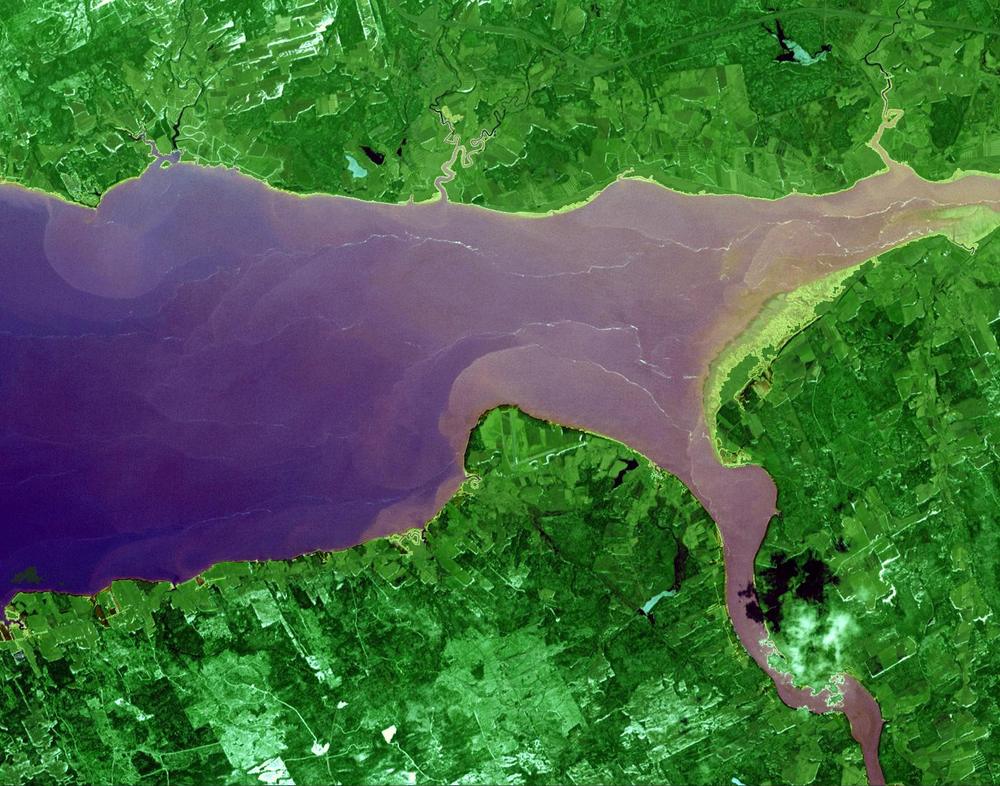
The highest tides in the world are in Canada’s Bay of Fundy, between New Brunswick and Nova Scotia. (source: NOAA, Where is the highest tide?) Funnel-shaped bays make tides much bigger, and the Bay of Fundy is the classic example: NOAA gives its range as over 15 metres, (source: NOAA National Ocean Service, What Affects Tides in Addition to the Sun and Moon?) and NASA says that at the head of the bay high tide can be as much as 17 metres (about 56 feet) above low tide. (source: NASA Earth Observatory, High and Low Tides in Bay of Fundy) The highest tides in the United States are near Anchorage, Alaska, where the range averages around 30 feet. (source: NOAA, Where is the highest tide?)
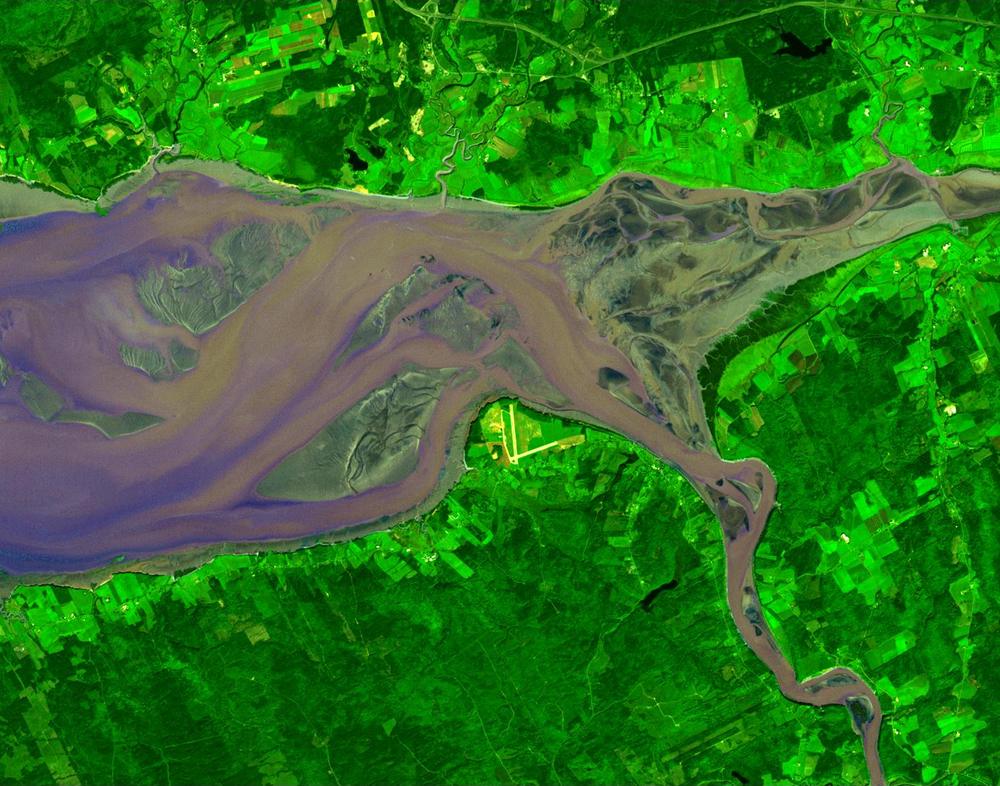
Images: NASA Earth Observatory, ASTER instrument on the Terra satellite (NASA/GSFC/METI/ERSDAC/JAROS and U.S./Japan ASTER Science Team). Vegetation is green; water is dark blue to light purple.
▶ Try it in the lab: question 4, flip between high and low tide in the Bay of Fundy
The Challenges tab has four activities. Each one uses the same model as the lab, and the last one uses real data.
Yes. The Sun’s tide-generating force is about half the Moon’s. Gravity gets weaker with the square of distance, but the tide-generating force gets weaker with the cube of distance, because a tide comes from the difference in pull between the near side and the far side of Earth. (source: NOAA National Ocean Service, What Causes Tides?)
Worked example (NOAA’s numbers):
The Moon’s distance matters too. The Moon is on average 384,400 km from Earth. (source: NASA Science, Moon Facts) At its closest point (perigee) it is about 363,300 km away and at its farthest (apogee) about 405,500 km. (source: NASA Science, Supermoons) Cube law: (384,400 ÷ 363,300)³ ≈ 1.18, so at perigee the Moon’s tide is about 18 % stronger than average; at apogee (384,400 ÷ 405,500)³ ≈ 0.85, about 15 % weaker. When a new or full moon comes close to perigee, the range is larger than usual: NOAA calls this a perigean spring tide. (source: NOAA, What is a perigean spring tide?) In the lab, open question 3 and use the Moon near / far buttons.
The pull that holds the Moon in its orbit is the same force: gravitation.
▶ Try it in the lab: question 3, switch the Sun’s pull off and move the Moon nearer
Most coasts have two high tides and two low tides every lunar day, which is 24 hours and 50 minutes (NOAA). Some places, such as many parts of the Gulf of Mexico, have only one high tide and one low tide a day.
Key takeaway: Usually two; in some places one.Both do. The Moon is the main cause because it is so close to Earth. The Sun is far more massive but about 390 times farther away, so its tide-generating force is about half the Moon’s (NOAA).
Key takeaway: Mostly the Moon; the Sun adds about half as much.No. Spring tides happen twice every lunar month, at new moon and at full moon, in every season. The word comes from the tide springing up, not from the season (NOAA).
Key takeaway: Spring tides come at every new and full moon.About 6 hours and 12.5 minutes on coasts with two high tides a day. High tides are 12 hours and 25 minutes apart (NOAA).
Key takeaway: High to low: about 6 h 12 min.Because the Moon moves along its orbit while Earth spins. Earth needs about 50 extra minutes each day to bring the same place back under the Moon, so a lunar day lasts 24 hours and 50 minutes (NOAA).
Key takeaway: About 50 minutes later each day.King tide is a popular name for a spring tide (NOAA). The range is larger still when a new or full moon comes close to perigee, the Moon’s closest point to Earth; NOAA calls that a perigean spring tide.
Key takeaway: A popular name for an extra-large spring tide.No. The lab draws the bulge much bigger than real so you can see it, and says so on the picture; the “Thinner bulge” switch draws it much thinner, but even that is far thicker than the real bulge. In the open ocean, far from continents, tides are usually 1 metre or less (NOAA).
Key takeaway: The bulge is drawn far larger than real.In the Bay of Fundy in Canada. NOAA gives the range as over 15 metres; NASA says high tide at the head of the bay can be as much as 17 metres above low tide.
Key takeaway: Bay of Fundy, Canada.How the model works: the lab uses the “equilibrium tide” on an Earth covered by ocean: the water height at your beach is the Moon’s tide plus 0.46 times the Sun’s tide. It is the standard first model, and it is why question 4 compares it with real stations.