Solar and Lunar Eclipses: Interactive 3D Simulator & Diagram
Grades 6–8 · MS-ESS1-1
Line up the Sun, Moon and Earth to turn day into night, turn the Moon red and find real eclipses.

Quiz questions with explanations
Easy
During a solar eclipse, what blocks the Sun?
- Earth
- Another planet
- A big cloud
- The Moon
Why: The Moon passes between the Sun and Earth, so its shadow falls on Earth.
During a lunar eclipse, whose shadow falls on the Moon?
- A cloud’s
- The Moon’s own
- The Sun’s
- Earth’s
Why: Earth is between the Sun and the Moon, so Earth’s shadow falls on the Moon.
At which phase of the Moon can a solar eclipse happen?
- Any phase
- Full moon
- New moon
- First quarter
Why: Only at new moon is the Moon between the Sun and Earth.
At which phase of the Moon can a lunar eclipse happen?
- Any phase
- Full moon
- Third quarter
- New moon
Why: Only at full moon is the Moon on the far side of Earth, where Earth’s shadow points.
Which eclipse is safe to watch with your eyes alone?
- A lunar eclipse
- A ring of fire (annular) eclipse
- A partial solar eclipse
- Any solar eclipse, if you wear sunglasses
Why: A lunar eclipse is just the Moon getting darker, so it is safe to watch. A partly covered Sun can hurt your eyes, and sunglasses are not safe (NASA).
What color does the Moon often turn during a total lunar eclipse?
- It disappears completely
- Bright blue
- Copper-red
- Green
Why: Sunlight bent through Earth’s air still reaches the Moon. The air takes out most of the blue light, as at sunset.
What is the dark middle part of a shadow called?
- The penumbra
- The umbra
- The orbit
- The corona
Why: In the umbra all of the light source is hidden. The lighter penumbra around it hides only part of it.
Who can see a total solar eclipse?
- Everyone on the night side of Earth
- Everyone on the day side of Earth
- Only people inside the narrow path of the Moon’s dark shadow
- Only people at the equator
Why: The Moon’s dark shadow is small when it reaches Earth. People outside the path see a partial eclipse or nothing.
Who can see a total lunar eclipse?
- Only astronauts
- Only people near the poles
- Only people in a narrow path
- Everyone on the side of Earth where the Moon is up
Why: The Moon itself gets dark, so anyone who can see the Moon can see the eclipse.
What can you see around the Moon during a total solar eclipse?
- Earth’s shadow
- The far side of the Moon
- The Sun’s core
- The Sun’s corona, its thin outer atmosphere
Why: With the bright face of the Sun covered, the faint pearly corona becomes visible.
About how many times wider is Earth than the Moon?
- About 3.7 times
- About 400 times
- About 10 times
- About 50 times
Why: Earth is 12,742 km across and the Moon 3,474.8 km (NASA fact sheets): 3.67 times.
Medium
Why isn’t there an eclipse at every new moon and full moon?
- The Sun is much too far away for the Moon’s shadow to reach us
- The Moon is too small to block the Sun most months
- The Moon’s orbit is tilted about 5° to Earth’s orbit
- Earth’s air blurs the shadow away in most months
Why: Most months the Moon passes above or below the Sun–Earth line, by up to about 34,500 km, so the shadows miss.
What is an annular (ring of fire) eclipse?
- A lunar eclipse where a thin ring of red light glows all around the edge of the Moon
- A partial solar eclipse seen at sunset, when the low Sun looks bitten and flat
- A solar eclipse watched from the Moon, where Earth looks like a glowing ring
- A solar eclipse where the Moon looks smaller than the Sun and a bright ring stays
Why: The Moon covers the middle of the Sun but not its edge, so a ring of sunlight stays.
When does a ring of fire happen instead of a total solar eclipse?
- Only in winter, when the Sun is low in the sky
- When the Moon is far enough away to look smaller than the Sun
- When the Moon is close enough to look bigger than the Sun
- When thin clouds cover the middle of the Sun
Why: Farther away, the Moon looks smaller than the Sun. Even at its average distance it looks 31.6′ wide from right under it, a little less than the Sun’s 32.0′ (Sun at its average distance).
How often do eclipse seasons come?
- About every 173 days, about twice a year
- Every 4 years, in each leap year
- Every month, at each new moon and full moon
- Once every 18 years, in each saros cycle
Why: The Sun lines up with the Moon’s node line twice in each eclipse year of 346.6 days.
A solar eclipse covers 99 % of the Sun where you are. Is it safe to look without eclipse glasses?
- Yes, if you wear very dark sunglasses
- No, even 1 % of the Sun is far too bright
- Yes, if you squint and look only briefly
- Yes, 99 % covered is almost the same as total
Why: Only totality is safe to watch with bare eyes. Before and after, use ISO 12312-2 eclipse glasses or a pinhole projector (NASA).
On 2 Aug 2027, Luxor (Egypt) gets about 6 min 20 s of totality but Riyadh only a partial eclipse (76 %). Why?
- Riyadh is outside the narrow path of the Moon’s dark shadow
- Riyadh is farther from the Sun than Luxor is that day
- The Moon looks smaller from Riyadh because it is farther north
- Riyadh is on the night side of Earth at that moment
Why: The path of totality is only about 260 km wide; Riyadh is far to the side of it, in the Moon’s lighter shadow.
Which of these is NOT a kind of lunar eclipse?
- Annular
- Partial
- Total
- Penumbral
Why: Earth’s shadow is always much wider than the Moon, so a lunar eclipse never makes a ring.
Does Earth’s shadow cause the Moon’s phases?
- Only the crescent phases, when the shadow is biggest
- No, phases come from how much of the Moon’s sunlit half we see
- Yes, Earth’s shadow slowly covers part of the Moon every single month
- Only in winter, when Earth’s shadow is longest
Why: Earth’s shadow points away from the Sun and touches the Moon only during a lunar eclipse, at full moon.
How many solar eclipses happen somewhere on Earth in one calendar year?
- 2 to 5
- 0 or 1
- Exactly 1
- About 12
Why: NASA’s Five Millennium Catalog: every calendar year has at least two and at most five solar eclipses (2029 has four).
Why is Earth’s shadow on the Moon always curved during a partial lunar eclipse?
- The Moon’s surface is curved
- The Sun moves in a circle
- Earth is round
- Earth’s air bends the shadow
Why: Only a sphere casts a round shadow from every direction. Aristotle used this as evidence that Earth is round.
Which 2029 date has a total lunar eclipse?
- 12 June 2029
- 14 January 2029
- 11 July 2029
- 26 June 2029
Why: NASA’s list: partial solar eclipses on 14 Jan, 12 Jun, 11 Jul and 5 Dec 2029; total lunar eclipses on 26 Jun and 20 Dec.
Hard
At average distances, about how long is the Moon’s dark shadow (umbra)?
- About 1.4 million km
- About 150 million km
- About 38,000 km
- About 373,600 km
Why: Similar triangles: (149.6 million − 384,400) × 1,737.4 ÷ (695,700 − 1,737.4) ≈ 373,600 km.
With the Sun at its average distance, the Moon’s centre must be closer than about what to give a total eclipse for a person right under it?
- About 380,000 km
- About 356,000 km
- About 1.38 million km
- About 405,500 km
Why: The shadow must reach the person, who stands 6,371 km closer than Earth’s centre: about 373,600 + 6,371 ≈ 380,000 km.
The Moon’s orbit is tilted 5.145°. How far above or below the Sun–Earth line can the Moon pass?
- About 6,400 km
- About 34,500 km
- About 345,000 km
- About 3,500 km
Why: 384,400 km × sin 5.145° ≈ 34,500 km, almost three Earth widths, so most months the shadows miss.
What is the saros cycle?
- The few weeks of one eclipse season, when eclipses are possible
- The 29.5-day lunar month from one new moon to the next new moon
- About 18 years 11 days, after which a very similar eclipse comes again
- The 346.6-day eclipse year, after which the Sun comes back to the same node
Why: 6,585.32 days: the long total eclipses of 2 Aug 2027 and 12 Aug 2045 are one saros apart.
Why can about half of Earth see a lunar eclipse, but only a narrow path a total solar eclipse?
- In a lunar eclipse the Moon itself goes dark; in a solar one you must stand in its small shadow
- Earth turns only during lunar eclipses, which carries every place into the shadow
- Lunar eclipses last many hours, so Earth turns far enough to carry every single place past the shadow
- The Moon is brighter than the Sun, so its eclipses can be seen from much farther away
Why: Earth’s shadow at the Moon is about 9,350 km across, much wider than the Moon, but the Moon’s dark shadow is at most about 270 km across.
What does the Danjon scale describe?
- How wide the path of totality is on the ground during a solar eclipse
- How long the total phase of a solar eclipse lasts at one place
- How bright and how big the corona looks during totality
- How dark and what color the Moon is during a total lunar eclipse
Why: It runs from L = 0 (very dark, the Moon almost invisible) to L = 4 (bright copper-red or orange), and depends on dust and clouds in Earth’s air (NASA).
For a solar eclipse somewhere on Earth, the new moon must come within about 16.7° of a node (average distances). What is this angle called?
- The angle of totality
- The saros angle
- The tilt of the orbit
- The ecliptic limit
Why: Beyond it the Moon’s lighter shadow misses Earth. For an umbral lunar eclipse the limit is smaller, about 10.7°.
Why do eclipse seasons come about 19 days earlier each year?
- Because every fourth year is a leap year with one extra day in February
- The Moon’s node line turns slowly westward, so the Sun meets a node every 346.6 days
- Because Earth’s orbit is an ellipse, so Earth moves faster in January than in July
- Because the Moon moves about 3.8 cm farther from Earth every year
Why: Because the node line turns, the Sun meets the same node every 346.6 days, about 19 days less than a calendar year (365.24 − 346.62).
What is a hybrid solar eclipse?
- A solar eclipse and a lunar eclipse that happen on the very same day
- An eclipse seen on another planet, such as Mars or Jupiter
- A partial eclipse that is seen from two different places at once
- Total along part of its path and a ring of fire along the rest
Why: The tip of the Moon’s shadow just reaches Earth’s surface along part of the path. The next one is on 14 Nov 2031 (NASA).
Laser ranging shows the Moon moving away from Earth by about 3.8 cm a year. What will this do to eclipses in the very far future?
- Nothing will change, because 3.8 cm a year is far too small to matter
- Total solar eclipses will stop; only rings of fire will remain
- Lunar eclipses will stop, because Earth’s shadow will no longer reach the Moon
- Eclipses will happen every month, because the orbit will flatten
Why: Farther away, the Moon will look too small to cover the Sun completely (NASA: about 3.8 cm a year).
Seen from Earth’s centre, the Moon is 32.9′ wide at 363,300 km and 29.5′ at 405,500 km; the Sun is about 32.0′. What follows?
- Close: total eclipses are possible; far: only rings of fire
- The distance does not matter, because only the Sun’s size decides it
- Close: only rings of fire are possible; far: total eclipses happen
- Both distances give total eclipses, because the Moon is always big enough
Why: A total eclipse needs the Moon to look at least as big as the Sun.
Lab controls
Views
More activities
Share & teachers
scisim.org/sims/earth-space/solar_and_lunar_eclipses
Students scan it with a phone or tablet camera.
Solar and Lunar Eclipses: Interactive 3D Simulator & Diagram lesson plan
Students will
- Use a model of the Sun, Earth and Moon to explain solar and lunar eclipses.
- Explain why eclipses do not happen every month (the 5° tilt and eclipse seasons).
- Explain who on Earth can see each kind of eclipse, using real 2027 data.
Lesson
5 min · Hook: the intro + a prediction
Ask: Watch the 15-second intro. Is there an eclipse every month? Write a prediction.
Expected answer
No: only in eclipse seasons, about twice a year (students test this later).
10 min · Solar and lunar modes
Ask: Make a total solar eclipse, then a blood moon. What is in the middle each time, and what phase is the Moon?
Expected answer
Solar: the Moon in the middle, new moon. Lunar: Earth in the middle, full moon.
15 min · Activities (pairs): sort + build a model
Ask: Do “Solar or lunar?” and then “Can you build a model of both eclipses?”
Expected answer
See the activity answers below; the three-sentence explanation is the formative check.
10 min · Why not every month?
Ask: Run a year with a flat orbit, then with the real tilt. Count the eclipses on the Graph.
Expected answer
Flat: an eclipse at every new and full moon. Real 5.1°: only in two or three short seasons.
5 min · Exit ticket
Ask: Why can about half of Earth see a lunar eclipse, but only a narrow path a total solar eclipse?
Expected answer
The Moon itself goes dark in a lunar eclipse; for a total solar eclipse you must stand in the Moon’s small dark shadow (only a few hundred km across).
What each part does
- Six modes
- Always-visible list (phones: a chip row under the picture): Solar eclipse, Lunar eclipse, Why not every month?, Total or ring of fire?, Real eclipses (NASA 2026–2045) and Sizes.
- Samples
- Ready-made set-ups such as Total, Partial, Ring of fire; Flat orbit 0°; 2 Aug 2027 in Luxor.
- 3D | 2D
- 3D: the Sun, Earth and Moon with the shadow cones and the sky seen from Earth. 2D: the labeled side view with umbra and penumbra.
- Run
- Students set the sliders and press Run; the Result box shows what happened and why. Predictions are asked in the Activities tab.
- Graph
- % of the Sun covered, light during the eclipse, the Moon and the shadow at each new and full moon, the Moon’s size vs the Sun’s.
Activity answers
Solar or lunar: can you tell the difference?
Why isn’t there an eclipse every month?
Can you build a model of both eclipses?
Does Earth’s shadow cause the Moon’s phases?
Who can see a solar eclipse, and who sees a lunar one?
How close must the Moon be for a total eclipse?
Can you predict the eclipses of 2029?
Day 2: “Who can see it?” (real 2027 cities), “How close must the Moon be?” and “Can you predict the eclipses of 2029?” (high school), then the Medium or Hard quiz. Lunar eclipses are safe to watch; for a real solar eclipse, check the safety section with your class. Without 3D graphics the 2D view shows the same ideas. Each activity has its own link (Assign & share).
What is the difference between a solar and a lunar eclipse?
A solar eclipse happens when the Moon lines up between the Sun and Earth, so its shadow falls on Earth (at new moon). A lunar eclipse happens when Earth lines up between the Sun and the Moon, so Earth’s shadow falls on the Moon (at full moon). The Moon’s orbit is tilted about 5°, so most months the shadows miss.
In this lab you can
- Line up the Sun, Moon and Earth in 3D and make a total, partial or ring of fire solar eclipse, then see it from the ground with the corona and the diamond ring.
- Move the Moon into Earth’s shadow and watch it turn copper-red; change the dust in Earth’s air.
- Play a whole year with a flat orbit and with the real 5.1° tilt to see why eclipses come only in eclipse seasons.
- Find the real eclipses of 2026–2045 from NASA’s list and see what your city sees, such as about 6 min 20 s of totality in Luxor on 2 Aug 2027.
Activities in this lab: Solar or lunar: can you tell the difference? · Why isn’t there an eclipse every month? · Can you build a model of both eclipses? · Does Earth’s shadow cause the Moon’s phases? · Who can see a solar eclipse, and who sees a lunar one? · How close must the Moon be for a total eclipse? · Can you predict the eclipses of 2029?
Modes in this lab: Solar eclipse · Lunar eclipse · Why not every month? · Total or ring of fire? · Real eclipses · Sizes
On this page: Solar vs Lunar Eclipse: What’s the Difference?What Is a Solar Eclipse?What Is a Lunar Eclipse?What Is a Blood Moon?How Often Do Eclipses Happen?What Is an Annular (Ring of Fire) Eclipse?What Are the Umbra and Penumbra?When Is the Next Total Solar Eclipse?How Big Is the Moon Compared to Earth?Is It Safe to Look at a Solar or Lunar Eclipse?What Are the Types of Eclipses?Go Deeper: Saros Cycles, Eclipse Seasons and the FutureHow long is the Moon’s shadow?Myths and factsFAQSources
Solar vs Lunar Eclipse: What’s the Difference?
The difference is which body is in the middle. In a solar eclipse the Moon passes between the Sun and Earth and blocks the Sun; in a lunar eclipse Earth passes between the Sun and the Moon and its shadow darkens the Moon. A solar eclipse can only happen at new moon and a lunar eclipse only at full moon, and every calendar year has 2 to 5 solar eclipses somewhere on Earth (NASA Five Millennium Catalog of Solar Eclipses).
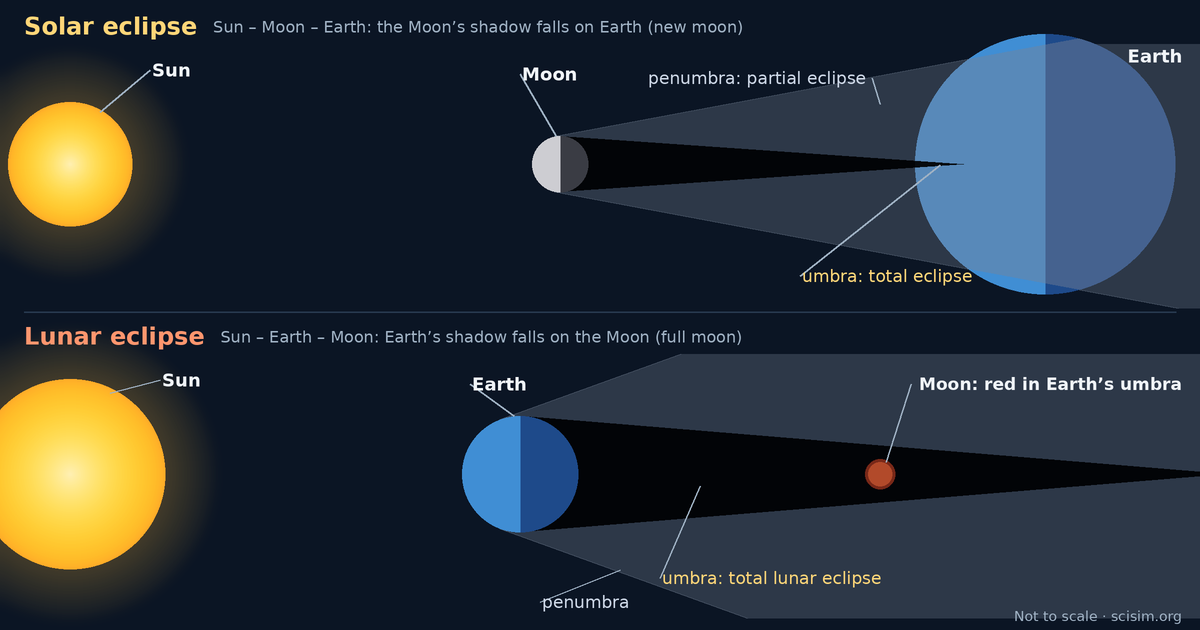
| Solar eclipse | Lunar eclipse | |
|---|---|---|
| What lines up | Sun – Moon – Earth (the Moon in the middle) | Sun – Earth – Moon (Earth in the middle) |
| Moon phase | New moon | Full moon |
| Whose shadow falls on what | The Moon’s shadow on Earth | Earth’s shadow on the Moon |
| Who can see it | Totality only in a narrow path, usually about 100–250 km wide; a partial eclipse over a wide area around it | Everyone on the side of Earth where the Moon is up |
| Longest total phase | A few minutes: 6 min 23 s on 2 Aug 2027, never more than about 7½ minutes | Over 1½ hours: 1 h 42 min on 26 Jun 2029 |
| How often | 2 to 5 a year somewhere on Earth | 2 to 4 a year in 2026–2045, counting faint penumbral ones |
| Safe to look at | Only with ISO 12312-2 eclipse glasses or a pinhole projector; bare eyes only during totality | Yes, with bare eyes, binoculars or a telescope |
| What it looks like | A bite out of the Sun, a ring of fire, or a black disc with the pearly corona | The Moon darkens and often turns copper-red |
Try it in the lab: Solar or lunar: can you tell the difference? ↑ Try it in the lab: Can you build a model of both eclipses? ↑
What Is a Solar Eclipse?
A solar eclipse happens when the Moon passes between the Sun and Earth and its shadow falls on Earth. Inside the Moon’s dark shadow, the umbra, the whole Sun is hidden: the sky turns dark, the brightest stars and planets come out and the Sun’s pearly corona appears around the black Moon. The umbra is small when it reaches Earth: at most about 270 km across. The path it sweeps over the ground is usually about 100–250 km wide, and wider where the Sun is low in the sky. On 2 August 2027 the path is about 260 km wide near Luxor, Egypt. Luxor gets about 6 minutes 20 seconds of totality; the longest, 6 min 23 s, is a little to the east (NASA eclipse list 2021–2030). Around the path, the lighter penumbra gives a partial eclipse: Riyadh sees 76 % of the Sun covered, Tunis 97 % and Dhaka only 3 %.
Totality never lasts long: at most about 7½ minutes (NASA), because the shadow races across Earth at more than 1,700 km/h.
Try it in the lab: Solar eclipse ↑ Try it in the lab: Who can see a solar eclipse, and who sees a lunar one? ↑
What Is a Lunar Eclipse?
A lunar eclipse happens when Earth passes between the Sun and the Moon, so Earth’s shadow falls on the full Moon. Earth’s dark shadow at the Moon’s distance is about 9,350 km across, more than 2½ times as wide as the Moon, which is why a lunar eclipse lasts hours: the Moon can stay fully inside it for 1 h 42 min, as on 26 June 2029 (NASA eclipse list 2021–2030). Everyone on the night side of Earth can see it, and it is safe to watch without special eyewear (NASA Scientific Visualization Studio).
Earth’s shadow does not cause the Moon’s phases: it points straight away from the Sun and touches the Moon only at full moon during an eclipse season. During a partial lunar eclipse the edge of the shadow is always curved, one of the oldest pieces of evidence that Earth is round. Compare the phases in the Moon Phases lab.
Try it in the lab: Lunar eclipse ↑ Try it in the lab: Does Earth’s shadow cause the Moon’s phases? ↑
What Is a Blood Moon?
A blood moon is the copper-red Moon of a total lunar eclipse. Even inside Earth’s dark shadow the Moon is not black, because the only sunlight left reaching it has passed through the ring of Earth’s air around the edge of our planet (NASA Scientific Visualization Studio). The air scatters most of the blue light away and bends the red light into the shadow, as at sunset. More dust or clouds in the air (after a big volcanic eruption, for example) make the Moon darker and redder; astronomers rate this on the Danjon scale from L = 0 (almost invisible) to L = 4 (bright copper-orange) (NASA). NASA’s list has 17 total lunar eclipses in 2026–2045, so a blood moon comes about once a year on average, though some years have none.
How Often Do Eclipses Happen?
Every calendar year has at least two and at most five solar eclipses somewhere on Earth (NASA Five Millennium Catalog), and NASA’s list for 2026–2045 has two to four lunar eclipses a year, counting the faint penumbral ones. They come in eclipse seasons, about twice a year: in 2029 there are four partial solar eclipses and two total lunar eclipses, in January, June–July and December (NASA eclipse list 2021–2030). Any one place sees a total solar eclipse only rarely; NASA’s list for 2026–2045 has 15 total, 16 annular, 1 hybrid and 12 partial solar eclipses.
Why don’t eclipses happen every month?
The Moon’s orbit is tilted 5.145° to Earth’s orbit (NASA Moon fact sheet), so at most new and full moons the Moon passes up to about 34,500 km above or below the Sun–Earth line and both shadows miss. The Moon crosses Earth’s orbital plane at only two points, the nodes. An eclipse needs a new or full moon close to a node, and the Sun lines up with the node line only twice in each 346.6-day eclipse year: these are the eclipse seasons, about 32–35 days long and about 173 days apart. Because the eclipse year is about 19 days shorter than a calendar year, the seasons come about 19 days earlier each year. Eclipse seasons have nothing to do with summer and winter, which come from Earth’s tilt: see the Seasons lab.
Try it in the lab: Why not every month? ↑ Try it in the lab: Why isn’t there an eclipse every month? ↑ Try it in the lab: Can you predict the eclipses of 2029? ↑
What Is an Annular (Ring of Fire) Eclipse?
An annular eclipse is a solar eclipse in which the Moon is too far from Earth to cover the whole Sun, so a bright ring of sunlight, the “ring of fire”, stays around the Moon. The Moon’s distance changes during each orbit, from about 363,300 km at mean perigee to 405,500 km at mean apogee (NASA Moon fact sheet). Seen from Earth it looks from about 29.5 to 32.9 arcminutes wide (an arcminute is 1/60 of a degree), while the Sun looks from 31.5 to 32.5 (NASA Sun fact sheet). At its average distance of 384,400 km the Moon looks 31.6 arcminutes wide even from right under it, a little smaller than the Sun’s 32.0 at its average distance: such an eclipse is a ring of fire. The next one is on 6 February 2027.
Even the thinnest ring of fire is still part of the Sun’s bright face, so an annular eclipse is never safe to look at without eclipse glasses.
Try it in the lab: Total or ring of fire? ↑ Try it in the lab: How close must the Moon be for a total eclipse? ↑
What Are the Umbra and Penumbra?
The umbra is the dark inner part of a shadow, where the light source is completely hidden; the penumbra is the lighter outer part, where only some of it is hidden. A wide light source such as the Sun always makes both: sunlight comes from every point of the Sun’s disc, so behind the Moon the rays form a dark cone that narrows to a tip, inside a lighter cone that widens. Standing in the Moon’s umbra you see a total eclipse, in the penumbra a partial one; beyond the umbra’s tip, in the antumbra, you see a ring of fire. At average distances the Moon’s umbra is about 373,600 km long, just short of Earth’s surface, while Earth’s much longer umbra reaches about 1.4 million km into space (calculated from the sizes and distances in the NASA fact sheets (NASA Sun fact sheet)).
When Is the Next Total Solar Eclipse?
The next total solar eclipse is on 2 August 2027; its path of totality crosses Morocco, Spain, Algeria, Libya, Egypt, Saudi Arabia, Yemen and Somalia (NASA eclipse list). The longest totality of 2026–2045 is the 2 August 2027 eclipse, with 6 min 23 s on the centre line in Egypt. The next total solar eclipse seen from the United States is on 30 March 2033 (Utqiagvik, Alaska), and the lower 48 states see one on 23 August 2044. The lab’s Real eclipses mode shows every eclipse of 2026–2045 and what your city sees.
| Date | Type | Longest totality | Path of totality crosses |
|---|---|---|---|
| 2 Aug 2027 | Total | 6 min 23 s | Morocco, Spain, Algeria, Libya, Egypt, Saudi Arabia, Yemen, Somalia |
| 22 Jul 2028 | Total | 5 min 10 s | Australia, N.Z. |
| 25 Nov 2030 | Total | 3 min 44 s | Botswana, S. Africa, Australia |
| 14 Nov 2031 | Hybrid (total and annular) | 1 min 08 s | Pacific, Panama |
| 30 Mar 2033 | Total | 2 min 37 s | e Russia, Alaska |
| 20 Mar 2034 | Total | 4 min 09 s | Nigeria, Cameroon, Chad, Sudan, Egypt, Saudi Arabia, Iran, Afghanistan, Pakistan, India, China |
| 2 Sep 2035 | Total | 2 min 54 s | China, Korea, Japan, Pacific |
| 13 Jul 2037 | Total | 3 min 58 s | Australia, New Zealand |
When is the next lunar eclipse?
The next lunar eclipse is on 20 February 2027 (penumbral), and the next total lunar eclipse, a blood moon, is on 31 December 2028 (NASA lunar eclipse list).
| Date | Type | Total phase | Seen from |
|---|---|---|---|
| 20 Feb 2027 | Penumbral | – | Americas, Europe, Africa, Asia |
| 18 Jul 2027 | Penumbral | – | e Africa, Asia, Australia, Pacific |
| 17 Aug 2027 | Penumbral | – | Pacific, Americas |
| 12 Jan 2028 | Partial | – (partial 56 min) | Americas, Europe, Africa |
| 6 Jul 2028 | Partial | – (partial 2 h 21 min) | Europe, Africa, Asia, Australia |
| 31 Dec 2028 | Total (blood moon) | 1 h 11 min | Europe, Africa, Asia, Australia, Pacific |
How Big Is the Moon Compared to Earth?
The Moon is about a quarter as wide as Earth: 3,474.8 km across against Earth’s 12,742 km, so 3.7 Moons would fit across Earth (NASA Moon fact sheet). It is also far away: about 30 Earths would fit in the 384,400 km between them. The Sun is about 400 times wider than the Moon but also about 390 times farther away, which is why the two look almost the same size in our sky, and why total eclipses are possible at all. Compare many more sizes in the Scale of the Universe lab.
| Earth | Moon | |
|---|---|---|
| Diameter | 12,742 km | 3,474.8 km (Earth is 3.7 times wider) |
| Gravity at the surface | 1 g (9.8 m/s²) | 0.165 g (1.62 m/s²) |
| Distance between them | 384,400 km on average, about 30 Earths lined up (363,300–405,500 km at mean perigee and apogee) | |
| Air | Yes: it bends sunlight into Earth’s shadow and turns the eclipsed Moon red | No: the sky on the Moon is black even in daytime |
Is It Safe to Look at a Solar or Lunar Eclipse?
A lunar eclipse is completely safe to watch with bare eyes, binoculars or a telescope. A solar eclipse is not: before and after totality, and during a partial or annular eclipse, look at the Sun only through eclipse glasses or handheld solar viewers that meet the ISO 12312-2 standard, or watch the projected image from a pinhole projector with the Sun behind you (NASA).
“regular sunglasses, no matter how dark, are not safe for viewing the Sun”
Only during totality, when the Moon completely covers the Sun’s bright face, is it safe to look with bare eyes; put the glasses back on as soon as the first bright bead of sunlight returns. Children should watch with an adult. Never look at the Sun through a camera, telescope or binoculars without a proper solar filter on the front.
What Are the Types of Eclipses?
There are four types of solar eclipse (total, annular, partial and hybrid) and three types of lunar eclipse (total, partial and penumbral) (NASA solar eclipse types)(NASA lunar eclipse list). The type depends on which part of the shadow falls where: the dark umbra, the lighter penumbra or, for a ring of fire, the antumbra beyond the umbra’s tip.
| Type | What happens | Next one |
|---|---|---|
| Total solar | The Moon covers the whole Sun; day turns into night in a narrow path | 2 Aug 2027 |
| Annular solar (ring of fire) | The Moon is too far away to cover the whole Sun; a bright ring stays | 6 Feb 2027 |
| Partial solar | Only the Moon’s lighter shadow touches Earth; the Sun looks bitten | 14 Jan 2029 |
| Hybrid solar | Total along part of the path, a ring of fire along the rest | 14 Nov 2031 |
| Total lunar (blood moon) | The whole Moon is inside Earth’s dark shadow and turns copper-red | 31 Dec 2028 |
| Partial lunar | Part of the Moon enters Earth’s dark shadow | 12 Jan 2028 |
| Penumbral lunar | The Moon passes only through Earth’s lighter shadow and dims a little | 20 Feb 2027 |
Go Deeper: Saros Cycles, Eclipse Seasons and the Future
Saros cycles, the eclipse year, the Danjon scale and why total eclipses will end (high school)
Saros: after 6,585.32 days (18 years 11 days 8 hours) the Sun, Moon and node line return to almost the same arrangement, so a very similar eclipse happens again, about a third of the way around Earth to the west (NASA). The long total eclipses of 2 August 2027 and 12 August 2045 are one saros apart.
Eclipse year: the Sun returns to the same node every 346.62 days because the node line turns westward once every 18.6 years. Two eclipse seasons fit in each eclipse year, 173.3 days apart.
Ecliptic limits: with average distances, a solar eclipse happens somewhere on Earth if a new moon falls within about 16.7° of a node; an umbral lunar eclipse needs a full moon within about 10.7° (calculated in this lab from the NASA fact sheet values). An eclipse season is longer than a month, so every season has at least one solar eclipse.
The far future: laser ranging shows the Moon moving away from Earth by about 3.8 cm a year (NASA). In the very far future it will look too small to cover the Sun, and only rings of fire will remain.
How this lab calculates: every eclipse type, % covered and shadow width comes from the true sizes and distances; the 3D picture only squeezes them so they fit on the screen. Real dates come from NASA’s eclipse list (Fred Espenak, NASA GSFC); times and city views from Astronomy Engine (Astronomy Engine), checked against NASA for all 89 eclipses of 2026–2045.
Key terms
- Umbra
- The dark inner part of a shadow, where the light source is completely hidden.
- Penumbra
- The lighter outer part of a shadow, where the light source is only partly hidden.
- Antumbra
- The region beyond the tip of the umbra, where the Moon looks smaller than the Sun and a ring of fire is seen.
- Corona
- The Sun’s thin outer atmosphere, seen as a pearly glow during totality.
- Totality
- The time during which the Sun or the Moon is completely inside the dark shadow.
- Annular eclipse
- A solar eclipse in which a bright ring of the Sun stays around the Moon.
- Node
- One of the two points where the Moon’s tilted orbit crosses the plane of Earth’s orbit.
- Eclipse season
- The few weeks, about twice a year, when the Sun is close enough to a node for eclipses to happen.
- New moon
- The phase when the Moon is between the Sun and Earth and its dark side faces us.
- Full moon
- The phase when the Moon is on the far side of Earth from the Sun and fully lit.
How long is the Moon’s shadow?
Whether you see a total eclipse or a ring of fire depends on whether the tip of the Moon’s dark shadow reaches you. Its length follows from similar triangles, with the sizes from the NASA fact sheets (NASA Sun and Moon fact sheets):
- Draw it: the dark shadow is a cone. Its edges touch the Sun’s edge and the Moon’s edge and meet at the tip, a distance L behind the Moon.
- Similar triangles: L ÷ Moon radius = (Sun–Moon distance + L) ÷ Sun radius, so L = Sun–Moon distance × Moon radius ÷ (Sun radius − Moon radius).
- Put in the numbers: at new moon the Moon is 149.6 million − 384,400 km from the Sun; L = 149,215,600 × 1,737.4 ÷ (695,700 − 1,737.4) ≈ 373,600 km.
- Compare: a person right under the Moon is 384,400 − 6,371 = 378,029 km from it, farther than 373,600 km: the tip falls short and the person sees a ring of fire.
- The limit: the shadow reaches the person only if the Moon’s centre is closer than about 373,600 + 6,371 ≈ 380,000 km from Earth’s centre.
- Check it with sizes: from right under the Moon at 384,400 km, the Moon looks 31.6′ wide and the Sun 32.0′, so the Moon is slightly too small: a ring of fire, as the lab shows.
Myths and facts
Myth: There is an eclipse every month.
Fact: The Moon’s orbit is tilted 5.1°, so the shadows usually miss; eclipses come only in short eclipse seasons, about twice a year.
Myth: The Moon’s phases are caused by Earth’s shadow.
Fact: Phases come from how much of the Moon’s sunlit half we see. Earth’s shadow falls on the Moon only during a lunar eclipse, at full moon.
Myth: Everyone on the day side of Earth sees a total solar eclipse.
Fact: Only people in the narrow path of the Moon’s dark shadow, usually about 100–250 km wide, see totality; others see a partial eclipse or nothing.
Myth: During a total lunar eclipse the Moon turns black and disappears.
Fact: It usually glows copper-red: sunlight bent through Earth’s air still reaches it.
Myth: Sunglasses are fine for watching a nearly total solar eclipse.
Fact: Even a thin crescent of the Sun can hurt your eyes. Use ISO 12312-2 eclipse glasses or a pinhole projector (NASA).
Frequently asked questions
When was the last total solar eclipse?
The last total solar eclipse was on 12 August 2026; its path of totality crossed the Arctic, Greenland, Iceland and Spain (NASA). The next one is on 2 August 2027.
How long does a solar eclipse last?
The partial phases take about two to three hours from the first bite to the last. Totality lasts only a few minutes: on 2 August 2027 up to 6 min 23 s, the longest of 2026–2045, and never more than about 7½ minutes (NASA).
How long does a lunar eclipse last?
Several hours. In 2026–2045 the Moon spends up to 3 h 51 min partly or fully inside Earth’s dark shadow (7 Aug 2036) and is completely inside it for up to 1 h 42 min (26 Jun 2029), according to NASA’s list.
What phase is the Moon in during an eclipse?
A solar eclipse always happens at new moon, when the Moon is between the Sun and Earth. A lunar eclipse always happens at full moon, when the Moon is on the far side of Earth from the Sun.
What is the path of totality?
It is the narrow strip of Earth’s surface swept by the Moon’s dark shadow, where a total solar eclipse is seen. The shadow itself is at most about 270 km across, and the path is usually about 100–250 km wide; it is wider where the Sun is low (about 300 km on 12 August 2026). On 2 August 2027 it is about 260 km wide near Luxor.
What is a penumbral lunar eclipse?
The Moon passes only through Earth’s lighter outer shadow, the penumbra. It dims a little, often too little to notice. The next one is on 20 February 2027.
What is a hybrid solar eclipse?
A solar eclipse that is total along part of its path and a ring of fire (annular) along the rest, because the tip of the Moon’s dark shadow only just reaches Earth. The next one is on 14 November 2031 (NASA).
How often is there a blood moon?
A blood moon is a total lunar eclipse. NASA’s list has 17 of them in 2026–2045, so about one a year on average, but they come in runs and gaps (four in a row in 2032–33, none in 2030–31): 2029 has two, and the next one after this page was built is on 31 December 2028.
Why does the Moon look the same size as the Sun?
The Sun is about 400 times wider than the Moon but also about 390 times farther away, so both look about half a degree wide. The Moon’s distance changes, so sometimes it looks slightly bigger (total eclipse) and sometimes slightly smaller (ring of fire).
What is the Saros cycle?
A period of 6,585.32 days (18 years 11 days 8 hours) after which a very similar eclipse happens again, shifted about a third of the way around Earth. The total eclipses of 2 August 2027 and 12 August 2045 are one saros apart.
Related simulations
Get new simulations by email
Teachers and other adults: sign up for new simulations and free lesson packs. Contact us
Sources
- NASA GSFC: Solar eclipses 2021–2030 (Eclipse Predictions by Fred Espenak, NASA's GSFC)
- NASA GSFC: Solar eclipses 2031–2040
- NASA GSFC: Solar eclipses 2041–2050
- NASA GSFC: Lunar eclipses 2021–2030
- NASA GSFC: Lunar eclipses 2031–2040
- NASA GSFC: Lunar eclipses 2041–2050
- NASA GSFC: Five Millennium Catalog of Solar Eclipses
- NASA GSFC: Periodicity of solar eclipses (saros)
- NASA GSFC: Danjon scale of lunar eclipse brightness
- NASA GSFC: Measuring the Moon’s distance (Apollo laser ranging)
- NASA Moon fact sheet
- NASA Sun fact sheet
- NASA Earth fact sheet
- NASA Science: Eclipse viewing safety
- NASA Science: Types of solar eclipses
- NASA Scientific Visualization Studio: Total lunar eclipse, March 2025
- NASA Sun-Earth Day: Eclipse facts
- OpenStax Astronomy 2e, 4.7 Eclipses of the Sun and Moon (CC BY 4.0)
- Moon surface map in the 3D view: Solar System Scope (CC BY 4.0), based on NASA data
- Earth map in the 3D view: NASA Blue Marble (public domain)
- Astronomy Engine 2.1.19 (MIT licence), Don Cross
Published · Last updated
Cite this page
SciSim. (2026, November 8). Solar and lunar eclipses: interactive 3d simulator & diagram. https://scisim.org/sims/earth-space/solar_and_lunar_eclipses