Full Adder Simulator: Build a Calculator
Loading the lab…
What is a full adder?
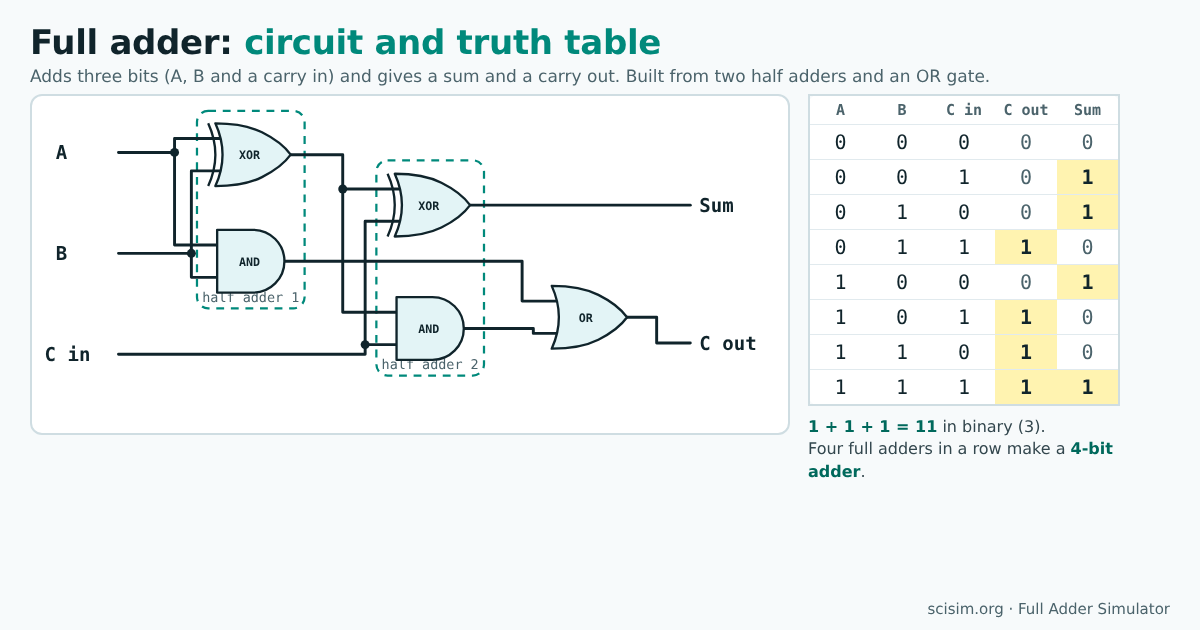
A full adder is a logic circuit that adds three bits: A, B and a carry in. It gives two outputs, a sum bit and a carry out, so 1 + 1 + 1 = 11 in binary. It is built from two half adders and an OR gate, and four full adders in a row add two 4-bit numbers.
In this lab you can
- Add two binary numbers on paper, one column at a time, and predict each carry before you see it.
- Build a half adder from two logic gates and watch it add 1 + 1 = 10.
- Open a full adder (two half adders and an OR gate) and check all 8 rows of its truth table, then find a broken gate.
- Chain four full adders into a 4-bit adder, type sums on a calculator keypad and watch the carry run from adder to adder.
- Make the overflow lamp light up (15 + 1 = 0 on 4 bits) and subtract with two’s complement in Go deeper.
Steps in this lab: Add on paper · Half adder · Full adder · Chain four (4-bit adder)
How do you add binary numbers?
Binary addition is adding numbers written with only 0 and 1, one column at a time from right to left, carrying to the next column just as you do with ordinary numbers. The only difference is that a column carries as soon as it reaches 2, because 2 in binary is written 10.
There are only five facts to know: 0 + 0 = 0, 0 + 1 = 1, 1 + 0 = 1, 1 + 1 = 10, and with a carry, 1 + 1 + 1 = 11 (source: All About Circuits, Digital textbook ch. 2: Binary Addition). Electronic circuits do these same steps with voltages, one column at a time. Tony Kuphaldt’s textbook Lessons in Electric Circuits (on All About Circuits) says of these adding circuits: “This is the very foundation of all the arithmetic which modern digital computers perform.” (source: All About Circuits, Digital textbook ch. 2: Binary Addition)
Example: 5 + 3 is 0101 + 0011. The ones column gives 1 + 1 = 10 (write 0, carry 1), and that carry keeps moving left until the answer is 1000, which is 8. If binary numbers are new to you, start with the Binary Numbers Lab.
What is a half adder?
A half adder is a logic circuit that adds two bits and gives a sum bit and a carry bit. It needs only two gates: an XOR gate makes the sum, and an AND gate makes the carry (source: All About Circuits, Digital textbook ch. 9: Half-Adder).
Why those two? The sum is 1 when exactly one input is 1, which is what XOR does. The carry is 1 only for 1 + 1, which is what AND does. You can try both gates on their own in the Logic Gates Simulator. A half adder has no input for a carry coming from the column to its right, so it can only do the rightmost column of a sum (source: Beauty and Joy of Computing (UC Berkeley): Binary Addition with Logic Gates).
How does a full adder work?
A full adder is a logic circuit that adds three bits: A, B and the carry in from the column to its right. It gives a sum bit and a carry out. It is made of two half adders and one OR gate, so 5 gates in all (source: Beauty and Joy of Computing (UC Berkeley): Binary Addition with Logic Gates).
The first half adder adds A and B. The second half adder adds that result to the carry in, and gives the final sum. If either half adder makes a carry, the OR gate sends a carry out. The truth table has 8 rows, one for each way to set three inputs:
| A | B | Carry in | Carry out | Sum | In decimal |
|---|---|---|---|---|---|
| 0 | 0 | 0 | 0 | 0 | 0 + 0 + 0 = 0 |
| 0 | 0 | 1 | 0 | 1 | 0 + 0 + 1 = 1 |
| 0 | 1 | 0 | 0 | 1 | 0 + 1 + 0 = 1 |
| 0 | 1 | 1 | 1 | 0 | 0 + 1 + 1 = 2 |
| 1 | 0 | 0 | 0 | 1 | 1 + 0 + 0 = 1 |
| 1 | 0 | 1 | 1 | 0 | 1 + 0 + 1 = 2 |
| 1 | 1 | 0 | 1 | 0 | 1 + 1 + 0 = 2 |
| 1 | 1 | 1 | 1 | 1 | 1 + 1 + 1 = 3 |
How does a 4-bit adder work? (ripple carry adder)
A 4-bit adder is four full adders in a row, one for each column of the sum. The carry out of each adder is wired to the carry in of the next one, so a carry can ripple from the right end to the left end. That is why it is called a ripple carry adder.
The ripple takes time: each adder has to wait for the carry from its neighbor. All About Circuits notes that an 8-bit adder built this way “has to wait” for every carry signal to move up from the first column (source: All About Circuits, Digital textbook ch. 9: Full-Adder). Four bits is not a toy size: the Intel 4004 of 1971, the first microprocessor, was a 4-bit chip (source: IEEE Spectrum, Chip Hall of Fame: Intel 4004).
What is overflow?
Overflow is when the answer of a sum is too big for the number of bits the adder has. Four bits make 24 = 16 patterns, the numbers 0 to 15, in the same way that 8 bits make 256 patterns (source: Stanford CS106A, Bits and Bytes).
So 15 + 1 = 16 does not fit: the four sum bits show 0000, and the last carry out has nowhere to go. In the lab that carry lights the overflow lamp. Real computers use more bits (often 64), but the same thing happens when a number gets too big for them.
Half adder vs full adder
The difference between a half adder and a full adder is the carry in: a half adder adds 2 bits, a full adder adds 3.
| Half adder | Full adder | |
|---|---|---|
| Inputs | 2 (A, B) | 3 (A, B, carry in) |
| Outputs | sum, carry | sum, carry out |
| Gates | XOR + AND (2) | 2 half adders + OR (5) |
| Biggest sum | 1 + 1 = 10 (2) | 1 + 1 + 1 = 11 (3) |
| Used for | the rightmost column only | every column of a multi-bit adder |
Worked example: 7 + 9 in binary
7 = 0111 and 9 = 1001. Add right to left; each column is one full adder:
| Column (worth) | A | B | Carry in | Total | Write | Carry out |
|---|---|---|---|---|---|---|
| 1 | 1 | 1 | 0 | 2 = 10 | 0 | 1 |
| 2 | 1 | 0 | 1 | 2 = 10 | 0 | 1 |
| 4 | 1 | 0 | 1 | 2 = 10 | 0 | 1 |
| 8 | 0 | 1 | 1 | 2 = 10 | 0 | 1 |
Every column carries, so the carry runs through all four adders and the answer is 10000 = 16. A 4-bit adder keeps only 0000 and lights the overflow lamp.
Go deeper
Subtraction with two’s complement
Computers subtract with the same adder. To work out A − B, flip every bit of B (NOT B) and put a 1 into the first carry in. Example: 7 − 3 = 0111 + 1100 + 1 = (1)0100, and 0100 = 4. The extra carry out on the left is dropped. Turn on Subtract in step 4 to see it.
Signed and unsigned numbers
The same 4 bits can be read two ways. Unsigned: 0 to 15. Signed (two’s complement): the left bit counts as −8, so the range is −8 to 7. 7 − 9 gives 1110, which is 14 unsigned or −2 signed. Signed overflow happens when two numbers with the same sign give an answer with the other sign.
Multiplication and division
Multiplying in binary is shifting and adding: 0101 × 0011 is 0101 + 01010, because 3 = 2 + 1. Division is shifting and subtracting. Both reuse adders like the ones in this lab many times.
❓ FAQ
1 + 1 = 10 in binary. That is 2 in decimal: you write 0 in this column and carry 1 to the next column. With a carry, 1 + 1 + 1 = 11 (3).
Key takeaway: 1 + 1 = 10.A half adder adds two bits (XOR for the sum, AND for the carry). A full adder adds three bits: A, B and a carry in, using two half adders and an OR gate.
Key takeaway: Full adders take a carry in.Four, one for each column. The carry out of each one goes into the carry in of the next. Eight bits need eight full adders.
Key takeaway: One full adder per bit.Because a carry made in one column has to travel, or ripple, through the next adders one after another before the answer is ready.
Key takeaway: Carries ripple left.The extra carry out has no bit to go into. On a 4-bit adder 15 + 1 shows 0000 and the overflow lamp lights; the real answer, 16, needs 5 bits.
Key takeaway: 4 bits hold 0 to 15.Teacher notes
Level: grades 6–8 for steps 1–4; grades 9–12 add “Go deeper” (two’s complement, signed numbers). Time: one 45-minute lesson.
- Hook (5 min): on the projector (Full screen), add 5 + 3 in ordinary numbers, then in binary on paper. Ask: “What do we write when a column makes 2?”
- Paper (10 min): step 1 with “predict the carry”: students call each carry before you press. The lab counts right answers.
- Gates (15 min): step 2, students build the half adder from two gates; step 3, they find the broken gate using the ✗ rows.
- Calculator (10 min): step 4, type 7 + 9 = and watch the carry run; then the overflow hunt. Exit ticket: the worksheet (For teachers → Print worksheet; answer key on page 2).
Common mix-ups: 1 + 1 is 10, not 2 and not 11; columns go right to left; the carry goes into the next column, not the same one; overflow is not an error in the adder, it is a lack of bits.
Standards: in the CSTA K–12 Computer Science Standards (2017), the standard that names logic in hardware is 3B-CS-02 (grades 11–12): “Illustrate ways computing systems implement logic, input, and output through hardware components.” (source: CSTA K–12 Computer Science Standards, revised 2017) For grades 6–8 the lab is enrichment that builds toward it.
Sources
- All About Circuits, Digital textbook, ch. 2 Binary Arithmetic: Binary Addition (the rules and the quote).
- All About Circuits, Digital textbook, ch. 9: Half-Adder (XOR for the sum, AND for the carry).
- All About Circuits, Digital textbook, ch. 9: Full-Adder (chaining adders; waiting for the carry).
- Beauty and Joy of Computing (UC Berkeley): Binary Addition with Logic Gates (half and full adders).
- IEEE Spectrum, Chip Hall of Fame: Intel 4004 Microprocessor (the first microprocessor, 4-bit, 1971).
- Stanford CS106A, Bits and Bytes (lecture 13) (8 bits = 256 patterns).
- CSTA K–12 Computer Science Standards (revised 2017)