What Does an Atom Really Look Like?
The school picture
Simple model: good for counting protons, neutrons, electrons and shells
Not to scale
Closer to reality
Best current model: every picture of an atom is a model
False color: atoms have no colorEach dot = one measurement, not a moving electron
School picture:
Closer to reality:
Why:
What does an atom really look like?
An atom does not look like a tiny solar system. It is a fuzzy cloud that shows where its electrons are likely to be found, around a nucleus about 18,000 times narrower than the atom (helium). The nucleus holds protons and neutrons, each made of three quarks. Every picture of an atom is a model.
In this lab you can
- Tap where you think hydrogen’s electron is, then measure it 10,000 times and watch a cloud appear.
- Zoom from a helium balloon into one atom, its nucleus, a proton and a quark, with a scale bar the whole way.
- Step from hydrogen to calcium and see which change is caused by PULL, SHIELD or a NEW SHELL.
- Look inside a proton and a neutron, and try to pull a quark out.
- Lay the school picture on top of the real one at the same scale, and fill orbital rooms, build protons from quarks, or test your own picture of an atom.
Scenes in this lab: Where is the electron? · How big is it really? · What changes in bigger atoms? · What is it made of?
Activities in this lab: What does the school picture simplify? · Fill the rooms · Build a proton and a neutron · How much is inside? · Which cause? · Your picture, before and after
What does an atom really look like?
An atom is a tiny nucleus surrounded by a cloud that shows where its electrons are likely to be found. The cloud has no sharp edge: it is thickest close to the nucleus and fades out slowly. Hydrogen’s electron is found most often about 53 pm (picometers) from the nucleus (source: NIST, CODATA 2022 recommended values).
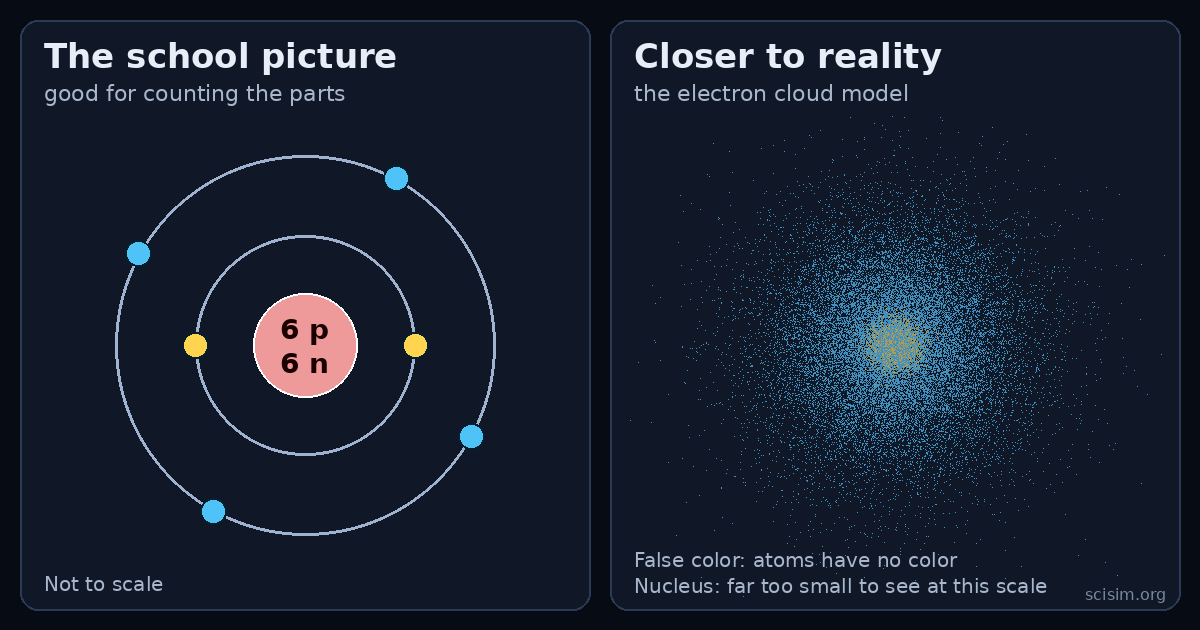
No photo shows an atom’s shape the way a camera shows a ball, so every picture of one is a model. In 2013 a team led by Aneta Stodolna used a photoionization microscope to record the pattern of hydrogen’s electron, with dark rings where it is almost never found (source: Stodolna et al., Phys. Rev. Lett. 110, 213001 (2013)). The atoms were excited and held in an electric field; the pattern showed a cloud with structure, not one track.
Do electrons orbit the nucleus?
No: an electron in an atom does not travel on a path that anyone can follow. We can only say where it is likely to be found. In the lab, each dot is one measurement of where hydrogen’s electron was found. After 10,000 measurements the dots make a cloud, and the most common distance is 53 pm, the radius of Bohr’s ring (source: NIST, CODATA 2022 recommended values).
So the school picture’s ring is not a track: it marks the distance where the electron is found most often. In 1926 Erwin Schrödinger wrote the wave equation that describes electrons this way (source: NobelPrize.org, Erwin Schrödinger: Nobel Prize in Physics 1933). See also the Bohr model lab.
What is the electron cloud model?
The electron cloud model is a picture of the atom in which electrons are shown as a cloud of chances, not as balls on rings. Where the cloud is thick, the electron is likely to be found; where it is thin, it is rarely found. OpenStax describes an orbital as “a general region in an atom within which an electron is most probable to reside” (source: OpenStax, Chemistry 2e, section 6.3 Development of Quantum Theory (CC BY 4.0)).
The cloud has no edge, so the “balloon” shapes in chemistry books are lines drawn around most of it: usually 90 % (some books use 95 %) (source: OpenStax, Organic Chemistry, section 1.2 Atomic Structure: Orbitals). For hydrogen, the 90 % line sits about 141 pm from the nucleus. Each orbital holds up to 2 electrons. The shapes of single orbitals are in the hydrogen orbitals lab.
Bohr model vs electron cloud model: what is the difference?
The Bohr model puts electrons on fixed rings; the electron cloud model shows where they are likely to be found. Both give the same most common distance for hydrogen’s electron, 53 pm (source: NIST, CODATA 2022 recommended values), which is why the Bohr model is still useful for counting and for energy levels.
| Question | School picture | Closer to reality | What the school picture is good for |
|---|---|---|---|
| Where is the electron? | On a ring around the nucleus | In a cloud of chances; most often 53 pm away in hydrogen | Shows the distance found most often |
| How big is the nucleus? | About a quarter as wide as the atom | About 18,000 times narrower than a helium atom | Shows that the nucleus is in the middle |
| Bigger atoms | More rings, always the same size | Clouds shrink along a row and jump out at a new shell (neon 38 pm, sodium 190 pm) | Counting electrons per shell: 2, 8, 8 |
| What is it made of? | Protons, neutrons and electrons are little balls | Protons and neutrons are 3 quarks each; no parts found in the electron | Counting protons, neutrons and electrons |
| Color and shape | Colored, flat | No color, round and 3D | Easy to draw and label |
Models of the atom changed as experiments showed new things; the atomic models lab and the atomic structure lab go through those steps.
How big is an atom?
An atom is about a tenth of a billionth of a meter across: OpenStax gives “on the order of 10−10 m” for its diameter (source: OpenStax, Chemistry 2e, section 2.3 (CC BY 4.0)). A helium atom has a radius of about 31 pm (source: Calculated atomic radii (Clementi and co-workers, 1963 and 1967), as listed in Wikipedia’s atomic radii data page).
How big is the nucleus compared with the atom?
The nucleus is tens of thousands of times narrower than the atom. Helium’s nucleus has a measured radius of 1.6785 fm (femtometers) (source: NIST, CODATA 2022 recommended values (complete listing)), so the atom is about 18,000 times wider than its nucleus. OpenStax puts it this way: “If the nucleus were the size of a blueberry, the atom would be about the size of a football stadium” (source: OpenStax, Chemistry: Atoms First 2e, section 2.3 (CC BY 4.0)). The school picture draws the nucleus about 4,500 times too big, so that it can be seen at all.
Are atoms mostly empty space?
“Mostly empty space” is only half true. In helium-4, 99.97 % of the mass is in the nucleus (source: NIST, CODATA 2022 recommended values (complete listing)), and the nucleus takes up less than a billionth of the atom’s space. But the rest is not empty: the electron cloud fills it. The cloud has almost no mass, yet it is what gives the atom its size and keeps other atoms from passing through.
Rutherford, Geiger and Marsden found the tiny nucleus by firing alpha particles at very thin gold foil: most went straight through, and a very few bounced back (source: E. Rutherford, Philosophical Magazine 21, 669 (May 1911); OpenStax Chemistry 2e, section 2.2).
Why do atoms get smaller across a row of the periodic table?
Atoms get smaller across a row because each new proton pulls every electron cloud in more (PULL), while the new electron joins the same shell and blocks only a little of that pull (SHIELD). From lithium to neon the radius falls from 167 pm to 38 pm (source: Calculated atomic radii (Clementi and co-workers, 1963 and 1967), as listed in Wikipedia’s atomic radii data page).
At the start of a new row the atom suddenly gets much bigger: shell 2 is full, so sodium’s eleventh electron starts a new shell far out (NEW SHELL), and the radius jumps from 38 pm to 190 pm. The inner electrons shield it, so the pull it feels is only about 2.5 protons’ worth (source: Clementi and Raimondi, J. Chem. Phys. 38, 2686 (1963)). The periodic trends lab shows the same trend for the whole table, and the periodic table gives every element.
Why do the shells hold 2, 8 and 8 electrons?
The shells of the school picture are made of orbitals, and each orbital (a “room”) holds up to 2 electrons: OpenStax says “each orbital within a shell can be occupied by two electrons” (source: OpenStax, Organic Chemistry, section 1.2 Atomic Structure: Orbitals). Shell 1 has one room, so it holds 2. Shells 2 and 3 each have one s room and three p rooms used by these atoms, so they hold 8. Calcium’s 20 electrons fill them as 2, 8, 8, 2.
What are protons and neutrons made of?
Protons and neutrons are each made of three quarks, held together by gluons. A proton is two up quarks and one down quark (charges +2/3 +2/3 −1/3 = +1); a neutron is one up and two down (+2/3 −1/3 −1/3 = 0) (source: Particle Data Group, Review of Particle Physics 2026: baryon summary table (p = uud, n = udd)).
Experiments at SLAC in Stanford, starting in 1967, fired fast electrons at protons and found small point-like parts inside, later identified as quarks; the work won the Nobel Prize in Physics in 1990 (source: NobelPrize.org, The Nobel Prize in Physics 1990). A quark has never been found alone (source: The Particle Adventure (Particle Data Group): Hadrons, Baryons, and Mesons). A proton is about 1,836.15 times heavier than an electron (source: NIST, CODATA 2022 recommended values (complete listing)). The Standard Model lab shows all the known particles.
What is an electron made of?
As far as anyone can measure, an electron is not made of anything smaller. Experiments show that electrons and quarks are smaller than 10−18 m, and they may be points with no size at all (source: The Particle Adventure (Particle Data Group): The Scale of the Atom). In the lab you can zoom in on the electron by ten times, six times over: the number climbs, but the dot stays a dot.
What does the school picture get right?
The school picture gets the parts and their places right: the nucleus is in the middle, the electrons are outside it, and the numbers of protons, neutrons and electrons are correct. It simplifies size, motion, shape and color: its nucleus is about 4,500 times too big, its electrons ride on rings, and it is flat and colored, while real atoms are round, 3D and have no color (source: NIST, CODATA 2022 recommended values (complete listing)).
Worked examples
Example 1: a stadium-sized atom
- Helium atom radius: 31 pm = 31 × 10−12 m (source: Calculated atomic radii (Clementi and co-workers, 1963 and 1967), as listed in Wikipedia’s atomic radii data page).
- Helium nucleus radius: 1.6785 fm = 1.6785 × 10⁻¹⁵ m (source: NIST, CODATA 2022 recommended values (complete listing)).
- Ratio: (31 × 10−12) ÷ (1.6785 × 10⁻¹⁵) = 18,469 → about 18,000.
- So if the helium atom were blown up to the size of a stadium, its nucleus would be about 18,000 times smaller than the stadium: a blueberry-sized speck in the middle. (The two radii are measured in different ways, so the answer is “about”.)
Example 2: counting quarks in carbon-12
- Carbon-12 has 6 protons and 6 neutrons.
- Each proton is up + up + down; each neutron is up + down + down.
- Up quarks: 6 × 2 + 6 × 1 = 18. Down quarks: 6 × 1 + 6 × 2 = 18.
- Check the charge: 18 × (+2/3) + 18 × (−1/3) = +6, which matches the 6 protons. Plus 6 electrons, so the atom is neutral.
Can we see atoms?
We cannot see an atom’s shape with our eyes or with a light microscope, because atoms are much smaller than the waves of light. The eye detects wavelengths from 380 to 700 nanometers (source: NASA Science, Visible Light); the shortest of these is about 3,600 times wider than a hydrogen atom (source: NIST, CODATA 2022 recommended values).
Special microscopes can map single atoms on a surface. The scanning tunneling microscope, built in 1981 by Gerd Binnig and Heinrich Rohrer, feels a surface with a very sharp tip; its pictures show “objects as small as individual atoms” (source: NobelPrize.org, Gerd Binnig: Nobel Prize in Physics 1986), and it is used to make atomic-scale images of metal surfaces (source: NIST, Scanning Tunneling Microscope). Even these pictures are maps made by a computer, with colors added.
✅ Quiz: what does an atom really look like?
Pick a level. You get 10 questions, one at a time, picked from a bank of 12. The answer and why appear after you choose. New questions picks another set.
What does the electron cloud show?
Each dot is one measurement of where the electron was found, each on a fresh hydrogen atom. Many measurements together make the cloud.
Do electrons travel around the nucleus on fixed tracks, like planets?
We can only say where an electron is likely to be found. The rings of the school picture mark the most common distance, not a track.
How wide is a helium atom compared with its nucleus?
Helium: atom radius 31 pm, nucleus radius 1.6785 fm. That is about 18,000 times.
Where is almost all of an atom’s mass?
In helium-4, 99.97 % of the mass is in the nucleus.
What color is an atom?
A single atom is too small to see with light, so there is no color you could look at. Colors in pictures of atoms are added to make the parts easy to tell apart.
Is an atom a hard, solid ball?
The cloud fades out slowly and has no edge. It is not empty either: the electron cloud fills it.
What is inside a proton?
A proton is two up quarks and one down quark, held together by gluons.
Is the nucleus of an atom the same as the nucleus of a cell?
They only share a name. A cell’s nucleus is a part of a living cell, made of a huge number of atoms.
Why is the school picture of the atom still useful?
The school picture is a simple model: it gets the parts, their places and their numbers right.
How many electrons can one orbital (one “room”) hold?
Each orbital holds at most 2 electrons. A shell with 4 rooms holds 8.
Can you see an atom with an ordinary light microscope?
The shortest wave the eye can see is about 3,600 times wider than a hydrogen atom.
What is an electron made of?
Electrons have been tested down to 10−18 m and no parts or size were found.
After 10,000 measurements of hydrogen’s electron, the tallest bar of the distance chart is at 53 pm. What does that mean?
The distance chart counts how often each distance was measured. 53 pm is the most common one: the radius of Bohr’s ring.
From neon to sodium the atom gets about 5 times wider (38 pm → 190 pm). Why?
NEW SHELL: the eleventh electron cannot fit in shell 2, so it sits in shell 3, far out, and the inner electrons shield it.
From lithium to neon the atoms get smaller (167 pm → 38 pm). Why?
PULL: one more proton pulls every cloud in, and the new electron in the same shell shields only a little.
What happens to the electron cloud when you add one neutron to the nucleus?
Neutrons have no charge, so they do not pull on electrons. The cloud stays the same.
A chemistry book draws a “balloon” around an orbital. What is the balloon?
The cloud has no edge. Books draw a line around about 90 % of it; for hydrogen that line is about 141 pm from the nucleus.
If an atom were as big as a football stadium, how big would its nucleus be?
OpenStax compares it to a blueberry in a stadium. Helium’s own numbers give about 18,000 times.
“Atoms are mostly empty space.” Which is the better way to say it?
The nucleus holds 99.97 % of helium’s mass in a tiny space; the light cloud fills the rest of the atom.
How many quarks are in one carbon-12 atom (6 protons, 6 neutrons)?
Each proton and each neutron has 3 quarks: 12 × 3 = 36 (18 up, 18 down).
Why do the dots of the cloud not show the electron moving?
A dot only says where the electron was found once. We cannot follow it between measurements.
Why can’t one quark be pulled out of a proton on its own?
The energy of the stretched bond makes a new pair, so quarks are never found alone (shown in the lab as a model).
An ion of oxygen has 8 protons but 7 electrons. It gets its eighth electron. What happens to its size?
SHIELD: the new electron joins the same shell; electrons push each other away, so the cloud swells slightly.
Why is the nucleus in the school picture drawn so big?
At true scale the nucleus would be about 18,000 times smaller than the atom. The drawing makes it about 4,500 times too big.
A proton is about 1,836 times heavier than an electron. Where does most of the proton’s mass come from?
The three quarks’ own masses add up to only about 1 % of the proton’s mass (9.02 MeV of 938.27 MeV). The rest comes from the energy inside.
Sodium (11) and chlorine (17) are in the same row, but sodium is much bigger (190 pm vs 79 pm). Why?
Same shell, more pull: the pull felt by the outer electrons rises from about 2.5 to 6.1.
Potassium (243 pm) is far bigger than argon (71 pm). Which cause explains it?
Argon’s s and p rooms are full (2, 8, 8), so potassium’s 19th electron starts shell 4. (Potassium has fewer neutrons than argon: 20 vs 22.)
What is an orbital?
An orbital is a cloud of chances, not a track or a box. Each holds at most 2 electrons.
Why is a whole atom round, even though p orbitals have two lobes?
Switch to “One orbital” to see a single shape; the whole atom adds all its electrons together into a round cloud.
Electrons have been tested down to 10−18 m. What was found?
If the electron has a size, it is smaller than 10−18 m. It may be a point.
How do we know the nucleus is tiny?
Most alpha particles went straight through; the very few that bounced back must have hit something tiny and heavy.
How do we know protons have parts inside?
The SLAC experiments (from 1967) found point-like parts, later identified as quarks (Nobel Prize in Physics 1990).
How was the pattern of hydrogen’s electron pictured in 2013?
The pattern looked like a cloud with dark rings, not like a single track.
Why doesn’t the electron fall into the nucleus?
The total energy is lowest at the real size of the cloud. See “Why doesn’t the atom collapse?” in Go deeper.
About how much of a helium atom’s space is inside its nucleus?
Volume grows with the cube of the radius: (1 ÷ 18,000)3 is far less than a billionth.
An atom has 11 protons and 12 neutrons. How many up quarks does it have?
Up quarks: 11 × 2 + 12 × 1 = 34. (Down quarks: 11 + 24 = 35.)
Go deeper (high school)
Why doesn’t the atom collapse?
In classical physics an electron moving in a circle gives off light all the time, loses energy and spirals into the nucleus in about 10−11 s, a hundred-billionth of a second (source: University of Illinois, Physics 102, Lecture 24: The classical and Bohr atom). Atoms are stable, so classical physics cannot be the whole story.
Quantum mechanics answers with a balance. Squeeze hydrogen’s 1s cloud to a smaller size a and two energies change: the motion energy grows as 1/a2 (T = 13.6 eV × (a0/a)2), while the pull energy only falls as 1/a (V = −2 × 13.6 eV × a0/a). The total is lowest at a = a0 = 53 pm, where it equals −13.6 eV (source: NIST SP 961 (May 2024), CODATA 2022 recommended values). Squeezing further costs more motion energy than the pull gives back.
Quantum numbers n, l, m and the shapes
Each orbital has three quantum numbers. n (1, 2, 3 …) sets the shell and roughly its size; l (0 to n − 1) sets the shape: s, p, d, f; m (−l to +l) sets the direction, so there are 2l + 1 orbitals of each kind.
| l | Letter | Orbitals (2l + 1) | Electrons (2 each) | Radial nodes for n = 4 (n − l − 1) |
|---|---|---|---|---|
| 0 | s | 1 | 2 | 3 |
| 1 | p | 3 | 6 | 2 |
| 2 | d | 5 | 10 | 1 |
| 3 | f | 7 | 14 | 0 |
A fourth number, spin, lets two electrons share one orbital. Switch the lab to “One orbital” to see all 1 + 3 + 5 + 7 shapes. More: hydrogen orbitals, spin and quantum numbers, the Aufbau principle.
Where the proton’s mass comes from
A proton’s mass is 938.27 MeV/c2 (source: NIST SP 961 (May 2024), CODATA 2022 recommended values). Its quarks are light: up 2.16 MeV and down 4.70 MeV (source: Particle Data Group, Review of Particle Physics 2026: quark summary table), so two up and one down give 9.02 MeV, about 0.96 % of the proton.
APS Physics puts it plainly: “the quark masses only add up to a mere 1% of a proton or neutron’s mass” (source: A. Walker-Loud, "Dissecting the Mass of the Proton", APS Physics 11, 118 (19 Nov 2018)). Almost all the rest is energy: the motion of the quarks and the energy of the gluon field that holds them, as E = mc2 allows. (Calculations that count the quark-mass part in a wider way get about 9 %.)
Why a whole atom is round although orbitals have shapes
A single p orbital has two lobes, but the three p orbitals together point along x, y and z. When all three hold the same number of electrons, their clouds add up to a perfect sphere. The same is true for full d and f sets. So atoms with full shells, like neon and argon, are exactly round, and other atoms are very nearly round on average. That is why the lab’s “Whole atom” view is a round cloud, and why “atoms are shaped like dumbbells” is a new mistake to avoid.
❓ FAQ
A light microscope cannot show atoms: they are much smaller than light waves. A scanning tunneling microscope can map single atoms on a surface as bumps, with colors added by a computer.
Key takeaway: Atom pictures are maps, not photos.Like a fuzzy round cloud with no sharp edge and no color, with a nucleus about 18,000 times narrower in the middle (helium). The cloud shows where the electrons are likely to be found.
Key takeaway: A fuzzy cloud around a tiny nucleus.A nucleus of protons and neutrons, surrounded by electrons. Protons and neutrons are each made of three quarks; electrons have no known parts. The atomic structure lab lets you build atoms from these parts.
Key takeaway: Protons, neutrons, electrons; quarks inside the first two.It grew out of quantum mechanics in the 1920s. In 1926 Erwin Schrödinger wrote the wave equation that gives the energy levels and the clouds of electrons in atoms; he shared the Nobel Prize in Physics in 1933.
Key takeaway: Schrödinger’s wave equation, 1926.The Bohr model puts electrons on fixed rings. The electron cloud model shows only where they are likely to be found. For hydrogen both give the same most common distance, 53 pm.
Key takeaway: Rings vs a cloud of chances.Because almost all the mass (99.97 % in helium-4) is in a nucleus tens of thousands of times narrower than the atom. But the space is not truly empty: the electron cloud fills it.
Key takeaway: The mass is tiny and central; the cloud fills the rest.Not with a light microscope. The best-known pictures of single atoms come from a scanning tunneling microscope, which feels a surface with a sharp tip instead of using light. Its inventors won the Nobel Prize in Physics in 1986.
Key takeaway: Special microscopes map atoms on surfaces.Squeezing an electron’s cloud makes its motion energy rise faster than its pull energy falls, so the total energy is lowest at the real size (about 53 pm for hydrogen). See Go deeper.
Key takeaway: The cloud’s energy is lowest at its real size.A quark is one of the smallest known particles. Protons and neutrons are each made of three quarks: up quarks have charge +2/3 and down quarks −1/3. More in the Standard Model lab.
Key takeaway: Protons and neutrons are made of quarks.No smaller parts have been found. Quarks, like electrons, are smaller than 10−18 m and may be points.
Key takeaway: No known parts.📋 Teacher notes and lesson plan
Summary. Two pictures side by side: the school (shell) picture of an atom and the electron cloud model. Every control changes both, or the side that does not change says so. Four scenes ask a prediction first; six activities and a three-level quiz check the ideas. The school picture is treated as a useful simple model, never as wrong.
Students will compare the school picture with the electron cloud model, explain that the cloud shows where an electron is likely to be found, use measured sizes to compare the nucleus with the atom, explain why atoms shrink along a row and grow at a new shell (PULL, SHIELD, NEW SHELL), and describe protons and neutrons as three quarks each.
Standards: MS-PS1-1 (partial: models of atoms): “Develop models to describe the atomic composition of simple molecules and extended structures.” Its boundary leaves out valence electrons and bonding energy, so this page supports the model-building, not the whole expectation. HS-PS1-1: “Use the periodic table as a model to predict the relative properties of elements based on the patterns of electrons in the outermost energy level of atoms.” Crosscutting concepts: Scale, Proportion, and Quantity (MS-PS1-1); Patterns (HS-PS1-1). Practice: Developing and Using Models. (Wording copied from nextgenscience.org, 19 Nov 2026.)
| Time | Step | What students do | Go to |
|---|---|---|---|
| 5 min | Hook | Draw an atom from memory; pick a picture in activity 6 (before) | Your picture |
| 10 min | Scene 1 | Predict where the electron is, then measure 10,000 times; read the distance chart | Where is the electron? |
| 8 min | Scene 2 | Predict the nucleus size, zoom to it, read the mass bars | How big is it really? |
| 10 min | Scene 3 | Step from hydrogen to calcium; name PULL, SHIELD, NEW SHELL; then activity 5 | Bigger atoms |
| 7 min | Scene 4 | Look inside a proton; count quarks for the scene 3 atom | What is it made of? |
| 5 min | Check | Activity 1, then the Easy or Medium quiz; pick a picture again (after) | Quiz |
Common student ideas
| Student idea | What the lab shows |
|---|---|
| Electrons orbit the nucleus like planets. | An electron has no path we can follow; the cloud shows where it is likely to be found (scene 1). |
| The cloud is made of many electrons, or of smeared “electron stuff”. | Hydrogen’s cloud is one electron: each dot is one measurement. |
| An orbital is a container with a wall. | A drawn orbital is a line around about 90 % of the cloud; the cloud has no edge (activity 4). |
| Atoms are colored, or solid little balls. | Atoms have no color and no hard edge; colors in pictures are added. |
| The nucleus of an atom is like the nucleus of a cell. | Same word, different things: an atom’s nucleus is protons and neutrons. |
| A bigger atomic number always means a bigger atom. | Atoms shrink along a row (PULL) and jump out at a new shell (scene 3). |
| Atoms are dumbbell-shaped (after seeing p orbitals). | A whole atom is round; single orbitals have shapes (One orbital view). |
Vocabulary
- atom
- the smallest unit of an element: a nucleus with electrons around it
- nucleus
- the tiny, heavy center of an atom, made of protons and neutrons
- electron cloud
- a picture of where an atom’s electrons are likely to be found
- orbital
- one region of the cloud; it holds up to 2 electrons
- shell
- a group of orbitals at about the same distance and energy
- quark
- a particle inside protons and neutrons (up: +2/3, down: −1/3)
- model
- a simplified picture or idea that explains and predicts; every picture of an atom is one
- picometer (pm)
- one trillionth of a meter (10−12 m)
Worksheet: a print-out for students and a separate answer key page for the teacher (opens the print dialog; choose "Save as PDF" to keep a file).
Sources
- NIST, CODATA 2022 recommended values
- NIST SP 961 (May 2024), CODATA 2022 recommended values
- NIST, CODATA 2022 recommended values (complete listing)
- Calculated atomic radii (Clementi and co-workers, 1963 and 1967), as listed in Wikipedia’s atomic radii data page
- Clementi and Raimondi, J. Chem. Phys. 38, 2686 (1963)
- Stodolna et al., Phys. Rev. Lett. 110, 213001 (2013)
- OpenStax, Chemistry 2e, section 2.3 (CC BY 4.0)
- OpenStax, Chemistry: Atoms First 2e, section 2.3 (CC BY 4.0)
- OpenStax, Chemistry 2e, section 6.3 Development of Quantum Theory (CC BY 4.0)
- OpenStax, Organic Chemistry, section 1.2 Atomic Structure: Orbitals
- E. Rutherford, Philosophical Magazine 21, 669 (May 1911); OpenStax Chemistry 2e, section 2.2
- The Particle Adventure (Particle Data Group): The Scale of the Atom
- Particle Data Group (CPEP): Fractional Charge Quiz
- Particle Data Group, Review of Particle Physics 2026: quark summary table
- Particle Data Group, Review of Particle Physics 2026: baryon summary table (p = uud, n = udd)
- The Particle Adventure (Particle Data Group): Hadrons, Baryons, and Mesons
- The Particle Adventure (Particle Data Group): Quark Confinement
- University of Illinois, Physics 102, Lecture 24: The classical and Bohr atom
- NobelPrize.org, The Nobel Prize in Physics 1990
- A. Walker-Loud, "Dissecting the Mass of the Proton", APS Physics 11, 118 (19 Nov 2018)
- NASA Science, Visible Light
- NIST, Scanning Tunneling Microscope
- NobelPrize.org, Gerd Binnig: Nobel Prize in Physics 1986
- NobelPrize.org, Erwin Schrödinger: Nobel Prize in Physics 1933
- NIST, Atomic Weights and Isotopic Compositions
- NGSS, MS-PS1-1
- NGSS, HS-PS1-1
The quote from OpenStax is used under CC BY 4.0. All drawings on this page are SciSim’s own.