Ten Frame Games: Number Bonds & Make 10
Free · Grades K–2 · ages 5–8Build numbers on big ten frames, see how many at a glance, make 10 in Zayn's stories, crack bond puzzles and race the clock.
What is a ten frame?
A ten frame is a grid of 10 boxes in 2 rows of 5 that children fill with counters, so every number shows as "5 and some more" and "how many more make 10". In this free game kids build numbers on frames, flash-count dots, make 10 in Zayn's stories, solve bond puzzles and race a Make-10 sprint.
In this game you can:
- Tap or drag big counters in two colors onto a five frame, a ten frame or two ten frames, and see the number bond appear
- Play "How many?": the frame flashes for a moment, you tap how many, then the dots come back to check
- Help Zayn in five read-aloud stories: fill the frame, make 10, find the missing part, add two groups and take away
- Solve bond puzzles: find the missing part, match the pairs that make 10 and spot the wrong bond
- Race the 60-second Make-10 sprint and beat your own best
Modes in this game: Play: Ten frame · Missions: Zayn's stories · Puzzles: Bond puzzles · Timed: Make-10 sprint
What is a ten frame and why 10?
A ten frame is a 2 × 5 grid of boxes, filled with counters from left to right along the top row first, so one look tells how many there are and how many more make 10. Ten matters because our numbers are built from tens: 13 is one full frame and 3 more, and 20 is two full frames. The middle line of 5 helps too: 7 is a full row of 5 and 2 more, so children stop counting one by one. In Play you tap or drag big counters in two colors onto the frame and watch the number bond appear, for example 4 + 3 = 7. "Just starting" uses a five frame (one row of 5), "I know the basics" one ten frame, and "Challenge me" two ten frames for numbers to 20.
📌 Kindergarten standard K.NBT.A.1 asks children to see the numbers 11 to 19 as "ten ones and some further ones", such as 18 = 10 + 8. (Common Core State Standards for Mathematics, K.NBT.A.1)
Example: 13 on two frames: one full frame of 10 and 3 counters on the second frame, so 13 = 10 + 3.
What is subitizing?
Subitizing is knowing how many things are in a small group at a glance, without counting them one by one. Mathematics educator Douglas Clements calls it "instantly seeing how many". A ten frame helps with bigger numbers too: a full top row and 2 more is 7, seen without counting. Press "How many?" in Play: the frame flashes for about two seconds and then hides, you tap how many you saw, and the dots come back so you can check how you saw it.
📌 Clements (1999) describes two kinds: perceptual subitizing, such as seeing 3 at once, and conceptual subitizing, such as seeing 8 as two groups of 4. (Douglas H. Clements, "Subitizing: What Is It? Why Teach It?", Teaching Children Mathematics 5(7), 400–405, March 1999)
Example: 7 flashed on a ten frame: a full row of 5 on top and 2 below, so it is 5 + 2 = 7.
How do you make 10?
To make 10, find the number that fills the frame: count the empty boxes, or count on from the number you have up to 10. Zayn's five stories practice it step by step: fill the frame, make 10, find the missing part hidden in a cup, add two groups, and take away. Each story has four questions; get all four right on the first try for three stars. Every story can be read aloud with the Read aloud button, so children who are still learning to read can play on their own. At "Just starting" the stories make 5 on a five frame, and at "Challenge me" they go up to 20 on two frames.
📌 Kindergarten standard K.OA.A.4: "For any number from 1 to 9, find the number that makes 10 when added to the given number". (Common Core State Standards for Mathematics, K.OA.A.4)
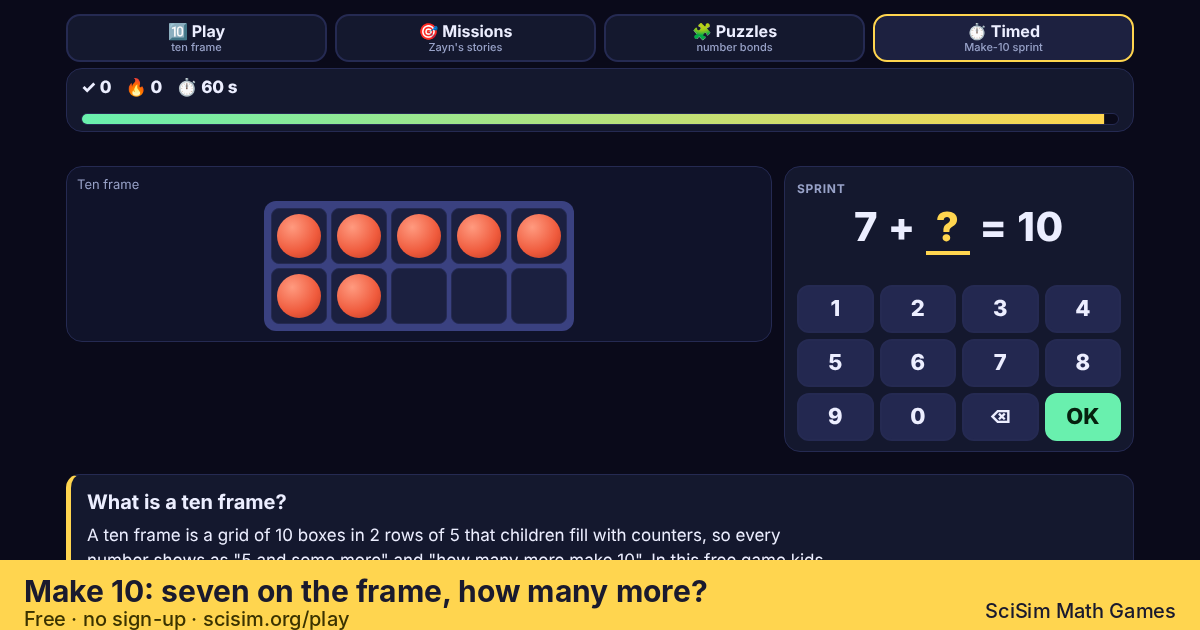
Example: 7 + ? = 10: the frame shows 7 counters and 3 empty boxes, so 7 + 3 = 10.
What are number bonds to 10?
A number bond shows a whole and the two parts it splits into; the number bonds to 10 are the pairs of numbers that make 10, such as 6 and 4. There are 11 of them if you count both orders and zero (0 + 10, 1 + 9, 2 + 8 … 10 + 0), which is 6 different pairs. The puzzles practice them three ways: find the missing part (6 + ? = 10), match the pairs that make 10 on number cards, and spot the one wrong bond in four. "Just starting" uses bonds of 5, and "Challenge me" uses bonds of 20 (13 + ? = 20) and the subtraction form (10 − 3 = ?).
📌 Kindergarten standard K.OA.A.3 asks children to "Decompose numbers less than or equal to 10 into pairs in more than one way", for example 5 = 2 + 3 and 5 = 4 + 1. (Common Core State Standards for Mathematics, K.OA.A.3)
Example: Missing part: 6 + ? = 10 → 4, because 6 and 4 make 10, so 10 − 6 = 4.
What does fluency within 10 mean?
Fluency means answering a fact like 7 + 3 quickly and correctly, without counting on your fingers. The Common Core asks kindergarteners to add and subtract within 5 fluently and first graders within 10. The 60-second sprint shows a frame with a make-10 question (make 5 at "Just starting", make 10 or 20 and subtraction at "Challenge me"), counts your streak and keeps your best for each sprint length. Facts you miss come back more often; a wrong answer shows the right one while the frame stays on screen, with no penalty.
📌 Grade 1 standard 1.OA.C.6: "Add and subtract within 20, demonstrating fluency for addition and subtraction within 10." (Common Core State Standards for Mathematics, 1.OA.C.6)
Example: Play one sprint a day and try to beat your best; the frame stays on screen, so a hard fact can still be counted.
Worked example: 8 + 5 with two ten frames
- Put 8 counters on the first frame and 5 on the second frame.
- The first frame has 2 empty boxes, so move 2 counters from the second frame to fill it.
- Now the first frame is a full 10 and the second frame has 3 left.
- 10 + 3 = 13, so 8 + 5 = 13. This is the make-ten strategy named in Common Core 1.OA.C.6.
For teachers · Grades K–2
Project the frame for a 3-minute flash warm-up ("How many?", the class calls out the number), use the stories or puzzles for small-group work on bonds of 5, 10 and 20, or share the link in Google Classroom with the Share button. No accounts and nothing to log in to: progress stays on each student's device, and the site keeps only anonymous usage statistics (Google Analytics).
- Flash warm-up: five or six flashes, then ask "How did you see it?" (5 and 2, a double, 10 take away 1).
- Small group: the stories at "I know the basics" for bonds of 10; move up when a story gets three stars.
- Early readers: turn on Read aloud so every story and question is spoken.
Standards:
CCSS.MATH.CONTENT.K.CC.B.5— Count to answer "how many?" questions about as many as 20 things arranged in a line, a rectangular array, or a circle, or as many as 10 things in a scattered configuration; given a number from 1-20, count out that many objects.CCSS.MATH.CONTENT.K.OA.A.3— Decompose numbers less than or equal to 10 into pairs in more than one way, e.g., by using objects or drawings, and record each decomposition by a drawing or equation (e.g., 5 = 2 + 3 and 5 = 4 + 1).CCSS.MATH.CONTENT.K.OA.A.4— For any number from 1 to 9, find the number that makes 10 when added to the given number, e.g., by using objects or drawings, and record the answer with a drawing or equation.CCSS.MATH.CONTENT.K.OA.A.5— Fluently add and subtract within 5.CCSS.MATH.CONTENT.K.NBT.A.1— Compose and decompose numbers from 11 to 19 into ten ones and some further ones, e.g., by using objects or drawings, and record each composition or decomposition by a drawing or equation (such as 18 = 10 + 8); understand that these numbers are composed of ten ones and one, two, three, four, five, six, seven, eight, or nine ones.CCSS.MATH.CONTENT.1.OA.C.6— Add and subtract within 20, demonstrating fluency for addition and subtraction within 10. Use strategies such as counting on; making ten (e.g., 8 + 6 = 8 + 2 + 4 = 10 + 4 = 14); decomposing a number leading to a ten (e.g., 13 - 4 = 13 - 3 - 1 = 10 - 1 = 9); using the relationship between addition and subtraction (e.g., knowing that 8 + 4 = 12, one knows 12 - 8 = 4); and creating equivalent but easier or known sums (e.g., adding 6 + 7 by creating the known equivalent 6 + 6 + 1 = 12 + 1 = 13).
Questions
How do you fill a ten frame?
Fill the top row from left to right first, then the bottom row from left to right. Then 7 always looks the same (a full row of 5 and 2 more), and the empty boxes show at once how many more make 10. In this game, tapping a counter in the tray puts it in the next empty box in exactly this order.
How many number bonds to 10 are there?
11 if you count both orders and zero (0 + 10, 1 + 9 … 10 + 0), or 6 different pairs: 0 and 10, 1 and 9, 2 and 8, 3 and 7, 4 and 6, 5 and 5. Number bonds to 20 work the same way: 21 with both orders and zero, 11 different pairs.
What grade learns number bonds?
Kindergarten in the US: Common Core K.OA.A.3 asks children to split numbers up to 10 into pairs, and K.OA.A.4 to find the number that makes 10. In grade 1 they add and subtract within 20 with strategies such as making ten (1.OA.C.6). This game has a level for each step.
How do ten frames help with adding?
They make the make-ten strategy visible. For 8 + 5, put 8 on one frame and 5 on another, move 2 over to fill the first frame, and you see 10 + 3 = 13. Once children see that 8 needs 2 to make 10, adding past 10 becomes two easy steps instead of counting on by ones.
Related games
Published 8 Nov 2026 · Last updated 8 Nov 2026 · https://scisim.org/play/ten-frames