Math Puzzles Game: Logic Grids for Kids
Free · Grades 2–6 · ages 7–12Solve Calcudoku cage puzzles, sudoku, magic squares and number pyramids with pencil marks and hints, help Zayn in read-aloud missions and race 60-second mini puzzles.
What are math puzzles?
Math puzzles are logic games where you fill a grid with numbers so that every rule is true, and each puzzle has exactly one solution. This free game has Calcudoku cage puzzles, sudoku, magic squares and number pyramids, with hints, read-aloud missions and a 60-second sprint for grades 2–6.
In this game you can:
- Solve four kinds of puzzles: Calcudoku (cages with + − × ÷ clues), 4×4 and 6×6 sudoku, magic squares and number pyramids
- Use pencil marks, check one cell, or ask for a hint that points at a clue but never gives you the number
- Help Zayn in five read-aloud stories with three small puzzles each, and earn three stars by solving every step on the first check
- Play four rounds, one puzzle of each type, and race 60 seconds of mini puzzles to beat your own best
- Grow from small grids and sums (grade 2) to 6×6 grids with all four operations (grades 5–6)
Modes in this game: Play: Free solve · Missions: Zayn's stories · Puzzles: Four rounds · Timed: Mini puzzles
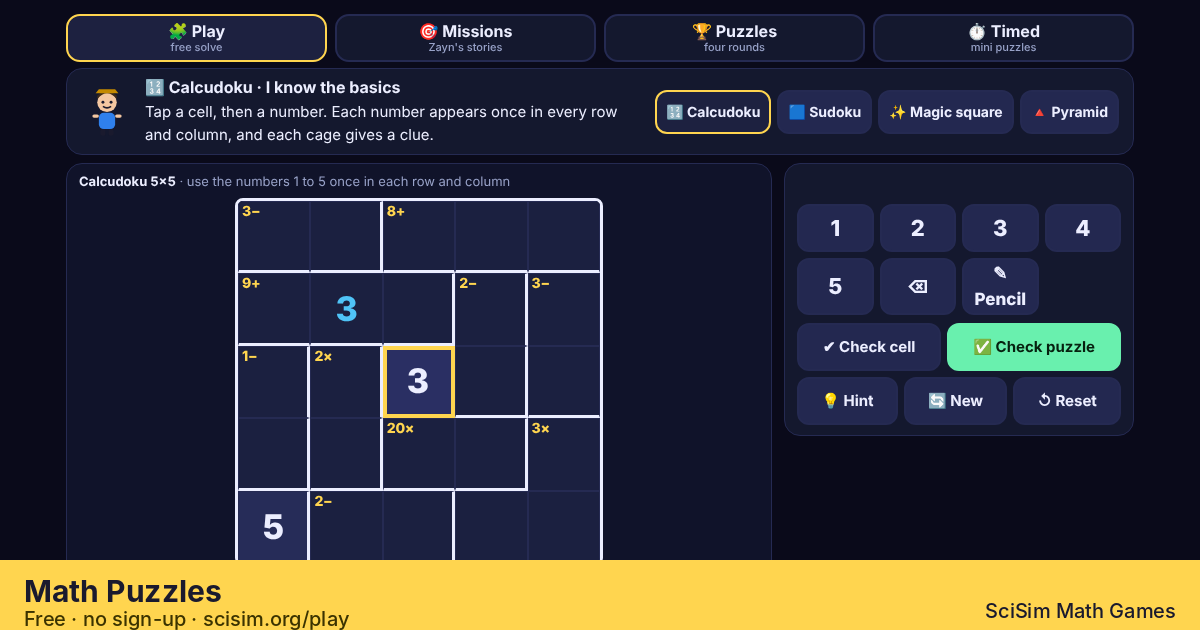
What is a Calcudoku puzzle and how do you solve it?
A Calcudoku is a square grid where every row and every column holds each number from 1 up to the grid size once, and the bold-edged cages each carry a clue such as 7+ or 12× that the numbers inside the cage must reach. Start with the cages that have the fewest possibilities, such as a small sum or a product with few factor pairs, and list the number pairs that fit. Then use the row and column rule to cross pairs out. In Play you choose the puzzle type, tap a cell, tap a number, and use Pencil to jot down possible numbers. Check cell tells you whether one cell is right without giving the number, and Hint marks the row, cage or line to look at next.
📌 The Common Core practice standard on problem solving says that mathematically proficient students "analyze givens, constraints, relationships, and goals." (Common Core State Standards for Mathematics, Standard for Mathematical Practice 1)
Example: In a 4×4 grid, a two-cell cage marked 3+ can only hold 1 and 2, because 1 + 2 is the only way to make 3 from the numbers 1 to 4.
How do you solve a 4×4 or 6×6 sudoku?
A sudoku is a grid where every row, every column and every outlined box holds each number once, and a good puzzle has exactly one solution. In a 4×4 sudoku the boxes are 2×2 squares and the numbers are 1 to 4; in a 6×6 sudoku the boxes are 2 rows by 3 columns and the numbers are 1 to 6. Look for a row, column or box with only one empty cell, because the missing number is the one it does not have yet, then use each new number to find the next.
📌 McGuire, Tugemann and Civario list 288 completed 4×4 sudoku grids that need at least 4 clues, and 28,200,960 completed 6×6 grids that need at least 8 clues. (Gary McGuire, Bastian Tugemann and Gilles Civario, "There is no 16-Clue Sudoku", arXiv:1201.0749)
Example: A row of a 4×4 sudoku reads 3, 1, empty, 2, so the empty cell must be 4, the only number that row does not have.
Why does every row of a magic square add up to the same number?
A magic square is a grid of different numbers where every row, every column and both diagonals add up to the same total, called the magic constant. The whole square holds the numbers 1 to 9 once each, which add to 45, and the three rows share that total equally, so each row adds to 45 ÷ 3 = 15. A 4×4 square with the numbers 1 to 16 adds to 136, so each row adds to 136 ÷ 4 = 34. For a square of size n the constant is n × (n × n + 1) ÷ 2. Some squares in the game use numbers that count up by 2, 3 or more, and then the magic constant is shown above the grid.
📌 Weisstein notes that the only normal 3×3 magic square, which uses the numbers 1 to 9, was known to the ancient Chinese as the Lo Shu. (Eric W. Weisstein, CRC Concise Encyclopedia of Mathematics, "Magic Square")
Example: In the Lo Shu square, 2 + 7 + 6 = 15 along the top row, 9 + 5 + 1 = 15 along the middle row and 2 + 5 + 8 = 15 along a diagonal.
How do you solve a number pyramid?
A number pyramid is a stack of stones where each stone is the sum of the two stones directly under it, so the top stone holds the total pattern of the bottom row. You can work up by adding and down by subtracting. If a stone is 12 and the stone under it on the left is 5, the stone under it on the right is 12 − 5 = 7. Look for a small triangle of three stones where two numbers are known and fill in the third, then repeat with the new number.
📌 Grade 3 standard 3.OA.D.9 asks students to "Identify arithmetic patterns (including patterns in the addition table or multiplication table), and explain them using properties of operations." (Common Core State Standards for Mathematics, 3.OA.D.9)
Example: A pyramid with the bottom row 3, 5, 4 has the middle row 8, 9 and the top stone 17, because 3 + 5 = 8, 5 + 4 = 9 and 8 + 9 = 17.
How do you solve a puzzle one step at a time?
Look for the one cell, line or stone where only one number can fit, fill it in, and then use that new number to find the next one. Zayn's five stories (the cage code, shell sorting, the turtle's secret, the stone steps and the treasure map) each have three small puzzles with only a few empty cells, so you practice one clue at a time. Every story can be read aloud. Solve a step on the first check, with no hint and no wrong mark, and it counts toward three stars. A wrong check marks the cells to look at again but never shows the answer.
📌 The Common Core practice standard on structure says that mathematically proficient students "look closely to discern a pattern or structure." (Common Core State Standards for Mathematics, Standard for Mathematical Practice 7)
Example: In a 4×4 sudoku, a row reads 1, empty, 4, 3. The empty cell cannot be 1, 4 or 3, so it must be 2.
Why does a good puzzle have exactly one solution?
A proper puzzle has exactly one solution, so logic alone always shows the next number and you never need to guess. The puzzle rounds give you one full puzzle of each type: Calcudoku, sudoku, a magic square and a number pyramid. "Just starting" uses 4×4 grids with + clues, 3×3 magic squares and 3-row pyramids; "I know the basics" uses 5×5 Calcudoku with + − ×, 6×6 sudoku and 4-row pyramids; "Challenge me" uses 6×6 Calcudoku with all four operations, fewer sudoku clues, 4×4 magic squares and 5-row pyramids. A computer solver tried every possibility for each puzzle in this game and found exactly one solution.
📌 McGuire, Tugemann and Civario proved by an exhaustive computer search that a standard 9×9 sudoku needs at least 17 clues to have exactly one solution. (Gary McGuire, Bastian Tugemann and Gilles Civario, "There is no 16-Clue Sudoku", arXiv:1201.0749)
Example: With only 7 clues a standard sudoku can never have one solution, because the two missing numbers could always be swapped.
How do × and ÷ clues help you solve puzzles faster?
A × or ÷ clue works like a multiplication fact family: 12× in a two-cell cage means the cells multiply to 12, and 2÷ means the bigger number is twice the smaller one. Knowing your times tables turns a clue into a short list of number pairs at a glance. The 60-second sprint gives mini puzzles with 2 to 4 empty cells, keeps your streak, keeps your best score for each sprint length and brings back the puzzle types you miss more often. A wrong answer shows the right numbers marked ✓ with no penalty, and Skip moves on.
📌 Grade 3 standard 3.OA.C.7 asks students to "Fluently multiply and divide within 100, using strategies such as the relationship between multiplication and division or properties of operations." (Common Core State Standards for Mathematics, 3.OA.C.7)
Example: In a 6×6 grid a two-cell cage marked 2÷ can hold 1 and 2, 2 and 4, or 3 and 6, because in each pair one number is twice the other.
Worked example: solving a 4×4 Calcudoku cage
- Clue: two cells in one row form a cage marked 3+. The numbers are 1 to 4, and the other two cells of the row already hold 3 and 4.
- The pair for 3+ is 1 and 2 (1 + 2 = 3), and the row rule agrees: only 1 and 2 are left for this row.
- The left cage cell has a 2 above it in its column, so it cannot be 2. The left cell is 1 and the right cell is 2.
- Check: 1 + 2 = 3, the row now reads 1, 2, 3, 4 and no number repeats.
For teachers · Grades 2–6
Project one puzzle and let the class call out where to start before anyone fills in a number, use the round puzzles for pair work ("Which clue is the most certain, and why?"), or share the link in Google Classroom with the Share button. No accounts and nothing to log in to: progress stays on each student's device, and the site keeps only anonymous usage statistics (Google Analytics).
- Say the clue first: ask students to explain which cage, row or line they used before they type a number.
- Use magic squares to practice addition within 100 and number pyramids to practice adding and subtracting.
- Early readers: turn on Read aloud so every story and rule is spoken.
Standards:
CCSS.MATH.CONTENT.3.OA.D.9— Identify arithmetic patterns (including patterns in the addition table or multiplication table), and explain them using properties of operations.CCSS.MATH.CONTENT.3.OA.C.7— Fluently multiply and divide within 100, using strategies such as the relationship between multiplication and division or properties of operations. By the end of Grade 3, know from memory all products of two one-digit numbers.CCSS.MATH.PRACTICE.MP1— Mathematically proficient students start by explaining to themselves the meaning of a problem and looking for entry points to its solution. They analyze givens, constraints, relationships, and goals.CCSS.MATH.PRACTICE.MP7— Mathematically proficient students look closely to discern a pattern or structure.
Questions
How do you play Calcudoku?
Fill the grid so that every row and column has the numbers 1 up to the grid size once. Each cage (the bold-edged group of cells) has a target and a sign: 7+ means the numbers add to 7, 12× means they multiply to 12, 2− means they differ by 2 and 3÷ means one is three times the other. Start with the small cages and use pencil marks.
What is the difference between sudoku and Calcudoku?
Sudoku gives you some numbers to start and adds a box rule: each row, column and outlined box holds every number once. Calcudoku starts with almost no numbers but adds cage clues with + − × ÷, and it has no boxes. Both are solved by logic and both have exactly one solution.
Does every puzzle in this game have only one answer?
Yes. A computer solver tried every possibility for each puzzle, including the mini puzzles in the sprint, and found exactly one solution, so you can always find the next number by logic without guessing.
How do you make a 3×3 magic square?
Use the numbers 1 to 9 once each and make every row, column and diagonal add up to 15. Put 5 in the middle, because it is the middle number, and make the pairs of cells opposite each other through the middle add to 10, such as 2 and 8 or 4 and 6. Then try the corners with the even numbers.
Related games
Published 12 Nov 2026 · Last updated 12 Nov 2026 · https://scisim.org/play/math-puzzles