Multiplication Games: Times Tables Practice 1–12
Free · Grades 2–5 · ages 7–11Train every fact from 1 × 1 to 12 × 12 on the Dojo board, earn belts in missions, crack puzzles and race the clock.
What is the best way to practice multiplication facts?
Practice a few facts at a time, see each one as an array, and come back to the ones you miss. This free multiplication game does exactly that: a 12 × 12 Dojo board shows every fact in red, amber or green, weak facts return more often, and belts, puzzles and a 60-second sprint keep you practicing.
In this game you can:
- Tap any fact on the 12 × 12 board, type the answer on the big keypad and watch the square turn green
- See every product as an array of rows and columns, with the skip-count jumps underneath
- Earn five belts in Missions, from the 2, 5 and 10 tables up to mixed facts to 12 × 12
- Solve missing-factor, array and spot-the-mistake puzzles
- Race the 60-second sprint and beat your own best
Modes in this game: Play: Dojo board · Missions: Belts · Puzzles: Missing factors & more · Timed: Sprint
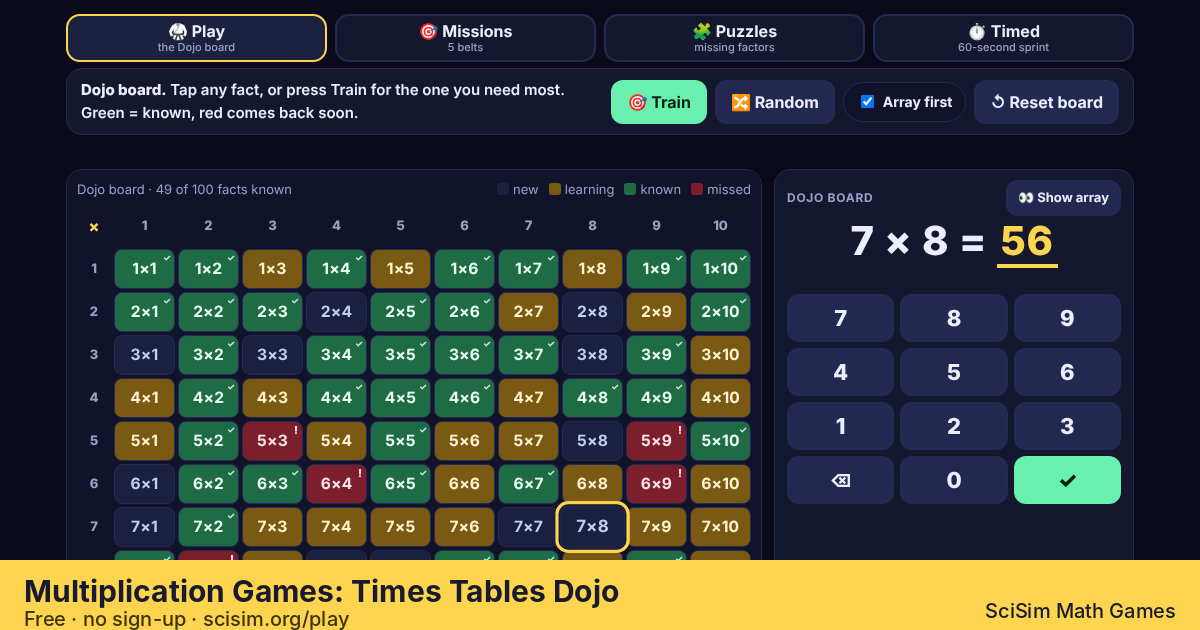
How does the Dojo board work?
The Dojo board is a times-table grid in which every square is one multiplication fact, colored by how well you know it. Tap a square such as 7 × 8, type 56 and the square turns green. A wrong answer turns it red and the fact comes back sooner, the way flashcards in a learning box do. A 12 × 12 board holds 144 facts, but because 7 × 8 and 8 × 7 are the same product there are only 78 different facts to learn (12 square numbers plus 66 pairs). Pick "Just starting" for the 2, 5 and 10 tables, "I know the basics" for 1 to 10, and "Challenge me" for 1 to 12, with division facts in the Black belt and the puzzles.
📌 A 12 × 12 table has 144 squares but only 78 different facts, because a × b = b × a (12 squares + 66 pairs). (counted on the board itself)
Example: 7 × 8: five eights are 40 and two more eights are 16, so 7 × 8 = 40 + 16 = 56.
Which times tables should you learn first?
Start with the 2, 5 and 10 times tables, add 3, 4 and 8, and finish with 6, 7, 9, 11 and 12. The belts follow roughly that order, one level at a time. England's national curriculum teaches the 2, 5 and 10 tables in Year 2 (age 6–7), the 3, 4 and 8 tables in Year 3 and all tables up to 12 × 12 by the end of Year 4; the US Common Core expects every product of two one-digit numbers to be known from memory by the end of grade 3. Each belt is six facts from its tables: answer them all first time for three stars.
📌 England's national curriculum: 2, 5 and 10 tables in Year 2, 3, 4 and 8 in Year 3, all tables to 12 × 12 by the end of Year 4. (Department for Education, Mathematics programmes of study: key stages 1 and 2 (2013))
Example: White belt at level 2 = the 2, 5 and 10 tables (at level 1 it is the 2s alone). Black belt at level 3 = any fact to 12 × 12, including the division form 72 ÷ 8 = ?
What are the tricks for the hard times tables?
A times-table trick is a shortcut that turns a fact you do not know into facts you already know. Four tricks cover most of the board. Nines: for n from 1 to 10 the digits of 9 × n add up to 9, so 9 × 7 = 63 (6 + 3 = 9). Fours: double and double again, so 4 × 7 = 14 + 14 = 28. Sixes: five of them plus one more, so 6 × 8 = 40 + 8 = 48. Twelves: ten of them plus two of them, so 12 × 7 = 70 + 14 = 84. The puzzles practice the facts backwards too: a missing factor (? × 6 = 42) is the division fact 42 ÷ 6 = 7, and spot-the-mistake asks you to find the one wrong equation in four.
📌 The digits of every 9 × n product from 9 × 1 to 9 × 10 add up to 9 (9, 18, 27 … 90). (check it on the board)
Example: Missing factor: ? × 6 = 42 → 7, because 7 × 6 = 42, so 42 ÷ 6 = 7.
Try it: Missing factors & more ▸
How fast should you know your multiplication facts?
Fluency means giving the right answer quickly without counting up, and short timed practice is one proven way to build it. The What Works Clearinghouse guide for elementary mathematics intervention (Institute of Education Sciences, 2021) makes timed activities its sixth recommendation: one way to build fluency, once the facts have been understood. The Sprint gives you 60 seconds of facts from your level, favors the ones you have missed before, counts your streak and saves your best. There is no penalty for a wrong answer: the right one is shown and the fact is scheduled again.
📌 Recommendation 6 of the IES practice guide Assisting Students Struggling with Mathematics: Intervention in the Elementary Grades (WWC 2021006, March 2021): regularly include timed activities as one way to build students' fluency in mathematics. (What Works Clearinghouse, IES, 2021)
Example: Run the Sprint once a week and watch the score climb; the board shows which facts slowed you down, so the next practice starts there.
Worked example: 7 × 8 with the array
- Build the array: 7 rows of 8 dots.
- Split the rows you know: 5 rows of 8 = 40.
- Add the rest: 2 rows of 8 = 16.
- 40 + 16 = 56, so 7 × 8 = 56 — and 8 × 7 = 56 too, the array just turns on its side.
For teachers · Grades 2–5
Project the Dojo board for a 5-minute warm-up (one table a day), use the Sprint as a station timer, or share the link in Google Classroom as homework. No accounts and nothing to log in to: each student's board is saved on their own device, and the site keeps only anonymous usage statistics (Google Analytics).
- Warm-up: pick one table, let the class call the answers while one student taps.
- Station: 60-second Sprint, write your best on a card, beat it tomorrow.
- Intervention: start every struggling student on "Just starting" (2, 5, 10) and move up only when the board is green.
Standards:
CCSS.MATH.CONTENT.3.OA.C.7— Fluently multiply and divide within 100, using strategies such as the relationship between multiplication and division or properties of operations. By the end of Grade 3, know from memory all products of two one-digit numbers.CCSS.MATH.CONTENT.3.OA.A.1— Interpret products of whole numbers, e.g., interpret 5 × 7 as the total number of objects in 5 groups of 7 objects each.CCSS.MATH.CONTENT.2.OA.C.4— Use addition to find the total number of objects arranged in rectangular arrays with up to 5 rows and up to 5 columns; write an equation to express the total as a sum of equal addends.
Questions
What is the fastest way to learn times tables?
Short daily practice beats one long session. Learn the tables in an order (2, 5, 10 → 3, 4, 8 → 6, 7, 9 → 11, 12), use arrays and skip counting to understand each fact, and keep returning to the ones you miss. The Dojo board does the returning for you: red and amber squares come back more often than green ones.
How many multiplication facts are there?
144 on a 12 × 12 table and 100 on a 10 × 10 table. Because the order does not matter (6 × 7 = 7 × 6), there are 78 different facts to learn up to 12 × 12 and 55 up to 10 × 10.
What grade learns times tables?
In the US, arrays come in grade 2 and multiplication facts in grade 3; students are expected to know all products of one-digit numbers from memory by the end of grade 3 (Common Core 3.OA.C.7). The 11 and 12 tables and review continue in grades 4 and 5. This game has a level for each stage.
Is this multiplication game free, and do I need an account?
Yes, it is free, with no account, no download and nothing to install. It runs in the browser on Chromebooks, tablets and phones, and your belts and best scores are saved on your own device.
Related games
Use it in science
- Density and buoyancy — mass = density × volume, the same multiplying with real units
- Scale of the universe — multiplying by 10 again and again
Published 8 Nov 2026 · Last updated 8 Nov 2026 · https://scisim.org/play/times-tables