Tape Diagram Game: Bar Models for Word Problems
Free · Grades 2–6 · ages 7–12Build tape diagrams with bars you can drag, model Zayn's word problems, pick the right model in puzzles and race 60-second quick models.
What is a tape diagram?
A tape diagram is a drawing of long bars split into parts that shows how the numbers in a word problem fit together, with the unknown marked by a ?. It is also called a bar model. In this free game kids build tape diagrams, model Zayn's word problems, pick the right model and race 60-second quick models.
In this game you can:
- Build your own tape diagram: drag the end of a bar or use + and −, split bars into equal units, and tap a label to make it the unknown ?
- Help Zayn in five read-aloud word-problem stories: put the numbers on the tape first, then find the ?
- Solve model puzzles: pick the model that matches a story, spot the model that does not match its number sentence, and find the missing number
- Race 60 seconds of quick models and beat your own best
- Grow from parts and "how many more" (grade 2) to "times as many" (grades 3–4) and fractions and ratios (grades 5–6)
Modes in this game: Play: Tape builder · Missions: Zayn's stories · Puzzles: Model puzzles · Timed: Quick models
What is a tape diagram?
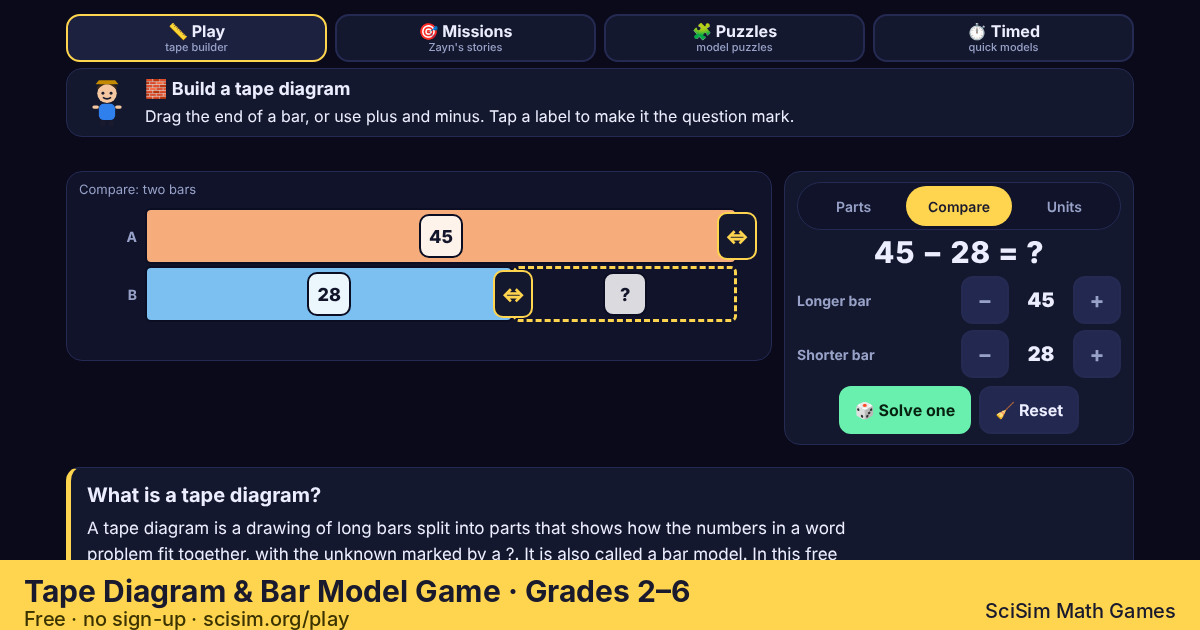
A tape diagram is a drawing of one or more bars, like strips of tape, where the length of each part stands for a number and a ? marks the number you want to find. The Common Core glossary describes it as "A drawing that looks like a segment of tape, used to illustrate number relationships". In Play you build one yourself: choose Parts, Compare or Units, drag the end of a bar or press + and −, and tap any label to turn it into the unknown ?. The number sentence under the tape changes as you build, for example 30 + 20 = ?. Press "Solve one" for a quick model to solve.
📌 The Common Core glossary says a tape diagram is "Also known as a strip diagram, bar model, fraction strip, or length model." (Common Core State Standards for Mathematics, Glossary)
Example: Parts model: one bar split into 30 and 20, with a brace over the whole bar marked ?, shows 30 + 20 = ?.
Tape diagram vs bar model: what is the difference?
There is no difference in the math: "tape diagram" is the name used in the US Common Core, and "bar model" is the name used in Singapore math and in the UK. Both draw quantities as bars, put equal amounts as equal lengths and mark the unknown. Singapore teachers call drawing them the "model method" and start with the part-whole model and the comparison model, the same two models this game uses at "Just starting".
📌 Ng and Lee (2009) report that Singapore's Ministry of Education introduced the model method into its primary mathematics curriculum in 1983. (Swee Fong Ng and Kerry Lee, "The Model Method: Singapore Children's Tool for Representing and Solving Algebraic Word Problems", Journal for Research in Mathematics Education 40(3), 282–313, 2009)
Example: Compare model: bar A is 45, bar B is 28 with a dashed piece marked ? to make it as long as bar A, so 45 − 28 = ?.
How do you solve a word problem with a tape diagram?
Read the story, draw a bar for each amount, put the known numbers on the bars, mark the unknown with ?, and then let the picture tell you whether to add, subtract, multiply or divide. Zayn's five stories practice exactly these steps. Each question has two parts: first you tap the numbers from the story onto the tape (the longer bar gets the bigger number), then you type the number that belongs at the ?. Each story has four questions, and four questions with the model and the answer right on the first try earn three stars. Every story can be read aloud. "Just starting" uses numbers within 100 (grade 2), "I know the basics" times as many and equal groups (grades 3–4), and "Challenge me" fractions and ratios (grades 5–6).
📌 Grade 2 standard 2.OA.A.1 asks students to solve word problems "with unknowns in all positions, e.g., by using drawings and equations with a symbol for the unknown number to represent the problem." (Common Core State Standards for Mathematics, 2.OA.A.1)
Example: "Zayn has 52 shells. 30 are white and the rest are pink." The tape is one bar of 52 with a part of 30 and a part marked ?, so 52 − 30 = 22 pink shells.
How do tape diagrams show "times as many" and ratios?
They use equal units: one unit is a bar of a fixed length, and "3 times as many" is a bar made of 3 of those units, while a ratio of 2 : 3 is one bar of 2 units next to a bar of 3 units. Once the bars are split into equal units, the work is always the same: find the value of one unit, then count units. If Mia has 24 stickers and that is 4 times as many as Zayn, Mia's bar has 4 units, so one unit is 24 ÷ 4 = 6. The puzzles practice reading models three ways: pick the model that matches a story, spot the one model that does not match its number sentence, and find the missing number in a finished model.
📌 Grade 6 standard 6.RP.A.3 names the tool directly: "Use ratio and rate reasoning to solve real-world and mathematical problems, e.g., by reasoning about tables of equivalent ratios, tape diagrams, double number line diagrams, or equations." (Common Core State Standards for Mathematics, 6.RP.A.3)
Example: Red and blue beads are in the ratio 2 : 3, with 30 beads in all. That is 5 equal units, so one unit is 30 ÷ 5 = 6 and the blue beads are 3 × 6 = 18.
How do you tell adding from multiplying in a word problem?
Look at the model: if a bar is longer by an extra piece, the problem is additive comparison (add or subtract); if a bar is made of several copies of another bar, it is multiplicative comparison (multiply or divide). "15 more than" adds a piece to the bar, while "3 times as many" repeats the whole bar 3 times. The 60-second sprint mixes the models of your level, shows each one with a ?, keeps your streak and keeps your best score for each sprint length. Models you miss come back more often, and a wrong answer shows the right one with no penalty.
📌 Grade 4 standard 4.OA.A.2 asks students to solve multiplicative comparison word problems, "distinguishing multiplicative comparison from additive comparison." (Common Core State Standards for Mathematics, 4.OA.A.2)
Example: Lily has 6 shells. "Zayn has 3 times as many" is 3 units of 6, so 18; "Zayn has 3 more" is 6 plus a small piece, so 9.
Worked example: a two-step times-as-many problem
- Story: Zayn has 6 marbles. Mia has 4 times as many. How many more marbles does Mia have than Zayn?
- Draw Zayn's bar as 1 unit and label it 6. Draw Mia's bar as 4 of the same units.
- Mia's bar is longer by 3 units, so mark those 3 units with a brace and a ?.
- One unit is 6, so 3 units are 3 × 6 = 18. Mia has 18 more marbles than Zayn (check: Mia has 24, and 24 − 6 = 18).
For teachers · Grades 2–6
Project one story for the whole class and let students call out where each number goes before anyone solves it, use the puzzles for pair talk ("Which model matches, and why?"), or share the link in Google Classroom with the Share button. No accounts and nothing to log in to: progress stays on each student's device, and the site keeps only anonymous usage statistics (Google Analytics).
- Model first: ask students to say what the ? stands for before they compute.
- Mix it up: the spot-the-wrong-model puzzles are good exit tickets.
- Early readers: turn on Read aloud so every story is spoken.
Standards:
CCSS.MATH.CONTENT.2.OA.A.1— Use addition and subtraction within 100 to solve one- and two-step word problems involving situations of adding to, taking from, putting together, taking apart, and comparing, with unknowns in all positions, e.g., by using drawings and equations with a symbol for the unknown number to represent the problem.CCSS.MATH.CONTENT.3.OA.A.3— Use multiplication and division within 100 to solve word problems in situations involving equal groups, arrays, and measurement quantities, e.g., by using drawings and equations with a symbol for the unknown number to represent the problem.CCSS.MATH.CONTENT.3.OA.D.8— Solve two-step word problems using the four operations. Represent these problems using equations with a letter standing for the unknown quantity. Assess the reasonableness of answers using mental computation and estimation strategies including rounding.CCSS.MATH.CONTENT.4.OA.A.2— Multiply or divide to solve word problems involving multiplicative comparison, e.g., by using drawings and equations with a symbol for the unknown number to represent the problem, distinguishing multiplicative comparison from additive comparison.CCSS.MATH.CONTENT.5.NF.B.6— Solve real world problems involving multiplication of fractions and mixed numbers, e.g., by using visual fraction models or equations to represent the problem.CCSS.MATH.CONTENT.6.RP.A.3— Use ratio and rate reasoning to solve real-world and mathematical problems, e.g., by reasoning about tables of equivalent ratios, tape diagrams, double number line diagrams, or equations.
Questions
How do you draw a tape diagram?
Draw a bar for each amount in the story, making bigger amounts longer and equal amounts the same length. Split a bar into parts or equal units where the story does, write the known numbers on the bars or above a brace, and put a ? where the unknown number goes. Then read the picture to choose the operation.
What grade learns tape diagrams?
Usually grades 1 to 3 start with drawings for adding and subtracting (Common Core 2.OA.A.1 asks for drawings and equations in grade 2), grades 3 and 4 use equal units for multiplication and "times as many" (4.OA.A.2), and grade 6 uses tape diagrams for ratios, a standard that names them (6.RP.A.3).
Why is it called a tape diagram?
Because each bar looks like a strip of tape. The Common Core glossary describes it as "A drawing that looks like a segment of tape, used to illustrate number relationships" and lists other names for the same drawing: strip diagram, bar model, fraction strip or length model.
Can you use a tape diagram for fractions?
Yes. To find 3/4 of 28, draw a bar for 28 and split it into 4 equal units. One unit is 28 ÷ 4 = 7, so 3 units are 21. To find a whole from a part, such as 12 being 2/5 of a class, 2 units are 12, one unit is 6, and all 5 units are 30.
Related games
Published 11 Nov 2026 · Last updated 11 Nov 2026 · https://scisim.org/play/tape-diagram